

Frisco’s population growth impact is defined as the sweeping transformation in housing costs, school capacity, infrastructure demand, and community demographics resulting from a population surge of over 400% since 2000. Today, Frisco holds approximately 236,955 residents, up from roughly 33,000 at the turn of the millennium. That growth rate is not a statistic to skim past. It means the city you are considering moving to has been rebuilt, repriced, and reimagined within a single generation. Understanding what is Frisco population growth impact means understanding every major force shaping your future home, from what you will pay for a house to which school your child attends.
What has driven frisco’s rapid population growth?
Frisco’s growth is not accidental. It sits at the intersection of several powerful forces that together made it one of the fastest-growing cities in the United States.
Geographic and economic positioning top the list. Frisco sits in Collin County, roughly 30 miles north of Dallas, placing it within easy reach of the Dallas-Fort Worth metroplex job market. The DFW area hosts dozens of Fortune 500 and Fortune 1000 headquarters, including Toyota North America, JPMorgan Chase, and Liberty Mutual. Frisco itself attracted the PGA of America headquarters, which brought thousands of jobs and a wave of ancillary development.
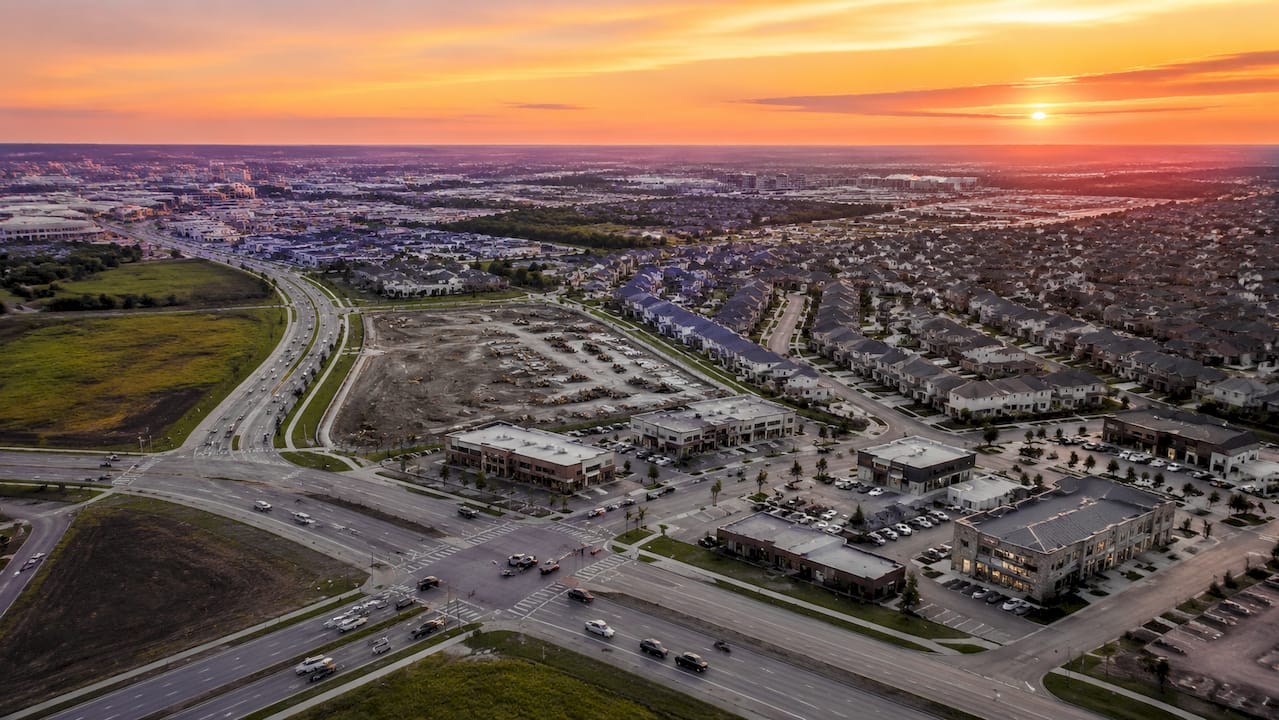
Quality of life is the second major pull factor. Frisco ISD has consistently ranked among the top school districts in Texas. The city offers a dense network of parks, retail centers, sports venues, and family-friendly neighborhoods. For families leaving higher-cost metros like Chicago, Los Angeles, or New York, Frisco offered a compelling combination of space, schools, and relative affordability.
Housing supply also played a role. For most of the 2000s and 2010s, Frisco had abundant undeveloped land. Builders could deliver new subdivisions quickly, keeping prices lower than comparable suburbs in other major metros. That supply pipeline attracted buyers who wanted new construction without the premium attached to established neighborhoods closer to Dallas.
- Proximity to DFW’s major employment corridors
- Top-ranked Frisco ISD schools drawing families from across Texas and nationally
- Competitive home prices relative to other major metro suburbs
- Large-scale master-planned communities offering amenities at scale
- Corporate relocations generating sustained job growth in Collin County
Pro Tip: If you are relocating from out of state, research specific Frisco employment corridors before choosing a neighborhood. Living near the Legacy West or Stonebriar areas can cut your commute significantly depending on your employer.
How has population growth affected frisco’s housing market?
The Frisco housing market is the most direct place where population growth becomes personal for buyers. The numbers tell a clear story.
Median home prices rose 127% between 2013 and 2023, driven by relentless demand and shrinking land supply. That increase outpaced wage growth for most households, which is why affordability has become a genuine policy concern at City Hall. A home that cost $250,000 a decade ago now lists closer to $567,000 in many Frisco zip codes.
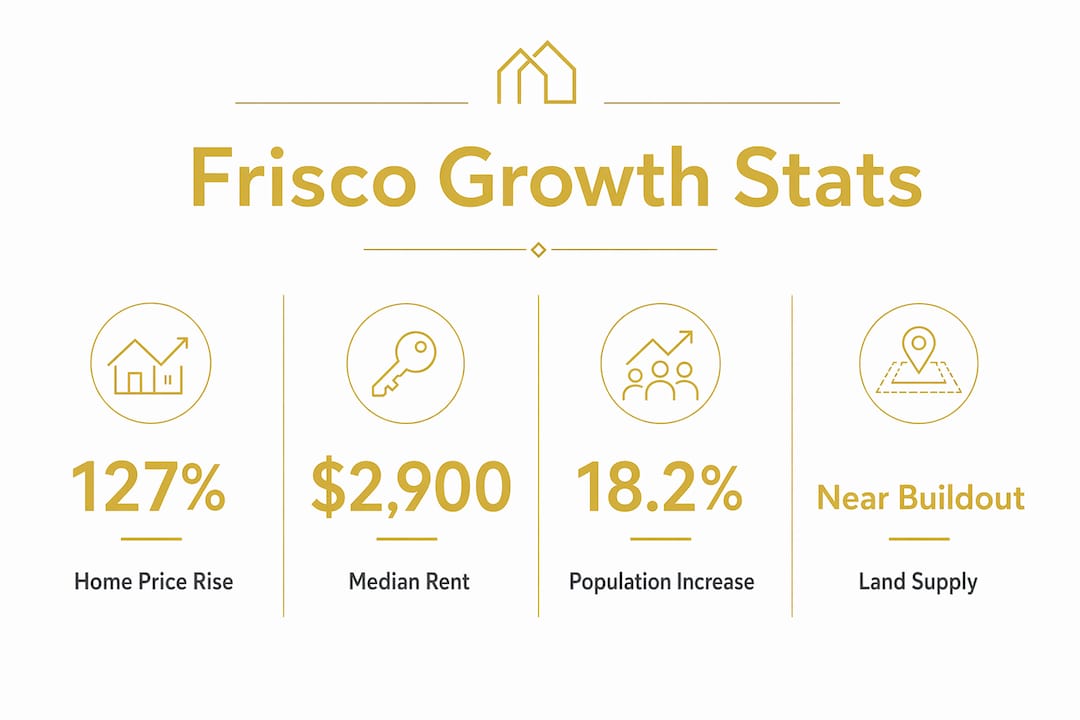
The rental market reflects the same pressure. Median rent in Frisco reached approximately $2,900 in 2025. That figure places Frisco well above the national median rent and creates a real barrier for lower-income residents, service workers, and seniors on fixed incomes.
The supply side is shifting in a way that will affect buyers for the next decade. Frisco’s full residential buildout is expected within 10 years. The era of affordable greenfield subdivisions is ending. Future development will require rezoning, higher-density projects, and more complex financing. That transition means new construction will cost more to deliver and, by extension, more to buy.
| Housing Factor | 2013 Baseline | 2023–2025 Status |
|---|---|---|
| Median home price | ~$250,000 | Up 127%, ~$567,000 |
| Median monthly rent | Below $1,800 | ~$2,900 |
| Land availability | Abundant greenfield | Near buildout within 10 years |
| Development type | New subdivisions | Rezoning and higher density |
For buyers, this data points in one direction. Waiting does not get you a better deal in Frisco. As land supply tightens, prices for well-located homes will hold or climb. Investors who bought in Frisco’s Star Trail neighborhood five years ago have seen strong appreciation precisely because demand kept outpacing supply.
Pro Tip: Ask your agent specifically about homes in established Frisco neighborhoods rather than the newest phases of development. Established areas often offer better lot sizes and mature landscaping at comparable prices.
How has growth changed frisco’s demographics?
Frisco’s demographic profile has shifted substantially, and that shift matters for anyone thinking about community fit and long-term neighborhood character.
The most striking change involves racial composition. Between 2019 and 2023, the share of residents identifying as only white dropped from 60.7% to 46.8%, while residents identifying as two or more races rose from 3.2% to 11.7%. That is a significant shift in just four years. Frisco is becoming a majority-minority city, a transition that reflects broader Collin County and DFW trends.
These Frisco demographic changes carry real implications for daily life:
- Schools now serve students from a wider range of cultural and linguistic backgrounds, which has expanded dual-language programs and ESL resources in Frisco ISD.
- Local retail and restaurant options have diversified, with a noticeable increase in South Asian, East Asian, and Latin American businesses along Preston Road and the Eldorado Parkway corridor.
- Community organizations and faith communities have multiplied, reflecting the needs of a more varied population.
- Housing preferences are shifting, with multigenerational households becoming more common, which affects demand for larger floor plans and accessory dwelling units.
For families moving to Frisco, this diversity is generally a strength. It signals a city with growing cultural depth, a wider range of community institutions, and schools preparing students for a genuinely multicultural workforce. The effects of growth on Frisco’s social fabric are visible in ways that make the city feel less like a generic suburb and more like a real community with distinct character.
What infrastructure and school challenges has growth created?
Growth at Frisco’s pace does not come without friction. The city’s infrastructure and school system have both felt the strain, and understanding those pressures helps you make a smarter relocation decision.
On the infrastructure side, water, sewage, and road systems have all faced expansion demands that city leaders are working to manage. Frisco has invested heavily in road widening along major corridors like Preston Road, Eldorado Parkway, and the Dallas North Tollway. Water capacity planning is ongoing, with the city drawing from North Texas Municipal Water District supplies. These are not signs of failure. They are signs of a city actively managing growth rather than ignoring it.
The school picture is more nuanced. Frisco ISD enrollment does not grow uniformly across the district. Here is what the data shows:
- Newer neighborhoods in the western and northern parts of Frisco see consistent enrollment growth as young families move in.
- Older, established neighborhoods closer to the city’s original core are seeing enrollment plateau or decline as original residents age out of the school system.
- Some elementary campuses have excess capacity while others are at or above target enrollment.
- Frisco ISD has used boundary adjustments and new campus openings to manage these imbalances, but the process creates uncertainty for families mid-move.
- School enrollment in Frisco ISD is unpredictable at the campus level, with some zones growing while others shrink or stabilize due to existing resident demographic shifts.
Families should analyze campus-level school enrollment trends rather than district-wide data, as growth and decline patterns vary significantly by neighborhood.
This is one of the most underappreciated facts about Frisco ISD. The district’s overall reputation is strong, but individual campus quality, class sizes, and program availability vary. A home one mile from another can sit in a very different school environment. Research at the campus level, not just the district level, before you commit to a specific address.
How should you evaluate frisco’s growth before moving?
Prospective residents often make the mistake of treating Frisco as a single market. The Frisco population increase impacts play out very differently depending on which neighborhood, school zone, and price tier you are targeting.
Here is a practical framework for evaluating your move:
- Focus on specific neighborhoods, not city-wide averages. Median home price data for all of Frisco masks wide variation. A home in a newer master-planned community in far north Frisco will behave differently than one near the older downtown core.
- Check school attendance zone boundaries before you make an offer. Frisco ISD boundaries shift. Confirm the current assigned campus for any home you are seriously considering, then research that campus specifically using Texas Education Agency ratings and enrollment trend data.
- Assess infrastructure timelines in your target area. Ask your agent which road projects, utility expansions, or commercial developments are planned near any home you are considering. A new retail corridor or highway interchange can change a neighborhood’s character and value within two to three years.
- Use local demographic data to understand neighborhood trajectory. A neighborhood with a rising share of young families signals strong school demand and stable property values. A neighborhood with an aging population may offer lower prices but different community dynamics.
- Work with an agent who specializes in Frisco and Collin County. General DFW agents often lack the campus-level and neighborhood-level knowledge that makes the difference in a market this specific.
Exploring communities like Light Farms gives you a concrete example of how a single master-planned community within Frisco has its own pricing dynamics, school assignments, and amenity profile that differ from the broader city picture.
Key takeaways
Frisco’s population growth impact is most visible in housing prices, school enrollment patterns, and infrastructure investment, and buyers who research at the neighborhood level make significantly better decisions than those who rely on city-wide averages.
| Point | Details |
|---|---|
| Housing prices have surged | Median home prices rose 127% from 2013 to 2023; waiting to buy rarely produces savings. |
| Land supply is nearly exhausted | Frisco expects full residential buildout within 10 years, shifting future supply to higher-density projects. |
| Demographics are shifting fast | The white-only population share dropped from 60.7% to 46.8% between 2019 and 2023, reshaping community services. |
| School enrollment varies by campus | District-wide Frisco ISD data masks wide campus-level variation; research individual schools before choosing a neighborhood. |
| Infrastructure is under active management | Roads, water, and utilities are expanding, but buyers should confirm project timelines in their specific target area. |
What i’ve learned watching frisco change in real time
I have worked with families relocating to Frisco for years, and the single most common mistake I see is treating it like a stable, predictable suburb. It is not. Frisco is a city in active transformation, and that creates both opportunity and real risk depending on where and when you buy.
The opportunity is straightforward. A city with 18.2% population growth from 2020 to mid-2025 and a near-buildout land supply is a city where well-located homes hold value. Buyers who understand that dynamic and act on it tend to do well.
The risk is subtler. Frisco’s rapid growth has created pockets of the city that feel unfinished. Roads that dead-end into future development. Schools that are overcrowded in one zone and underenrolled two miles away. Neighborhoods where the retail and restaurant infrastructure has not yet caught up to the residential density. These are not permanent problems, but they are real ones for the family that moves in expecting a finished product.
My honest read is that Frisco rewards buyers who do the work. The city’s demographic changes and infrastructure investments are net positives for long-term residents. But the families who thrive here are the ones who chose their specific neighborhood with intention, not the ones who just picked Frisco as a general destination and hoped for the best.
— Felix
Ready to find your place in frisco’s growth story?
Frisco’s market moves fast, and the right home in the right neighborhood requires more than a Zillow search. Kamilashayehomes specializes in helping relocating families understand exactly how Frisco’s growth affects the specific streets, school zones, and price tiers that matter to them. Start with a free home valuation to understand what your budget can realistically achieve in today’s market. Then browse featured properties in Frisco and surrounding Collin County communities to see what is actually available. Kamila Shaye brings neighborhood-level knowledge that turns a complicated, fast-moving market into a clear, confident decision for your family.
FAQ
What is frisco’s current population?
Frisco’s population reached approximately 236,955 residents as of mid-2025, reflecting an 18.2% increase from the 2020 Census baseline of 200,531.
How much have home prices increased in frisco due to growth?
Median home prices in Frisco rose 127% between 2013 and 2023, driven by sustained demand and shrinking land availability, according to Texas A&M Real Estate Research Center data.
Is frisco ISD a good school district for families moving in?
Frisco ISD ranks among the top districts in Texas overall, but enrollment and campus quality vary significantly by neighborhood. Research individual campus ratings through the Texas Education Agency before choosing a specific address.
How diverse is frisco’s population today?
Frisco has grown substantially more diverse. The share of residents identifying as only white dropped from 60.7% in 2019 to 46.8% in 2023, while multiracial residents increased from 3.2% to 11.7% in the same period.
Will frisco run out of land for new homes?
City planners and development experts expect Frisco to reach full residential buildout within the next 10 years. Future housing supply will shift toward rezoning and higher-density projects rather than traditional greenfield subdivisions.
Recommended
- Moving from California to Light Farms – Your Complete Relocation Guide – Kamila Shaye Homes & Estates of Prosper Frisco & Celina
- Light Farms Homes for Sale in 2025: Buyer Competition & Price Predictions – Kamila Shaye Homes & Estates of Prosper Frisco & Celina
- Top 10 Reasons Families Are Moving to Light Farms in 2025 – Kamila Shaye Homes & Estates of Prosper Frisco & Celina
- Light Farms Community Events You Can’t Miss in 2025 – Kamila Shaye Homes & Estates of Prosper Frisco & Celina