

Estate sale real estate is defined as property sold by an executor or administrator on behalf of a deceased person’s estate, typically following death, incapacitation, or major downsizing. The industry term for many of these transactions is a probate sale, and understanding that distinction matters before you make an offer. These sales follow legal procedures that differ significantly from a standard owner-to-buyer transaction. If you are researching what is estate sale real estate, you need to know the process, the risks, and the real opportunities before you commit.
How does estate sale real estate work vs. traditional sales?
Estate sale real estate transactions are managed by a court-appointed executor or administrator, not the original homeowner. That single fact changes almost everything about how the deal unfolds. The executor carries a fiduciary duty to the estate’s beneficiaries, which means every decision, including price acceptance, must be justifiable under the law.
The process typically starts when the estate enters probate, a legal proceeding that validates the deceased’s will and authorizes the executor to act. From there, the property is listed, offers are reviewed, and in many jurisdictions, the sale requires court approval before closing. Some probate courts require buyers to deposit 10% upfront as a condition of the purchase, a requirement you would never encounter in a standard sale.

Closing timelines are longer and far less predictable than traditional sales. Standard home sales close in 30–45 days. Estate sales can stretch months beyond that due to court schedules, multiple heirs, and legal paperwork. That delay is not a red flag. It is simply the cost of the process.
The table below shows the core differences between estate sales and traditional home sales at a glance.
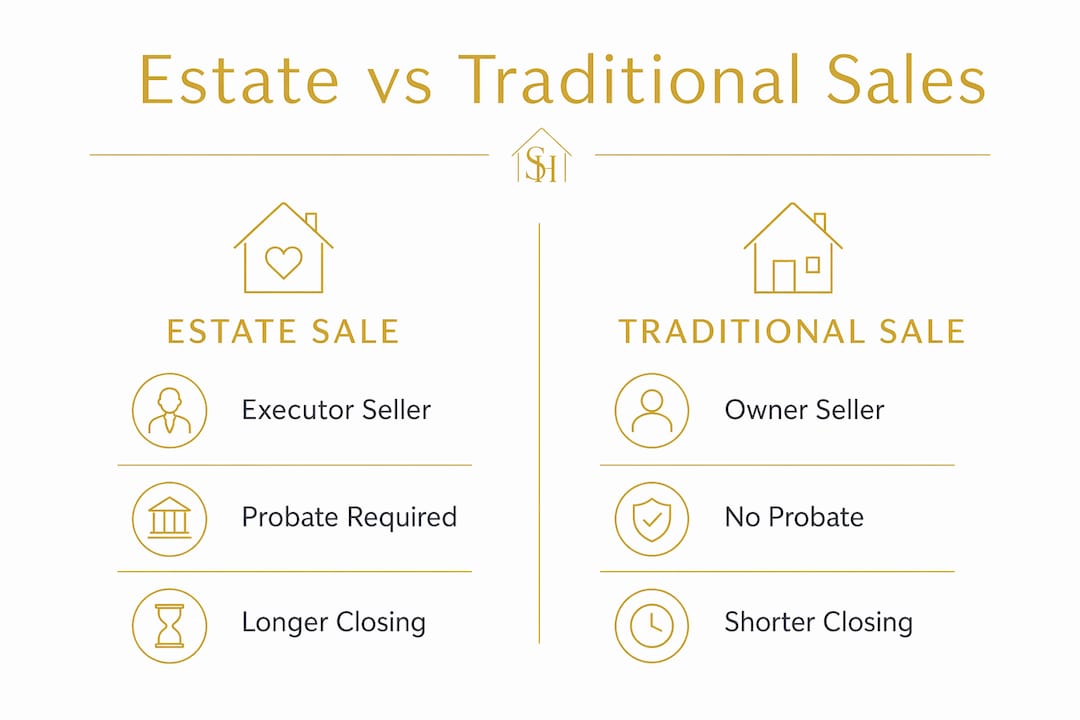
| Factor | Estate Sale | Traditional Sale |
|---|---|---|
| Who sells | Executor or administrator | Owner-occupant or investor |
| Disclosures | Limited, executor may lack full history | Full seller disclosure required |
| Condition | Sold as-is in most cases | Negotiable repairs common |
| Timeline | Months, subject to court approval | 30–45 days typical |
| Negotiation | Constrained by fiduciary duty | Flexible, owner-driven |
| Deposit | Court may require 10% upfront | Standard earnest money |
Pro Tip: Ask your real estate agent to confirm whether the estate is in active probate before you submit an offer. If probate has not been opened yet, your closing timeline could extend by several additional months.
What should buyers know before purchasing an estate sale property?
Buying an estate sale home requires a different mindset than a standard purchase. The biggest shift is accepting that the seller, the executor, has limited knowledge of the property’s history. Executors frequently lack personal knowledge of maintenance records, past repairs, or defects, which means the disclosure documents you receive may be thin.
Here is what every buyer should prepare for before making an offer:
- As-is condition is a legal term, not a description. Buyers often misunderstand “as-is” as meaning the home is livable. It is a legal disclaimer that the seller will make no repairs, regardless of what the inspection reveals. Budget accordingly.
- Title complexity is real. Multiple heirs, unpaid property taxes, or old liens can cloud the title. Engage a title company early. Early title searches reduce the risk of hidden encumbrances that could derail your closing.
- Negotiation has hard limits. Executors are fiduciaries legally obligated to maximize estate value. They cannot accept a lowball offer without justification, even if they personally wanted to. Your negotiation leverage is real but bounded.
- Financing must be airtight. Cash offers are preferred in estate sales because they eliminate financing contingencies that could slow an already complex process. If you are using a mortgage, get full pre-approval, not just pre-qualification, before you submit.
- Emotional timelines are part of the deal. Estate sales are emotionally charged events involving multiple heirs, each with their own attachment to the property. Decisions can take longer than you expect for reasons that have nothing to do with your offer.
Pro Tip: Schedule a professional home inspection before you finalize your offer price, not after. In an as-is sale, the inspection is your only tool for quantifying repair costs and adjusting your bid accordingly.
What are the benefits of buying estate sale real estate?
Estate sale properties are priced to liquidate, not to maximize profit. That is the core financial appeal. Executors are motivated to close the estate efficiently, which often means accepting offers below what an owner-occupant would hold out for. For buyers comfortable with some uncertainty, that pricing dynamic creates real opportunity.
The financial case goes deeper than the purchase price. Heirs who inherit estate property receive a stepped-up tax basis equal to the property’s current market value at the time of inheritance. This minimizes capital gains tax liability if they sell quickly. For investors purchasing from the estate, the below-market entry price offsets the cost of repairs and the extended wait for closing.
“Savvy investors often see estate sale homes as priced-to-move opportunities, though they must budget for potential repairs and long closing timelines.” — 253 Realty
The emotional and procedural complexity of estate sales also reduces buyer competition. Many buyers walk away when they hear “as-is” or “probate.” That hesitation works in your favor if you are prepared. Unique properties, historic homes, and larger lots often surface through estate sales precisely because they have not been updated or flipped. You are buying something with character, not a renovated product with a premium price tag. For buyers who want to evaluate whether a property fits their investment goals, a current home valuation is a smart first step before making any offer.
How to navigate the estate sale buying process effectively
A structured approach separates buyers who close successfully from those who lose time and money on failed offers. Follow these steps in order.
- Hire a real estate agent with probate experience. Not every agent knows how estate sales work. Find one who has closed probate transactions and understands the executor’s legal constraints. This is the single most important step you can take.
- Confirm the probate status. Ask whether the estate is in active probate, and if court confirmation of the sale is required. This determines your realistic closing timeline before you invest time in due diligence.
- Order a title search immediately. Do not wait until you are under contract. Title companies are essential early in estate sale purchases to check for liens, unpaid taxes, or multi-heir ownership complications.
- Schedule a professional home inspection. The executor will not repair anything. Your inspection report becomes your pricing tool. Use it to calculate your maximum offer based on realistic repair costs.
- Secure financing before you offer. Cash is king in estate sales, but if you need a mortgage, arrive with a full pre-approval letter. Understand that the lender may require an appraisal, which adds another variable to your timeline.
- Submit a clean, well-documented offer. Executors respond to offers that are easy to justify to beneficiaries and courts. Include your pre-approval, proof of funds for any required deposit, and a flexible closing date. Avoid unnecessary contingencies.
- Build patience into your plan. Longer, unpredictable closing timelines are standard in estate sales. If your situation requires a firm move-in date, an estate sale may not be the right fit. If you have flexibility, that flexibility becomes a competitive advantage.
For buyers evaluating specific neighborhoods in North Dallas, resources like buying in Star Trail and key checks before buying in Light Farms offer market-specific context that applies directly to estate sale due diligence.
Key takeaways
Estate sale real estate offers real value for prepared buyers, but the process requires patience, professional support, and a clear understanding of the legal framework before you make a move.
| Point | Details |
|---|---|
| Executor controls the sale | An executor or administrator manages the transaction under fiduciary duty, not the original owner. |
| Expect longer timelines | Estate sales can extend months beyond the standard 30–45 day closing due to probate court requirements. |
| As-is means no repairs | Budget for repairs before you offer, since the executor will not fix anything regardless of inspection findings. |
| Title search is non-negotiable | Order a title search early to uncover liens, unpaid taxes, or multi-heir ownership before you are under contract. |
| Below-market pricing is real | Executors prioritize efficient liquidation, which often produces purchase prices below what an owner would accept. |
What i’ve learned watching buyers navigate estate sales
Most buyers who struggle with estate sales make the same mistake. They treat the executor like a motivated seller who wants to negotiate. The executor is not a seller in the traditional sense. They are a legal officer with obligations to the court and the beneficiaries. Once you understand that, the entire dynamic shifts.
I have watched buyers walk away from genuinely good properties because the process felt slow or the disclosures felt thin. That reaction is understandable, but it often means leaving real value on the table. The buyers who succeed are the ones who do their homework upfront, hire the right agent, and treat the extended timeline as a feature rather than a flaw.
The emotional weight behind these sales is also worth acknowledging. Someone’s family home is being sold, often under difficult circumstances. Approaching the process with empathy, not just strategy, tends to produce better outcomes. Executors remember buyers who are respectful and easy to work with. That goodwill can matter when multiple offers are on the table.
The bottom line is this: estate sale real estate rewards preparation. Buyers who arrive with inspections done, financing secured, and realistic expectations consistently outperform those who treat it like a standard purchase. The complexity is real, but so is the opportunity.
— Felix
How Kamilashayehomes can help you buy an estate sale property
Kamilashayehomes specializes in helping buyers navigate the North Dallas real estate market, including properties sold through estate and probate transactions in Prosper, Celina, Frisco, and surrounding communities. Kamila Shaye brings hands-on experience with complex transactions, from understanding executor obligations to negotiating within the constraints of probate law. Whether you are a first-time buyer or an experienced investor, having a local expert in your corner changes the outcome. Browse the current featured properties to see available opportunities, or connect with Kamilashayehomes directly for personalized guidance on your next purchase.
FAQ
What is the estate sale definition in real estate?
An estate sale in real estate is a property sale managed by an executor or administrator on behalf of a deceased person’s estate, typically requiring probate court involvement. It differs from a standard sale because the seller has legal obligations to beneficiaries and the court, not just to closing the deal.
How long does an estate sale home purchase take to close?
Estate sale closings typically extend well beyond the standard 30–45 day window due to probate court approvals and multi-heir decision-making. Buyers should plan for a timeline of several months and avoid hard move-in deadlines when purchasing estate sale properties.
Are estate sale homes always sold as-is?
Most estate sale properties are sold as-is, meaning the executor will not make repairs or credits based on inspection findings. Buyers should complete a professional inspection before finalizing their offer price to accurately account for repair costs.
What are the biggest risks for estate sale buyers?
The primary risks include title complications from liens or multiple heirs, limited property disclosures from executors with no personal knowledge of the home, and extended closing timelines. Engaging a title company early and hiring an experienced real estate agent significantly reduces these risks.
How do i find estate sale properties in north dallas?
Work with a real estate agent who specializes in probate and estate transactions in your target area. Kamilashayehomes covers Prosper, Celina, Frisco, and surrounding North Dallas communities and can identify estate sale opportunities that match your criteria and budget.
Recommended
- How to Buy a Home in Windsong Ranch: Step-by-Step Guide for First-Time Buyers – Kamila Shaye Homes & Estates of Prosper Frisco & Celina
- Pros and Cons of Buying a Home in Light Farms | 2025 Buyer’s Guide – Kamila Shaye Homes & Estates of Prosper Frisco & Celina
- What’s the Resale Value Like in Windsong Ranch? Real Data & Market Trends – Kamila Shaye Homes & Estates of Prosper Frisco & Celina