
Frisco city infrastructure investment is defined as the public allocation of funds toward roads, parks, utilities, and community facilities that shape how the city grows and how property values move. Right now, Frisco is executing over $200M in roadway projects across its northern corridors, plus an $80M downtown redevelopment. These numbers are not background noise. For buyers, investors, and residents, they signal where Frisco is heading and which neighborhoods will benefit most.
What is Frisco city infrastructure investment covering right now?
Frisco city infrastructure investment spans four main categories: transportation, parks and recreation, utilities, and public facilities. Each category connects directly to how livable a neighborhood feels and how much a home in that area is worth. The city does not fund these projects casually. Every dollar traces back to a capital improvement plan approved through the city budget process.
Transportation is the largest piece. Frisco is building multi-lane roundabouts on Frisco Street for $22.98M, with completion targeted for late 2027. The widening of Teel Parkway carries a $9.36M price tag and is expected to wrap in early 2027. Legacy Drive upgrades are also underway. These are not minor patch jobs. They represent a deliberate effort to move traffic efficiently as population density increases.
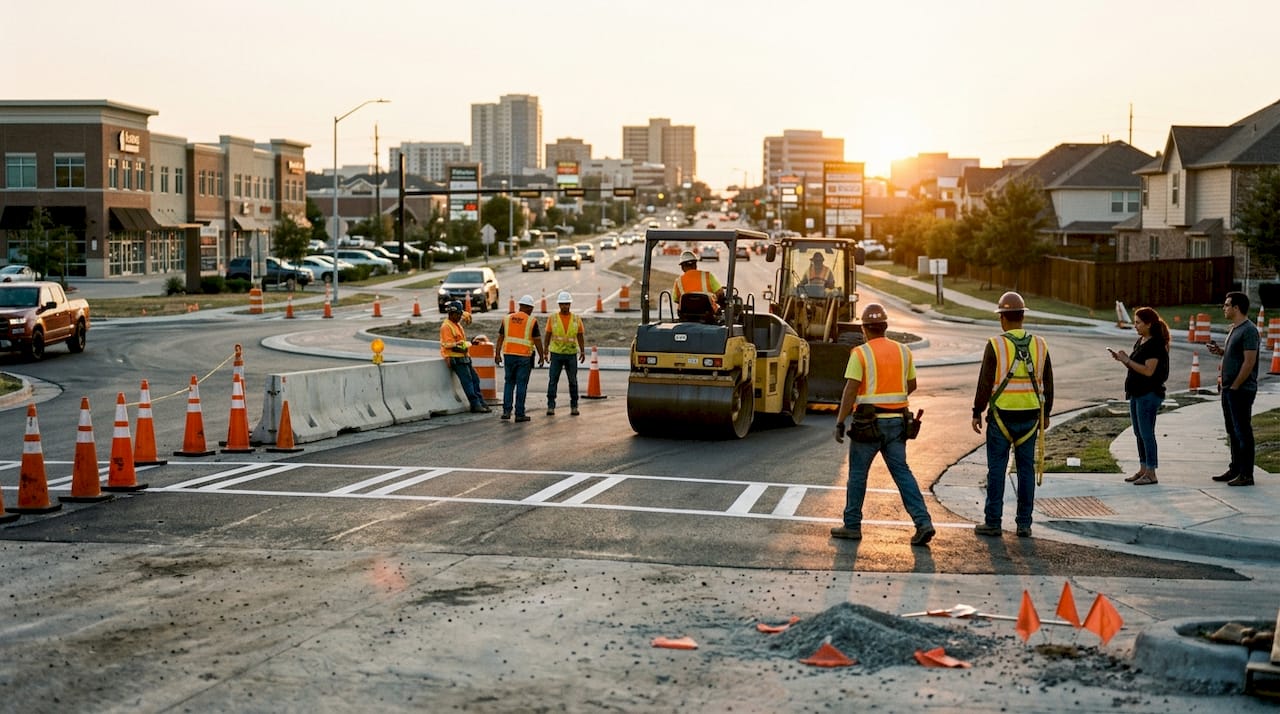
The Downtown Rail District redevelopment is the headline project. Frisco has committed $80M to transform this area into a walkable, pedestrian-friendly district set to reopen in summer 2026. That kind of investment reshapes buyer interest in surrounding blocks almost immediately after groundbreaking.
Grand Park rounds out the civic amenity side. The city approved a $35M Phase 1 development covering 68 acres, with an amphitheater, event lawn, kayak launch pond, and walking trails targeted for 2027. Parks of this scale do not just add green space. They create destination appeal that pulls buyers from across the region.
Key projects at a glance
| Project | Budget | Expected completion |
|---|---|---|
| Downtown Rail District redevelopment | $80M | Summer 2026 |
| Northern Corridor roadway improvements | $200M+ | Phased through 2027+ |
| Grand Park Phase 1 | $35M | 2027 |
| Frisco Street roundabouts | $22.98M | Late 2027 |
| Teel Parkway widening | $9.36M | Early 2027 |
The pattern here is consistent. Frisco is not reacting to growth. It is building ahead of it, which is exactly the condition that rewards early buyers and long-term investors.
How does Frisco fund these projects?
Frisco’s infrastructure funding comes from a combination of property tax revenue, debt service bonds, and capital improvement budgets approved annually by the city council. Understanding the funding structure tells you how stable these projects are and how likely they are to stay on schedule.
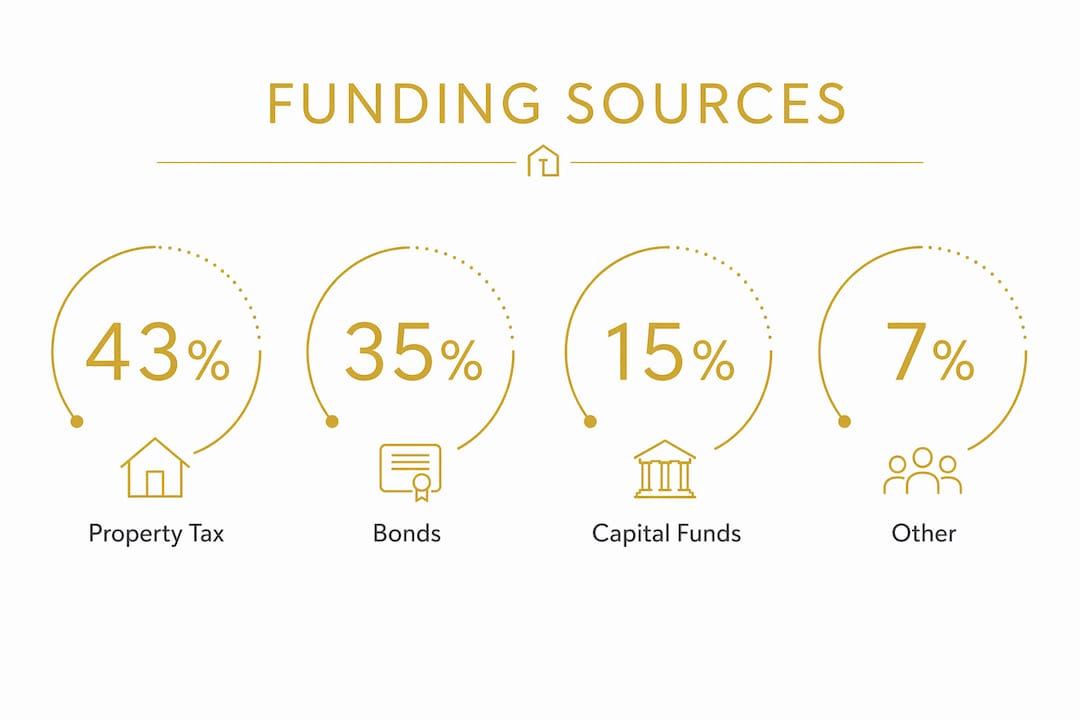
The city’s fiscal year 2026 property tax rate sits at $0.425517 per $100 valuation. That rate is relatively low for a Texas city of Frisco’s size and service level. Frisco also raised its homestead exemption to 20% in fiscal year 2026, giving owner-occupants meaningful relief even as home values climb.
The city expects to collect $14M more in property tax revenue this year due to rising home valuations. That additional revenue feeds directly into the capital improvement pipeline. Higher home values generate more funding for the very projects that push home values higher. It is a reinforcing cycle, and Frisco has managed it carefully.
Key funding mechanisms include:
- Property tax revenue: Funds roads, schools, emergency services, and parks
- General obligation bonds: Finance large capital projects approved by voters
- Debt service allocations: Cover repayment of bonds issued for completed projects
- State and federal grants: Supplement local funding for qualifying transportation corridors
Pro Tip: When evaluating a Frisco neighborhood, check whether nearby road or park projects are bond-funded. Voter-approved bonds are the most reliable signal that a project will actually get built on schedule.
The homestead exemption increase matters for buyers specifically. A 20% homestead exemption means your taxable home value drops by 20% the moment you claim it as your primary residence. That directly reduces your annual tax bill while the city still collects enough to fund its capital program.
How does infrastructure investment affect Frisco real estate values?
Infrastructure investment is the most reliable non-market driver of property value in Frisco. Roads, parks, and transit access determine neighborhood desirability long before a single listing goes live. Buyers pay premiums for walkability, short commutes, and access to amenities. Frisco is building all three at once.
Frisco’s development strategy connects new residential areas with the Dallas North Tollway, the PGA corridor, and the FM 423 corridor. This creates what analysts call a lifestyle ecosystem. Buyers are not just purchasing a home. They are buying into a network of recreation, business access, and community amenities that makes daily life easier and more appealing.
Homes near funded capital improvements in Collin County show increased liquidity and market resilience compared to comparable homes farther from active projects. Infrastructure generally outlasts market cycles, which means the benefit compounds over time rather than peaking at completion.
The Downtown Rail District is the clearest current example. Properties within walking distance of the redevelopment zone have already attracted buyer attention ahead of the summer 2026 reopening. That is the pattern you see with well-funded civic projects. The price appreciation begins before the ribbon cutting, not after.
For investors, the location-to-pricing relationship in Frisco is direct and measurable. Homes adjacent to completed road improvements sell faster and hold value better during market slowdowns. That is not a theory. It is the documented behavior of Collin County real estate across multiple market cycles.
Pro Tip: Do not wait for a project to finish before buying near it. The strongest appreciation window typically runs from groundbreaking to six months post-completion. After that, the premium is already priced in.
What future growth can investors and residents expect?
Frisco’s infrastructure plans are phased deliberately to match population growth forecasts. The city is not building everything at once. It is sequencing projects so that each wave of development supports the next. That approach protects the city’s fiscal position and gives investors a readable roadmap.
Phased construction helps future-proof investments against market fluctuations by spreading risk across multiple budget cycles. A project funded in 2026 bonds will generate neighborhood-level benefits through 2030 and beyond. Timing and location are the two variables that separate strong returns from average ones.
Here is what the growth trajectory looks like for the next several years:
- Summer 2026: Downtown Rail District reopens, activating walkable retail and residential demand in the core.
- Early 2027: Teel Parkway widening completes, improving north-south connectivity for the western residential corridors.
- Late 2027: Frisco Street roundabouts finish, reducing congestion on one of the city’s busiest east-west routes.
- 2027 and beyond: Grand Park Phase 1 opens, establishing a regional amenity anchor that draws buyers to surrounding neighborhoods.
- Long term: Northern Corridor roadway investments continue to open fringe areas for master-planned residential development.
The secondary effects of this pipeline are significant. Retail follows rooftops, and rooftops follow infrastructure. As road capacity expands and parks open, expect grocery anchors, restaurants, and hospitality projects to fill in around the new nodes. That commercial activity further supports home appreciation rates in adjacent neighborhoods.
Frisco’s corporate relocation appeal also connects to this infrastructure pipeline. Companies choose Frisco partly because the city’s road network and amenity base support a workforce that demands quality of life. More corporate arrivals mean more high-income buyers entering the market, which sustains demand even when broader Texas real estate cools.
The areas most likely to see value appreciation in the near term are those within a half-mile of the Teel Parkway widening, the Grand Park footprint, and the Downtown Rail District. Buyers who align their purchase timing with the construction calendar rather than waiting for completion capture the most upside.
Key Takeaways
Frisco’s infrastructure investment program is one of the most active in North Texas, with over $300M in committed projects reshaping transportation, parks, and the downtown core through 2027.
| Point | Details |
|---|---|
| Scale of investment | Frisco has committed over $300M across roads, parks, and downtown redevelopment through 2027. |
| Tax funding stability | A 20% homestead exemption and a $0.425517 tax rate keep funding stable while easing buyer costs. |
| Real estate timing | Buying near active projects before completion captures the strongest appreciation window. |
| Lifestyle ecosystem | Projects like Grand Park and the Rail District create amenity networks that sustain long-term demand. |
| Phased growth roadmap | Sequenced construction from 2026 through 2027-plus gives investors a clear timeline to align with. |
Why I think most buyers are reading Frisco infrastructure news the wrong way
Most buyers treat infrastructure announcements as background information. They read about a new park or road project, nod, and move on. That is a mistake. Funded, approved projects with bond backing are among the most reliable signals available in real estate. They are public, verifiable, and tied to a construction calendar.
The distinction I keep coming back to is funded versus announced. Frisco has both. The Grand Park Phase 1 approval with a $35M budget is a funded project. A conceptual rendering on a city planning slide is not. Buyers who learn to read the difference gain a real edge. The funded projects are the ones worth positioning around.
I have also noticed that buyers underestimate how long the benefit window stays open. Infrastructure generally outlasts market cycles. A road widening completed in 2027 will still be driving neighborhood desirability in 2035. That long tail is why proximity to capital improvements matters more than proximity to the hottest listing of the month.
The lifestyle ecosystem argument is real, not marketing language. When a city connects parks, transit corridors, and business districts into a single walkable network, it changes how people live. Buyers in master-planned communities near these nodes are not just buying square footage. They are buying into a city that has already paid for the infrastructure around them.
My honest advice: map the funded projects, identify the neighborhoods within a half-mile radius, and compare those listings against the broader market. The premium you pay today is almost always smaller than the premium you will pay after the ribbon cutting.
— Felix
Frisco homes positioned near active infrastructure projects
Kamilashayehomes works with buyers and investors who want to understand exactly how Frisco’s capital projects affect the neighborhoods they are considering. Kamila Shaye brings local market knowledge and a clear read on which areas are positioned to benefit from the current construction pipeline. Whether you are looking at the Downtown Rail District zone, the Grand Park corridor, or the northern residential areas tied to the Teel Parkway widening, the right guidance makes the difference between buying at the right time and buying after the opportunity has passed. Start with a free home valuation to understand where your target property sits today, or browse featured Frisco listings selected for their proximity to active infrastructure investment.
FAQ
What is Frisco city infrastructure investment?
Frisco city infrastructure investment is the public funding and execution of roads, parks, utilities, and community facilities designed to support population growth and improve quality of life. Current commitments exceed $300M across transportation and civic amenity projects through 2027.
How does Frisco pay for infrastructure projects?
Frisco funds infrastructure through property tax revenue, voter-approved general obligation bonds, and debt service allocations, with the fiscal year 2026 tax rate set at $0.425517 per $100 valuation.
Does infrastructure investment raise home values in Frisco?
Homes near funded capital improvements in Collin County show stronger liquidity and market resilience than comparable homes farther from active projects, with appreciation typically beginning at groundbreaking rather than at project completion.
Which Frisco neighborhoods benefit most from current projects?
Areas near the Downtown Rail District, Grand Park, Teel Parkway, and the Northern Corridor roadway improvements are best positioned for near-term value growth based on current funded project locations.
When is the best time to buy near a Frisco infrastructure project?
The strongest appreciation window runs from project groundbreaking through approximately six months after completion. Waiting until a project finishes means the premium is already reflected in list prices.