

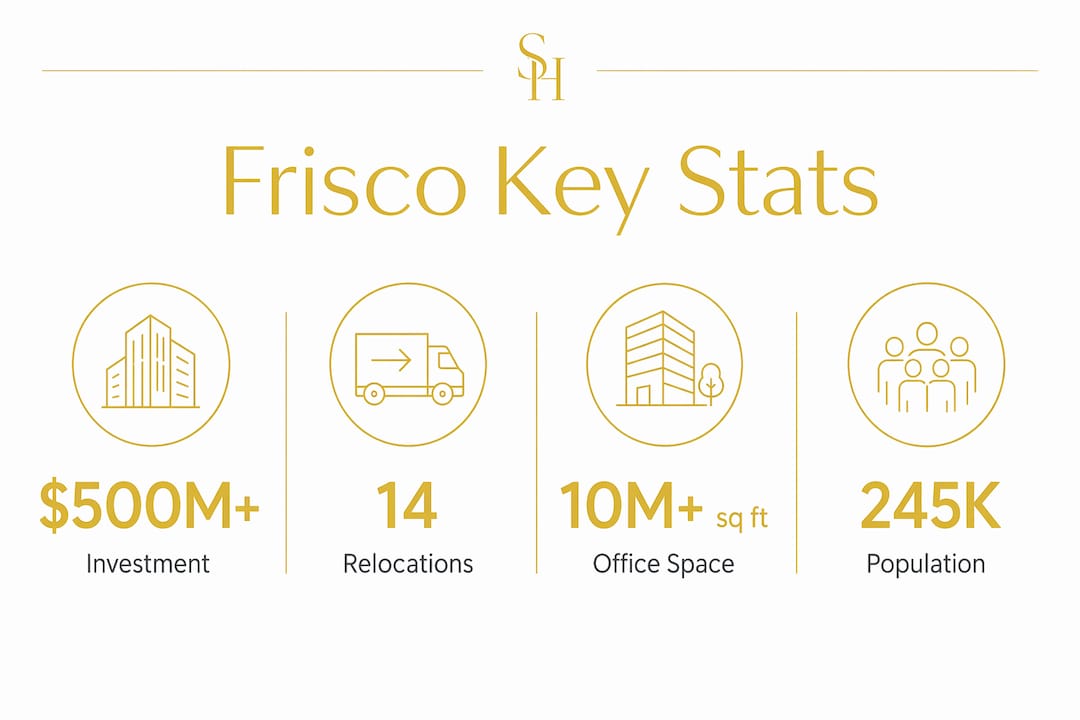
Frisco, Texas is the top corporate relocation destination in North Texas, drawing companies with a combination of zero state income tax, a fast-growing workforce, and one of the most deliberately planned business environments in the American Sun Belt. Why Frisco attracts corporate relocations is no mystery to executives who have studied the numbers. The Frisco Economic Development Corporation facilitated 14 major corporate relocations and expansions in fiscal 2025, generating over $500 million in new capital investment. Companies like Oracle and T-Mobile have already planted roots here. The city’s population growth now exceeds 245,000 residents, creating a talent pool that most suburban markets cannot match.
What key economic factors make Frisco attractive for corporate moves?
Frisco’s economic case is built on hard numbers, not marketing slogans. The city recorded over $500 million in new capital investment in 2025 alone, with that activity expected to create or retain more than 3,100 jobs. That level of investment in a single fiscal year signals sustained corporate confidence, not a one-time spike.
The diversity of industries making the move is equally telling. Technology, financial services, healthcare, and professional services firms all appear in Frisco’s 2025 relocation roster. That breadth protects the local economy from sector-specific downturns in a way that single-industry towns cannot.

Perhaps the most telling data point: 9 out of 14 major corporate relocations in 2025 happened without any government financial incentives. Companies chose Frisco on the merits of its workforce, infrastructure, and quality of life alone. That shift away from incentive dependency signals genuine, durable Frisco business advantages rather than subsidized short-term deals.
Key economic drivers for executives evaluating a corporate move to Frisco:
- No state income tax. Texas levies no personal or corporate income tax, which directly improves net compensation for executives and reduces payroll friction.
- Strong job creation. Over 3,100 jobs created or retained in 2025 reflects a labor market with real momentum.
- Capital investment depth. $500 million-plus in a single year means commercial real estate, infrastructure, and services are all expanding to meet demand.
- Incentive-free growth. The majority of 2025 relocations required no public subsidy, which means the city’s value proposition holds up without artificial support.
- Industry diversity. Tech, finance, and healthcare presence reduces exposure to any single economic cycle.
How does Frisco’s infrastructure and location benefit relocating companies?
Location is the first filter most site selection consultants apply, and Frisco passes it cleanly. The city sits within the Dallas-Fort Worth Metroplex, giving companies direct access to one of the largest labor markets in the United States. DFW International Airport is roughly 30 minutes away, connecting executives to direct flights across North America and internationally.
The road network reinforces that connectivity. The Dallas North Tollway and Highway 121 run directly through Frisco, making commutes from surrounding communities manageable. That matters for talent acquisition. Employees in Plano, McKinney, Allen, and Prosper can reach Frisco offices without fighting the congestion that defines downtown Dallas or central Houston.
Frisco’s planned office space expansion is the infrastructure story that most executives miss. The city has committed to adding over 10 million square feet of office space over the next 15 years. That pipeline means companies relocating now can grow into larger footprints without relocating again. The 2025 data already shows over 650,000 square feet of new office development underway.
Pro Tip: When evaluating office space in Frisco, ask developers specifically about mixed-use master-planned campuses. These developments integrate retail, dining, and green space directly into the work environment, which reduces midday commute friction and improves employee satisfaction scores.
Frisco vs. Dallas urban core: infrastructure comparison
| Factor | Frisco | Dallas Urban Core |
|---|---|---|
| Average commute time | Below regional average | Above regional average |
| Office space pipeline | 10M+ sq ft planned | Limited new development |
| Airport access | ~30 min to DFW | ~25 min to DFW/Love Field |
| Traffic congestion | Low to moderate | High |
| Mixed-use development | Widespread | Selective |
Why does Frisco’s quality of life and talent pool matter for businesses?
Quality of life is not a soft benefit. It is a talent retention tool with direct impact on hiring costs and turnover rates. Frisco understands this better than most Texas cities, and the data backs it up.
Frisco ISD is ranked #11 in Texas by Niche in 2026. That ranking drives a school-driven real estate cycle where families actively choose Frisco neighborhoods to access those schools. For relocating executives with children, the school quality removes one of the biggest objections to a corporate move. It also stabilizes home values, which protects the financial position of employees who purchase property here.
The city’s master-planned communities like Light Farms and Star Trail are designed around the live-work-play model. Trails, parks, pools, and retail are built into the neighborhood fabric rather than added as afterthoughts. That design reduces the daily friction that erodes employee satisfaction over time.
“Companies increasingly choose Frisco for its quality of life as a business retention tool rather than just an employee perk.” — Frisco Economic Development Corporation, 2025
Frisco’s population reached an estimated 245,000 residents by mid-2026, growing by more than 150,000 since 2005. That growth rate produces a continuously refreshed talent pool of educated professionals. High-growth industries like technology and finance benefit most, since they compete hardest for skilled workers who also prioritize where they live.
The Frisco job market appeal extends beyond compensation. Employees weigh school quality, commute time, neighborhood safety, and recreational access when deciding whether to accept a relocation offer. Frisco scores well across all four categories, which raises acceptance rates for executive recruitment packages.
How does Frisco compare to other North Texas markets for corporate relocations?
Frisco’s growth model separates it from both Dallas and older North Texas suburbs. Corporate relocation trends favor Frisco over Dallas for companies that prioritize infrastructure stability and leasing predictability. Dallas offers scale and brand recognition, but its urban core carries higher congestion, older building stock, and less predictable rent trajectories.
Frisco’s intentional colocation of commercial and residential areas limits the sprawl that plagues cities like Plano and Irving. Employees do not face 45-minute commutes from affordable housing to office parks. That design decision is a deliberate HR advantage, and corporate site selection teams are starting to quantify it.
Leasing activity and rent stability in Frisco also give investors and CFOs more confidence than they find in volatile urban markets. New office developments are pre-leased at higher rates, which signals genuine demand rather than speculative building. For companies signing 10-year leases, that stability matters as much as the initial rent figure.
The comparison is not that Dallas is failing. It is that Frisco offers a specific combination of growth capacity, infrastructure quality, and workforce access that older markets cannot replicate without decades of redevelopment. Companies choosing between the two are often choosing between short-term brand cachet and long-term operational efficiency.
Key Takeaways
Frisco’s corporate relocation appeal rests on five converging factors: no state income tax, a $500 million-plus investment base, planned office expansion, top-ranked schools, and a master-planned environment that retains talent without subsidies.
| Point | Details |
|---|---|
| Economic momentum | $500M+ in 2025 capital investment and 14 major relocations confirm sustained corporate demand. |
| Incentive-free appeal | 9 of 14 relocations in 2025 required no government incentive, proving intrinsic business value. |
| Infrastructure pipeline | Over 10 million sq ft of office space planned in 15 years supports long-term growth capacity. |
| Talent and schools | Frisco ISD ranked #11 in Texas drives family relocation acceptance and stabilizes home values. |
| Quality of life as strategy | Mixed-use master-planned communities reduce commute friction and improve employee retention. |
What executives often miss about Frisco’s growth model
Most site selection analyses focus on tax rates and square footage costs. Those numbers matter, but they miss the more durable reason Frisco keeps winning corporate relocations: the city is built around the idea that where people live shapes how well they work.
I have watched executives tour Frisco and immediately focus on the office park specs. They check ceiling heights, fiber access, and parking ratios. Those are valid criteria. But the executives who make the best long-term decisions also walk the neighborhoods. They drive through Light Farms on a Saturday morning. They check the school ratings before they check the lease terms. They ask their HR teams what the employee acceptance rate looks like for North Texas offers versus other markets.
The answer, consistently, is that Frisco offers get accepted at higher rates. Employees with families see the school rankings. They see the trail systems and the community pools. They see that their commute will be 18 minutes, not 45. That acceptance rate advantage translates directly into lower recruitment costs and faster team assembly after a move.
Frisco’s city planning team deserves credit for something most municipalities get wrong. They did not let commercial development sprawl unchecked. They integrated it with residential planning from the start. The result is a city that feels intentional rather than accidental. For executives who have relocated teams to cities that grew without a plan, that distinction is immediately recognizable.
The one thing companies often overlook is the startup and innovation ecosystem that is beginning to form around the corporate anchor tenants. As Oracle, T-Mobile, and others establish large footprints, the supporting ecosystem of vendors, consultants, and tech startups follows. Frisco is early in that cycle, which means companies relocating now are positioning themselves ahead of the density curve rather than arriving after it peaks.
— Felix
Relocating to Frisco? Kamilashayehomes knows this market
Executives relocating a business to Frisco also need to relocate their lives. Kamilashayehomes specializes in exactly that transition, with deep knowledge of Frisco’s top neighborhoods including Light Farms and Star Trail, two of the most sought-after master-planned communities for corporate professionals. Kamila Shaye brings firsthand experience helping relocating executives and their teams find homes that match both their lifestyle and their commute requirements. Whether you need a home valuation before listing a current property or want to understand what your budget gets you in Frisco’s 2026 market, Kamilashayehomes provides the local insight and hands-on guidance that makes the process clear from day one.
FAQ
Why does Frisco attract so many corporate relocations?
Frisco offers no state income tax, a rapidly growing educated workforce, and a planned business environment with over $500 million in 2025 capital investment. Its location within the Dallas-Fort Worth Metroplex provides airport access and highway connectivity without urban congestion.
Do companies need incentives to relocate to Frisco?
No. Nine of 14 major corporate relocations in 2025 occurred without government financial incentives. Companies choose Frisco based on workforce quality, infrastructure, and quality of life.
How does Frisco ISD affect corporate relocation decisions?
Frisco ISD is ranked #11 in Texas by Niche in 2026, which raises employee acceptance rates for relocation offers. Families prioritize school quality, so strong districts directly reduce recruitment friction for companies moving teams here.
How much office space is Frisco adding?
Frisco plans to add over 10 million square feet of office space over the next 15 years. Over 650,000 square feet of new development was already underway in 2025.
How does Frisco compare to Dallas for corporate real estate?
Frisco offers lower congestion, newer building stock, and more predictable rent trends than the Dallas urban core. Its master-planned layout also reduces employee commute times, which corporate HR teams increasingly factor into site selection.