

Frisco Independent School District is one of Texas’s highest-rated public school systems, serving over 62,713 students across 76 campuses with an ‘A’ rating from the Texas Education Agency. If you are moving to North Dallas and trying to understand the Frisco ISD school system explained in plain terms, this guide covers everything from campus structure and academic performance to enrollment boundaries and special programs. The district maintains a student-teacher ratio of 17:1 and a graduation rate that ranks among the top in the state.
What schools and grade levels does frisco ISD include?
Frisco ISD is organized across three school levels, each covering a distinct grade range. Elementary schools serve pre-kindergarten through grade 5. Middle schools cover grades 6 through 8. High schools run grades 9 through 12.
The district currently operates:
- 44 elementary schools serving the youngest learners with foundational academics
- 19 middle schools focused on academic transition and exploratory coursework
- 13 high schools offering advanced coursework, athletics, and career pathways
- 3 special programs centers designed for students with unique academic or developmental needs
Each school type carries a different average class size. Elementary classrooms typically run smaller to support early literacy and numeracy development. High schools tend to have larger class sizes but offset that with more course variety and elective options.
Pro Tip: When researching specific campuses, check the Frisco ISD website’s school finder tool to confirm which elementary feeds into which middle and high school. The feeder pattern matters more than the individual school rating.

The 3 special programs centers are worth understanding separately. These campuses serve students who qualify for specialized instruction, including gifted and talented learners, students with significant disabilities, and those enrolled in alternative education settings. They are not traditional neighborhood schools, so placement is based on evaluation and eligibility rather than home address.
| School Type | Number of Campuses | Grade Range |
|---|---|---|
| Elementary | 44 | PK/K–5 |
| Middle School | 19 | 6–8 |
| High School | 13 | 9–12 |
| Special Programs Centers | 3 | Varies |
How does frisco ISD perform academically?
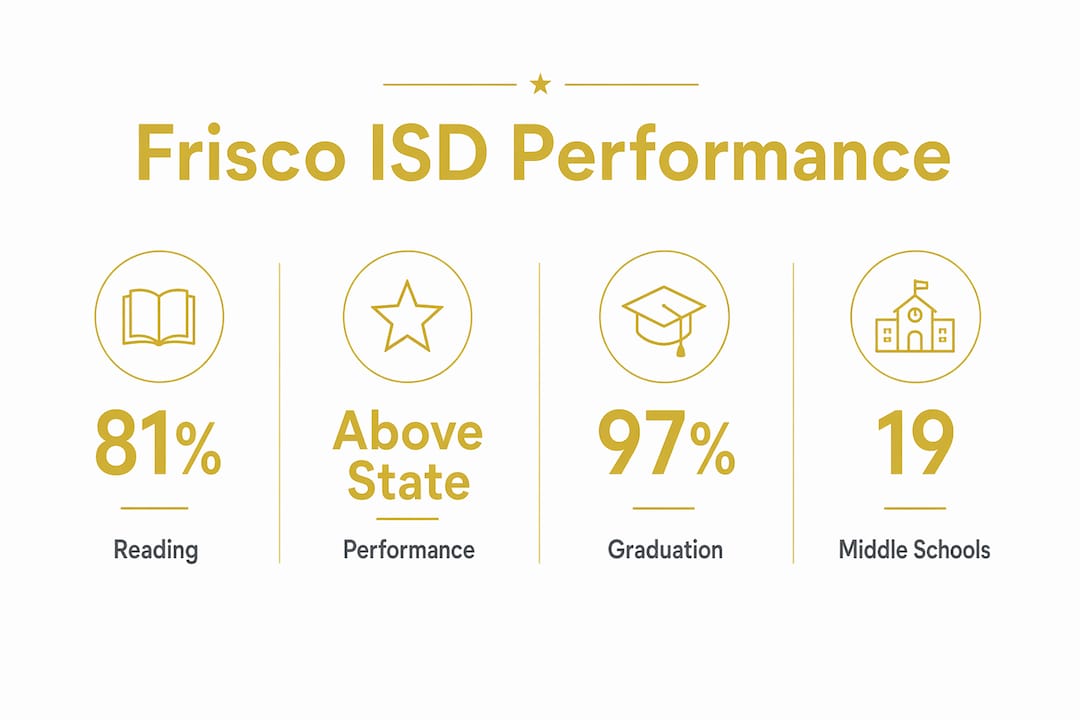
Frisco ISD’s academic results stand well above Texas state averages across every major metric. Student proficiency rates reach 81% in reading and 72% in math, compared to lower statewide figures. That gap reflects a district that invests heavily in instructional quality and teacher development.
The graduation rate tells an equally strong story. Frisco ISD posts a 97% graduation rate, ranking 11th among 1,202 Texas school districts. That ranking puts the district in the top 1% statewide for student completion. For parents prioritizing college readiness, that number matters.
“Frisco ISD’s ‘A’ rating from the Texas Education Agency reflects consistent performance across student achievement, school progress, and closing the gaps between student groups.” — Texas Tribune Schools Explorer
The district’s advanced academic offerings reinforce those outcomes. Frisco ISD provides AP, IB, and gifted education programs across multiple campuses. Advanced Placement courses are available at every high school. The International Baccalaureate program is offered at select campuses for students seeking a globally recognized curriculum. Gifted and talented identification begins in elementary school, with dedicated instruction built into the school day rather than treated as an afterthought.
| Metric | Frisco ISD | Texas State Average |
|---|---|---|
| Reading Proficiency | 81% | Below 81% |
| Math Proficiency | 72% | Below 72% |
| Graduation Rate | 97% | Lower statewide |
| State Ranking | 11th of 1,202 | N/A |
| TEA Rating | A | Varies |
What programs and extracurriculars does frisco ISD offer?
Frisco ISD’s program depth separates it from most suburban districts its size. The district treats extracurricular and career development as part of the core student experience, not optional additions.
Academic enrichment programs include:
- Advanced Placement (AP): Available at all 13 high schools, covering subjects from calculus to art history
- International Baccalaureate (IB): Offered at select campuses for students pursuing a rigorous, internationally recognized diploma
- Gifted and Talented (GT): Identification starts in elementary school, with differentiated instruction built into the regular school day
- Career and Technical Education (CTE): Pathways in fields like healthcare, engineering, business, and digital media prepare students for both college and the workforce
What makes Frisco ISD’s approach unusual for a large suburban district is how career pathways are integrated with advanced academics. A student can pursue AP coursework alongside a CTE certification in the same school year. That combination is rare at this scale.
Extracurricular offerings are equally broad. Athletics programs span UIL-sanctioned sports at every level. Fine arts programs include orchestra, band, choir, theater, and visual arts. Student clubs cover everything from robotics and debate to cultural organizations and community service groups.
Pro Tip: Ask the specific high school about its CTE pathway options before you commit to a neighborhood. Not every campus offers every pathway, and some specialized programs require application or audition.
District leadership actively supports a balance between academic rigor and student wellbeing. That philosophy shows up in counseling resources, social-emotional learning programs, and community partnerships that extend beyond the classroom.
What should families know about frisco ISD enrollment and boundaries?
Frisco ISD’s enrollment has grown 17.7% over the past decade, making it one of the fastest-growing districts in Texas. That growth creates a school boundary environment that changes more often than most parents expect.
Here is what you need to know before buying a home in the district:
- Verify boundaries before you close. The district opens 1–4 new schools annually to manage population growth. A boundary that was accurate six months ago may have shifted.
- Use the official Frisco ISD boundary tool. The district maintains an online address lookup tool that shows current school assignments. Third-party real estate sites often lag behind official updates.
- Understand the geographic spread. Frisco ISD spans Collin and Denton counties, covering communities including Frisco, Plano, McKinney, Little Elm, and several unincorporated areas. Two homes on the same street can occasionally fall in different school zones.
- Re-verify after major rezoning cycles. The district typically announces boundary changes in the spring for the following school year. If you are buying in the fall, confirm the assignment applies to the upcoming academic year.
- Factor in feeder patterns. Your child’s elementary school determines the middle and high school they will attend. Buying based on elementary school alone without checking the full feeder pattern is a common mistake.
Families relocating from out of state are often surprised by how dynamic Texas school boundaries can be. The rapid community and school growth in this region is a feature of North Dallas real estate, not an exception. Planning around it is part of making a smart home purchase. For families also exploring nearby neighborhoods, the schools near Light Farms article from Kamilashayehomes covers another popular Frisco ISD area in detail.
How does student diversity shape the frisco ISD experience?
Frisco ISD is one of the most ethnically diverse suburban school districts in Texas. Nearly 45% of students identify as Asian, making Frisco ISD an outlier compared to most North Texas districts. The remaining student population includes White, Hispanic, Black, and multiracial students.
The economic profile of the district is relatively affluent. Only around 14% of students qualify as economically disadvantaged. That figure is well below the Texas state average and reflects the higher household incomes typical of the Frisco and surrounding communities.
What this diversity means in practice:
- Students are exposed to a wide range of cultural perspectives inside and outside the classroom
- Parent communities often organize cultural events, language programs, and international festivals that enrich the school calendar
- Academic competition tends to be high, which motivates strong students but can create pressure for others
- Some students find the competitive environment challenging, so parents should weigh their child’s individual learning style against the district’s academic intensity
The diversity also shapes extracurricular culture. Language clubs, cultural student organizations, and international academic competitions are common across Frisco ISD campuses. For families coming from multicultural urban centers, the district’s demographic composition will feel familiar.
Key takeaways
Frisco ISD is a top-rated Texas public school district with strong academic outcomes, diverse programs, and rapidly shifting enrollment boundaries that require careful research before any home purchase.
| Point | Details |
|---|---|
| District size and rating | Frisco ISD serves 62,713 students across 76 campuses with a TEA ‘A’ rating. |
| Academic performance | Reading proficiency is 81%, math is 72%, and graduation rate ranks 11th statewide at 97%. |
| Program depth | AP, IB, gifted education, and CTE pathways are available across the district’s 13 high schools. |
| Boundary dynamics | The district opens 1–4 new schools annually; always verify your address using the official boundary tool before buying. |
| Student diversity | Nearly 45% Asian enrollment and 14% economic disadvantage rate create a high-achieving, multicultural environment. |
What i tell every family before they choose a neighborhood
Most parents arrive in North Dallas having already decided on Frisco ISD based on the ratings. The ‘A’ grade and top-11 graduation ranking are real and well-earned. But the rating is a district-wide average, and individual campus experiences vary more than the headline number suggests.
The boundary issue is the one I see catch families off guard most often. I have worked with buyers who purchased a home specifically for a particular elementary school, only to find out at closing that a rezoning had already been announced for the following August. The official district tool is the only source you should trust. Real estate listing sites, neighborhood Facebook groups, and even well-meaning neighbors can give you outdated information.
The competitive academic culture is the second thing worth thinking through carefully. Frisco ISD’s high proficiency rates and strong AP participation are genuine strengths. They also reflect a student body where academic pressure is real and consistent. For a child who thrives in that environment, Frisco ISD is exceptional. For a child who needs more space to develop at their own pace, the district still has strong support systems, but you should explore those resources before assuming they will be easy to access.
My honest recommendation: visit the specific campus your child would attend, not just the district website. Talk to the principal. Ask about counseling resources and how the school handles academic stress. The district’s commitment to student wellbeing is genuine at the leadership level. Whether it translates to your child’s specific campus is worth verifying in person.
If you are also considering communities just outside Frisco, the Windsong Ranch school guide from Kamilashayehomes is worth reading before you finalize your search area.
— Felix
Find your home in frisco ISD with Kamilashayehomes
Choosing the right home in Frisco ISD means more than finding a great school rating. It means confirming the boundary, understanding the feeder pattern, and knowing which neighborhoods are zoned for the programs your child needs. Kamilashayehomes specializes in exactly this kind of school-focused home search across Frisco, Prosper, Celina, and surrounding North Dallas communities. Start with a free home valuation to understand what your budget can access in the district. Browse current listings in Frisco ISD neighborhoods to see what is available right now. Kamila Shaye brings local knowledge and real relocation experience to every search, so you can make a confident, informed decision.
FAQ
What is frisco ISD and where is it located?
Frisco Independent School District is a public school district in North Texas serving communities in Collin and Denton counties, including Frisco, Plano, McKinney, and Little Elm. It operates 76 campuses and holds an ‘A’ rating from the Texas Education Agency.
How do i find out which frisco ISD school my address is zoned for?
Use the official Frisco ISD address lookup tool on the district website to confirm your current school assignment. Third-party real estate sites frequently show outdated boundary information, especially after annual rezoning cycles.
Does frisco ISD offer IB and AP programs?
Yes. Frisco ISD offers Advanced Placement courses at all 13 high schools and International Baccalaureate programs at select campuses. Gifted and talented identification begins at the elementary level.
What is the graduation rate for frisco ISD?
Frisco ISD posts a 97% graduation rate, ranking 11th among 1,202 Texas school districts. That places the district in the top 1% statewide for student completion.
Is frisco ISD a good fit for all students?
Frisco ISD is an excellent district academically, but its competitive environment is not ideal for every learner. Parents should evaluate their child’s individual needs alongside the district’s strong academic profile and available support resources.
Recommended
- Best Schools Near Light Farms and Why Families Love Them – Kamila Shaye Homes & Estates of Prosper Frisco & Celina
- What Schools Serve Star Trail? | A Parent’s Guide to Prosper ISD – Kamila Shaye Homes & Estates of Prosper Frisco & Celina
- What Schools Serve Windsong Ranch? A Family-Focused Education Guide – Kamila Shaye Homes & Estates of Prosper Frisco & Celina
- Is Star Trail a Good Place to Live? Discover Why Families Love It – Kamila Shaye Homes & Estates of Prosper Frisco & Celina