

A bridge loan is a short-term, asset-backed loan that lets you buy a new home before your current one sells, using your existing equity to cover the gap. Think of it as a financial runway: you get access to funds now, then repay the loan once your old property closes. According to Investopedia, bridge loans are a recognized form of interim financing, but they come at a cost premium over permanent mortgages.
Common uses in real estate:
- Residential: A homeowner makes a non-contingent offer on a new home while their current home is still listed, using the bridge loan to fund the down payment or cover the purchase entirely.
- Commercial/investor: A developer acquires a property quickly, stabilizes it, then refinances into a permanent loan once the asset qualifies.
Bridge loans are typically costlier than conventional financing and run for short terms. Before committing, it’s worth comparing alternatives carefully, including understanding common reverse mortgage myths and facts to evaluate all equity-based financing options.
Key Takeaways
A bridge loan is a short-term, asset-backed financing tool that solves a timing gap, but its higher cost and strict repayment timeline mean it works best when your equity is strong and your exit plan is concrete.
| Point | Details |
|---|---|
| Definition and purpose | A bridge loan covers the gap between buying a new home and selling your current one. |
| Typical cost range | Rates commonly run 8–14%; a $100,000 bridge loan costs roughly $7,000 in interest and fees over 6 months. |
| Key eligibility factor | Most lenders require ~20% equity and a documented exit plan before approving a bridge loan. |
| Main risk | If your home doesn’t sell within the term, extension fees apply and refinancing risk rises sharply. |
| Kamilashayehomes next step | Request a home valuation to confirm your equity position before approaching a bridge lender. |
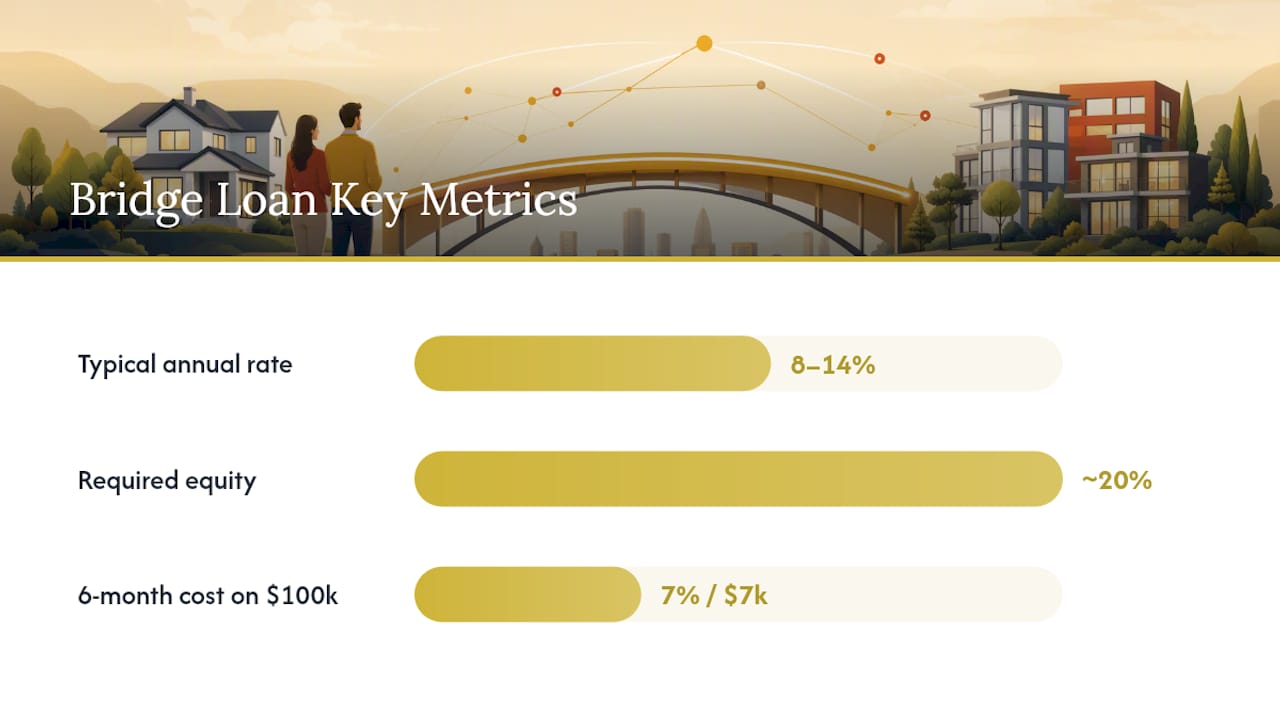
Table of Contents
- What is a bridge loan in real estate, and when do buyers use one?
- How does a bridge loan work structurally?
- What do bridge loans typically cost in the U.S.?
- Who qualifies for a bridge loan?
- How much does a $100,000 bridge loan actually cost?
- Pros, cons, and the risks you need to understand
- What alternatives to a bridge loan should you consider?
- What does the bridge loan timeline look like?
- When does a bridge loan actually make sense for you?
- A North Dallas agent’s perspective on bridge loans
- How Kamilashayehomes helps buyers who need bridge financing
- Sources
- FAQ
What is a bridge loan in real estate, and when do buyers use one?
Also called a swing loan or gap financing, a bridge loan is short-term, asset-based financing designed to solve a timing problem. You have equity locked in a property you haven’t sold yet, but you need that equity now to buy something else.
The most common residential scenarios:
- Buy before you sell: You find the right home in Frisco or Prosper before your current home is under contract. A bridge loan funds the purchase so you don’t lose the deal.
- Down payment from equity: Your new home requires a 20% down payment, but that cash is tied up in your current home. The bridge loan releases it.
- Avoiding a contingent offer: In a competitive market, a contingent offer (one that depends on your home selling first) is often rejected. A bridge loan lets you make a clean offer.
Investors and developers use bridge loans differently. Speed is the draw: closing in days rather than the weeks a conventional loan requires. Fix-and-flip buyers use them to acquire and renovate, then repay via sale. Value-add investors acquire a property, raise occupancy or rents, then refinance into a long-term commercial loan once the asset stabilizes.
PNC notes that bridge loans give quick access to funds but are typically more expensive than permanent lending, a trade-off that makes sense only when timing is genuinely the constraint.
How does a bridge loan work structurally?
The mechanics depend on which property secures the loan and how the lender structures repayment.

Collateral: Most residential bridge loans are secured by your current home, your new home, or both. Lenders underwrite based on the asset value and your exit plan, not primarily on your income profile. Baseline confirms that bridge underwriting is asset-based and centers on the exit strategy: the lender needs to know exactly how and when you’ll repay.
Two common structures:
- Single combined bridge: One loan covers both properties. You make interest-only payments during the term, then repay the principal when your old home sells.
- Second mortgage bridge: The lender places a second lien on your current home. You carry your existing mortgage plus the bridge loan simultaneously.
Repayment and exit: Chase explains that residential bridge loans are usually interest-only and run under 12 months, which means you need a concrete repayment path before you close. The three most common exits are sale proceeds from your current home, a refinance into a permanent mortgage, or conversion to a HELOC once you have sufficient equity.
Closing speed: Bridge loans close faster than conventional mortgages, sometimes in one to two weeks, because underwriting focuses on the asset rather than a full income-documentation review.
Pro Tip: Before signing, map your exit in writing: know your listing date, your expected sale timeline, and what happens if the sale takes 30 days longer than planned. Lenders will ask for this; having it ready also protects you.
What do bridge loans typically cost in the U.S.?
Terms and pricing vary between residential and commercial bridge loans, but the cost premium over conventional financing is real in both categories.
Residential bridge loans:
- Term: typically 6–12 months, occasionally up to 18 months
- Interest rates: generally run higher than a 30-year fixed mortgage; published market commentary shows rates for bridge and short-term asset-based lending ranging from 8–14% depending on LTV and borrower profile
- Origination fees: commonly 1–3 points (1–3% of the loan amount)
- Other costs: appraisal, title, and potentially an extension fee if the loan term needs to be extended
Commercial bridge loans: Avana Capital’s 2026 borrower’s guide notes typical commercial bridge terms of 12–24 months with floating rates (SOFR plus a spread) and all-in rates in the 8–11% range for institutional-quality deals. Higher-risk deals or lower-quality sponsors push toward the top of the range.
If you owe $300,000 on a home worth $500,000, your usable equity is roughly $100,000 before hitting that ceiling.
Rate callout: Residential bridge rates in the current market commonly fall between 8% and 12% annually, well above the rate on a conventional 30-year mortgage. That spread is the price of speed and flexibility.
Who qualifies for a bridge loan?
Bridge loan eligibility is tighter than a standard mortgage in some ways and more flexible in others. Lenders care less about your income-to-debt ratio and more about your equity position and exit plan.
Typical requirements:
- Credit score: Most lenders want a score of 680 or higher; some set the floor at 700 for residential bridge products.
- Home equity: SoFi’s guide identifies ~20% equity in your current home as a common threshold. Lenders need a cushion in case the sale price comes in below expectations.
- Debt-to-income (DTI): Carrying two mortgages simultaneously raises your DTI. Lenders will stress-test whether you can cover both payments if the sale is delayed.
- Exit plan documentation: A signed listing agreement, a purchase contract on your current home, or a pre-approval letter for permanent financing on the new home all strengthen your application.
- Appraisal: Lenders typically require a current appraisal or broker price opinion on the property securing the loan.
Some lenders only offer bridge loans to borrowers who will use the same institution for the new permanent mortgage. That bundling requirement is worth asking about upfront.
How much does a $100,000 bridge loan actually cost?
Here’s a straightforward worked example using conservative assumptions.
Assumptions:
- Loan amount: $100,000
- Interest rate: 10% per year (interest-only)
- Term: 6 months
- Origination fee: 2 points ($2,000)
Sensitivity notes:
- At 12% instead of 10%, monthly interest rises to $1,000, and total interest over 6 months reaches $6,000, pushing total cost to roughly $8,000.
- If the loan runs 9 months instead of 6, total interest at 10% reaches approximately $7,500, plus the origination fee.
- An extension fee (often 0.5–1 point) adds another $500–$1,000 if you need more time.
The numbers above are illustrative estimates. Your actual cost depends on the rate your lender quotes, the term, and any additional closing costs specific to your state and transaction.
Pros, cons, and the risks you need to understand
Advantages:
- Speed: Cascara Capital notes that bridge financing can close in days versus weeks for conventional loans, a decisive edge in competitive markets.
- Non-contingent offers: removes the contingency that sellers in Prosper and Frisco routinely reject.
- Equity access: unlocks capital that would otherwise be frozen until your home sells.
- Flexible structuring: investors can tailor terms to a specific acquisition and renovation timeline.
Disadvantages:
- Higher cost: rates and fees add up fast, as the worked example above shows.
- Dual-loan exposure: carrying two mortgages simultaneously strains cash flow and raises DTI.
- Refinancing risk: if your exit fails (home doesn’t sell, permanent financing falls through), you face extension penalties or a forced sale.
The most serious risk: your current home sits on the market longer than expected. In a slower segment, like luxury homes that take longer to sell, a 6-month bridge loan can expire before you have a buyer. Extensions cost money, and lenders are not obligated to grant them.
What alternatives to a bridge loan should you consider?
A bridge loan is one solution to a timing gap. Several alternatives are cheaper or less risky depending on your situation.
| Option | Best when | Cost vs. bridge | Main risk |
|---|---|---|---|
| HELOC | You have time to set one up before listing | Lower rate, variable | Lender can freeze it if home value drops |
| Home equity loan | You want a fixed rate and lump sum | Lower rate, fixed | Adds a second lien; slower to close |
| Contingent offer | Seller is flexible or market is slow | No extra financing cost | Seller may reject or accept a competing offer |
| Simultaneous closing | Both transactions can close same day | Minimal extra cost | Requires precise coordination |
| Seller financing | Seller is motivated and has equity | Negotiable | Rare; depends on seller’s situation |
| Short-term personal loan | Small gap, strong credit | Higher rate, unsecured | Limited amounts; expensive at scale |
Decision rules:
- If you have 60 or more days before you need to close, a HELOC is often cheaper and worth setting up first.
- If the seller won’t accept a contingency and you can’t wait, a bridge loan or simultaneous closing are the realistic paths.
- For new construction in Texas, where closing dates shift, a bridge loan’s flexibility can outweigh its cost.
What does the bridge loan timeline look like?
- Application (Days 1–5): Submit financials, property details, and exit plan documentation. Bridge lenders move faster than conventional underwriters.
- Appraisal and underwriting (Days 5–10): Lender orders an appraisal or broker price opinion. Asset-based underwriting is the focus.
- Closing (Days 10–14): Funds are disbursed. You can proceed with the new purchase.
- Bridge period (Months 1–6 or 1–12): Interest-only payments due monthly. Your old home is listed and marketed.
- Exit (Before maturity): Sale proceeds repay the bridge loan in full, or you refinance into a permanent mortgage.
Common exit strategies:
- Sale proceeds: the cleanest exit; lender is repaid at closing of the old home.
- Permanent refinance: if the old home hasn’t sold but the new home has enough equity, you refinance the bridge into a long-term mortgage.
- HELOC conversion: once the new home is owned free and clear or with sufficient equity, a HELOC replaces the bridge.
If you miss the maturity date, most lenders offer a 30–90 day extension, but at a cost (typically 0.5–1 additional point plus a higher rate). Baseline’s analysis is direct: weak exit planning is a leading cause of bridge loan failures. Know your exit before you close.
When does a bridge loan actually make sense for you?
Green-light conditions:
- You have at least 20% equity in your current home.
- Your home is priced competitively and you expect a sale within the bridge term.
- You can cover both mortgage payments for at least 3 months if the sale is delayed.
- You have a pre-approval for permanent financing on the new home.
- The cost premium (roughly $7,000–$10,000 on a $100,000 bridge) is acceptable relative to the deal you’re capturing.
Red flags:
- Your current home is in a slow or luxury segment with unpredictable sale timelines.
- Your equity is thin (under 20%), limiting what lenders will offer.
- You cannot cover two mortgage payments simultaneously without financial strain.
- Your exit plan is “we’ll figure it out” rather than a contracted sale or a confirmed refinance.
Pro Tip: Ask your lender for the extension terms before you sign. Knowing the cost of a 60-day extension in advance lets you budget for the worst case without being surprised by it.
For first-time buyers in North Dallas, a bridge loan is rarely the right first move. It suits move-up buyers with strong equity and a clear plan far better than buyers who are still building their financial footing.
A North Dallas agent’s perspective on bridge loans
Bridge loans come up regularly in Prosper, Frisco, and Celina, especially when a buyer finds a home in a master-planned community before their current home is under contract. The market in these communities moves fast enough that contingent offers are often a non-starter.

When a client is considering a bridge loan, the first thing to look at is the realistic sale timeline for their current home, not the optimistic one. A home priced at $650,000 in Prosper may sell in three weeks in a strong spring market, but that same home in a softer period could sit for 60–90 days. That difference determines whether a 6-month bridge is comfortable or dangerously tight.
The practical checklist used with clients: confirm equity position with a current valuation, model the dual-payment scenario for at least three months, verify the lender is licensed through NMLS Consumer Access, and get the extension terms in writing before closing. Buyers who skip that last step are the ones who call in a panic at month five.
Questions worth asking any bridge lender: What is the extension policy and cost? Do you require me to use your institution for the permanent mortgage? How is the exit plan documented in underwriting? The answers tell you a lot about how that lender will behave if the sale takes longer than expected.
How Kamilashayehomes helps buyers who need bridge financing
Knowing whether you have enough equity to make a bridge loan work starts with an accurate home valuation, and that’s where Kamilashayehomes comes in. Kamila Shaye provides current market valuations for North Dallas homes in Prosper, Frisco, Celina, and surrounding communities, so you know your equity position before you approach a lender.

From there, the process is coordinated: listing strategy and timing are aligned with your purchase timeline, lender introductions connect you with bridge-loan-experienced mortgage professionals, and transaction management keeps both closings on track. For buyers relocating from Canada or California, that coordination matters even more when timelines are compressed.
Request a home valuation to get a clear picture of your equity and whether a bridge loan is a realistic path for your next move.
Sources
- Bridge loan – Investopedia
- What are bridge loans? – SoFi
- Bridge Loans: What They Are and How They Work – Chase
- Bridge loans explained – Baseline
This article is general information, not financial or legal advice. Bridge loan terms, rates, and eligibility vary by lender. Verify current requirements directly with a licensed mortgage professional and confirm lender credentials through NMLS Consumer Access.
This article is general information, not a substitute for advice from a qualified financial advisor. Consult a qualified financial professional about your own circumstances before acting on anything here.
FAQ
What is the downside of a bridge loan?
How much would a $100,000 bridge loan cost?
Is a bridge loan a good idea when buying a house?
For buyers with thin equity or uncertain sale timelines, alternatives like a HELOC or simultaneous closing are usually safer.
How difficult is it to get a bridge loan?
Bridge loans are harder to qualify for than conventional mortgages: lenders typically require a credit score of 680 or higher, strong home equity, a low combined debt-to-income ratio, and a documented exit plan. Some lenders also require you to use their institution for the permanent mortgage on the new home.