
MUD and PID taxes are special-district charges added on top of standard county, city, and school taxes — and if you’re buying a home in a new Texas subdivision, there’s a real chance you’ll pay both. Your first move: confirm whether the property sits inside a Municipal Utility District, a Public Improvement District, or both before you make an offer.
Three actions to take right now:
- Ask the listing agent for the official MUD Notice and any PID assessment roll before signing a contract.
- Pull the property’s parcel record on the county appraisal district (CAD) website to see every taxing entity listed.
- Call your lender and confirm how they’re handling special-district charges in your escrow and debt-to-income calculations.
These charges show up as separate line items on your annual Texas property tax statement. Miss them during due diligence and your monthly payment could be hundreds of dollars higher than you budgeted.
Key Takeaways
MUD and PID taxes are separate special-district charges that appear on your Texas property tax bill and can add hundreds of dollars per month to your housing costs, requiring verification before any offer is made.
| Point | Details |
|---|---|
| Verify district status first | Search the county CAD parcel record to identify every taxing entity before making an offer. |
| MUD taxes are ad valorem | MUD charges are tied to assessed value and bond debt; rates may decline as bonds retire over 20–30 years. |
| PID assessments convey with the property | Unpaid PID balances transfer to the buyer at closing unless negotiated or prepaid. |
| Disclosure rights are statutory for MUDs | Texas Water Code §49.452 / §49.4521 gives buyers the right to terminate if a proper MUD Notice is not delivered. |
| Lender escrow must reflect both charges | Confirm with your lender that MUD taxes and PID assessments are both included in escrow and DTI calculations. |
Table of Contents
- What are MUD taxes and how does a MUD get financed?
- What is a PID and how are PID assessments structured?
- How do MUDs and PIDs compare side by side?
- How do these charges appear on your tax bill and affect your mortgage?
- How to confirm whether a property is in a MUD or PID
- What are the seller disclosure rules for MUD and PID notices?
- Do MUD or PID charges ever end?
- Buyer checklist and questions to ask your agent
- How MUD and PID charges affect resale and long-term value
- What I’ve seen working with North Dallas buyers
- Sources
- FAQ
What are MUD taxes and how does a MUD get financed?
A Municipal Utility District is a political subdivision of the State of Texas, created under the Texas Water Code to finance and operate utilities and infrastructure in areas where a city hasn’t yet extended services. Developers in fast-growing suburbs like Prosper, Celina, and Frisco use MUDs to build the infrastructure a new community needs before home sales begin.
Common services a MUD funds:
- Water supply and treatment
- Wastewater collection and treatment
- Stormwater drainage and detention ponds
- Roads and street lighting within the district
- Parks, trails, and recreational facilities
- Sometimes solid waste collection
The financing mechanism works like this: the MUD issues tax-exempt bonds to pay developers back for eligible infrastructure costs. Those bonds are then repaid over time through ad valorem property taxes levied on every parcel inside the district, plus user fees for water and sewer service. Bond issuance requires certification by the Texas Commission on Environmental Quality (TCEQ) and approval by the Texas Attorney General, which gives investors confidence in the debt.
Because MUD bonds carry an unlimited ad valorem tax authority and their tax lien holds priority equivalent to county, city, and school taxes, lenders and title companies treat MUD taxes seriously. That priority means the MUD can collect before almost any other creditor.
Sellers are required under Texas Water Code §49.452 to deliver a MUD Notice to buyers before contract execution. The notice discloses the district’s existence, current tax rate, and outstanding bond debt. If you don’t receive it on time, you have the right to terminate the contract.
Pro Tip: MUD tax rates are often highest in the early years of a district when bond debt is largest. As bonds are retired over time, the debt-service portion of the tax rate can drop. Ask for the district’s bond amortization schedule so you can see when that relief might arrive.
What is a PID and how are PID assessments structured?
A Public Improvement District is created by a city or county under Texas Local Government Code Chapter 372, not by the state. That’s the first structural difference from a MUD: a city council or county commissioners court initiates the PID, approves its annual budget and assessment roll, and maintains ongoing oversight.
PIDs fund a broader range of improvements and services than MUDs typically do:
- Enhanced landscaping, streetscaping, and entry features
- Sidewalks, trails, and public plazas
- Public safety services and lighting upgrades
- Promotional and marketing services for a district
- Capital infrastructure improvements (capital PIDs)
- Ongoing maintenance and operations (M&O PIDs)
That last distinction matters. A capital PID finances one-time infrastructure improvements, similar in concept to a MUD bond. An M&O PID funds recurring services like landscaping maintenance or security patrols. Some communities carry both types simultaneously, which means the assessment line on your tax bill could reflect two separate PID charges.
PID assessments are not ad valorem taxes. They’re special assessments calculated based on a benefit formula tied to each parcel, approved annually by the governing city or county. The assessment roll and budget are public documents, and cities like Austin publish them as part of their PID policy and oversight process. Formation typically involves a petition, public hearings, and a city council ordinance, so there’s a paper trail you can follow.
How do MUDs and PIDs compare side by side?
The two district types solve different problems and are structured differently enough that confusing them can lead to real miscalculations at the offer stage.
| Feature | MUD | PID |
|---|---|---|
| Who creates it | State (TCEQ + voters) | City or county council |
| Primary funding vehicle | Ad valorem property tax (bond-backed) | Special assessment (benefit-based) |
| Typical uses | Water, sewer, drainage, roads, parks | Landscaping, amenities, security, capital improvements |
| How it appears on your bill | Separate MUD tax line | Separate PID assessment line |
| Duration / payoff | Tied to bond life (often 20–30 years) | Assessment term set by ordinance; often prepayable by parcel |
| Governance | Elected MUD board | City/county council oversight |
The practical buyer takeaway: a MUD tax rate is set annually by an elected board and can fluctuate with bond refinancing or new debt, while a PID assessment is set by a city ordinance and tends to be more predictable year to year. Neither is inherently worse, but they require different verification steps and affect your lender’s escrow calculations differently.
How do these charges appear on your tax bill and affect your mortgage?
On a Texas property tax statement, you’ll see each taxing entity listed separately. A home inside a MUD will show a line like “Willow Creek MUD” with its own tax rate applied to your assessed value. A home in a PID will show a separate “PID Assessment” line, sometimes labeled by the district name or the city’s PID designation.
How lenders handle these charges:
- MUD ad valorem taxes are almost always escrowed alongside county and school taxes.
- PID assessments may be escrowed or billed directly, depending on the lender and loan type.
- Both types count toward your total housing expense in a debt-to-income calculation.
Here’s a simple example of how to calculate MUD taxes and estimate the monthly impact. Suppose a home has an assessed value of $450,000 and the MUD tax rate is $0.75 per $100 of value:
- $450,000 ÷ 100 = $4,500
- $4,500 × $0.75 = $3,375 annual MUD tax
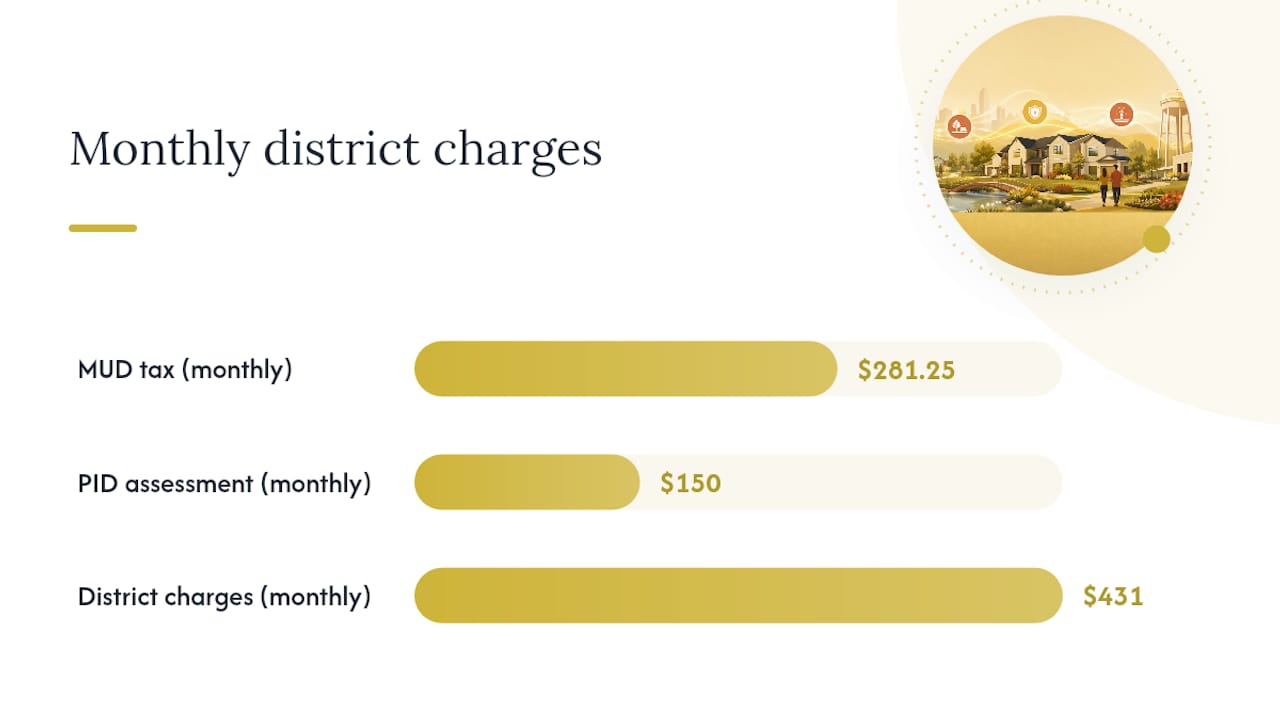
- $3,375 ÷ 12 = $281.25 added to your monthly escrow payment
Add a PID assessment of, say, $1,800 per year, and your monthly payment climbs another $150. That’s $431 per month in district charges alone, before county, city, and school taxes. Use a Texas mortgage payment calculator to model the full picture with your actual loan terms.
Pro Tip: Tell your lender about both the MUD tax rate and any PID assessment amount before underwriting begins. Some lenders pull only the prior year’s tax bill and miss a newly imposed PID assessment, which can create escrow shortfalls in year one.
How to confirm whether a property is in a MUD or PID
Follow these steps in order — each one narrows the picture and gives you a paper trail.
- Ask the listing agent directly. Request the official MUD Notice and any PID assessment roll or city ordinance. A good agent has these ready; if they don’t, that’s a signal to dig harder.
- Search the county appraisal district (CAD) website. Every Texas county CAD offers a parcel search by address. The results page lists every taxing entity for that parcel, including any MUD. For North Dallas properties, check the Collin County CAD or Denton County CAD depending on the address.
- Review the deed and plat. MUD boundaries are often referenced in the subdivision plat. The deed may also reference a MUD or PID by name.
- Check the district’s own website. Under the 2023 legislative changes from HB 2815 and HB 2816, districts that maintain a website must post the MUD Notice with required content under Texas Water Code §49.4521. Search the district name plus “Texas MUD” to find it.
- Look up the city or county PID ordinance. For PIDs, the creating city or county publishes the assessment roll and service plan. Search the city’s financial services or budget pages.
- Review the title commitment. Schedule B exceptions in a title commitment will list any MUD or PID liens and special assessments. Your title company sees these routinely.
Pro Tip: When buying inside a MUD, request the district’s most recent audited financials and bond amortization schedule. These show you how much debt remains, what the current debt-service tax rate covers, and roughly when the rate might decrease. A buyer’s agent familiar with North Dallas districts can pull this for you quickly.
What are the seller disclosure rules for MUD and PID notices?
Texas law is specific about MUD disclosures and less prescriptive about PIDs, which creates an asymmetry buyers need to understand.
MUD Notice requirements:
- Under Texas Water Code §49.452, sellers must deliver a written MUD Notice to buyers before the contract is executed or as a contract addendum.
- The 2023 legislative session (HB 2815 and HB 2816) replaced the three previously prescribed statutory forms with content requirements under §49.4521. Districts that maintain a website must post a compliant notice there.
- The Texas Real Estate Commission produced a voluntary Form 59-0 (effective February 2024) for license holders to use when a district hasn’t posted its own form.
- If a buyer does not receive a proper, timely MUD Notice, they have the right to terminate the contract at any point before closing, or to pursue damages if the notice was never provided.
PID notice practice:
- Texas law does not impose a statutory PID notice requirement equivalent to the MUD Notice. In practice, PID disclosures come through the title commitment, the tax certificate, or the listing agent’s disclosure.
- Buyers should ask for the city’s PID ordinance and the current assessment roll as part of their due diligence, not wait for the seller to volunteer it.
Statutory callout: Texas Water Code §49.452 / §49.4521 gives buyers a termination right if the MUD Notice is not properly delivered. This is one of the few contract exit rights in Texas real estate that doesn’t require the buyer to waive earnest money.
If you reach closing without having received a proper MUD Notice, stop and consult your agent and title company. The right to terminate is real, and exercising it is cleaner than discovering a surprise tax bill after you own the home.
Do MUD or PID charges ever end?
Yes, but the timeline and mechanics differ between the two.
MUD bonds and tax trajectory:
- MUD bonds are typically issued with multi-decade maturities. As the district retires debt, the portion of the tax rate dedicated to debt service can decrease.
- When all bonds are paid, the MUD may still levy a smaller operations and maintenance (O&M) tax, but the larger debt-service component drops off.
- Some MUDs are eventually annexed by a city. When that happens, the city assumes responsibility for services, but the handling of remaining bond debt varies and can be complex. Buyers in older MUDs near city limits should ask about annexation risk.
PID assessments and prepayment:
- PID assessments are billed annually with property taxes and convey with the property to the new owner unless paid off.
- Many PIDs allow individual parcel prepayment, which removes the assessment from that specific property permanently.
- The remaining assessment balance transfers to the buyer at closing unless the seller pays it off or the parties negotiate a credit.
At closing, you have three options: the seller pays off the outstanding assessment, the buyer assumes it, or the parties negotiate a price credit. For capital PIDs with large remaining balances, a payoff at closing is often the cleanest outcome. For M&O PIDs, prepayment may not be available since the charges are ongoing by design.
Buyer checklist and questions to ask your agent
Use this checklist during showings and before submitting an offer.
During due diligence:
- Confirm the property’s district status using the county CAD parcel search.
- Request the official MUD Notice or PID assessment roll from the listing agent.
- Ask for the district’s most recent audited financials and bond amortization schedule.
- Confirm with your lender how MUD taxes and PID assessments will be handled in escrow.
- Review Schedule B of the title commitment for district liens and assessment exceptions.
Sample negotiation asks:
- Request a seller credit equal to the remaining PID assessment balance, or require a payoff at closing.
- Ask the seller to provide the MUD district’s bond amortization schedule as a contract exhibit.
- Include a contract addendum clause requiring delivery of the official MUD Notice within three business days of execution.
- Ask for the district’s current budget to verify whether a rate increase is being considered.
Pro Tip: In North Dallas master-planned communities, MUD and PID charges together can add $0.50–$1.00+ per $100 of assessed value on top of base taxes. Request the district budgets early, not after you’re under contract. The Frisco home buying checklist covers this and other local due-diligence steps worth reviewing.
How MUD and PID charges affect resale and long-term value
High district charges don’t necessarily kill a sale, but they do shrink your buyer pool. A home carrying a combined MUD and PID burden that adds $500 or more per month to housing costs will qualify fewer buyers at a given price point, which matters when you’re the seller.
Resale considerations:
- Sellers must disclose MUD status by law; failing to do so creates liability.
- Buyers financing with conventional loans may face lender scrutiny if PID assessments aren’t clearly reflected in the tax certificate.
- Appraisers consider the total tax burden when assessing market value, particularly in markets where comparable homes outside the district carry lower effective rates.
An agent listing a home in a MUD or PID community can turn the district story into a selling point when the infrastructure is genuinely superior: newer roads, maintained parks, and community amenities that older neighborhoods lack. The key is transparency paired with a clear explanation of the long-term tax trajectory. Buyers respond better to “the MUD rate is $0.80 today and the bonds retire in 2031” than to discovering the charge buried in a tax certificate three days before closing.
For buyers relocating from out of state, particularly those moving from Canada to North Dallas, MUD and PID charges are often an unfamiliar concept. Framing them clearly early in the search process prevents sticker shock and builds trust.
What I’ve seen working with North Dallas buyers
Working with buyers across Prosper, Celina, and Frisco, the single most common surprise isn’t the MUD tax itself — it’s the combination of a MUD rate and a PID assessment that nobody mentioned until the tax certificate arrived three days before closing. By then, the buyer is emotionally committed, the lender is scrambling to recalculate escrow, and the seller has no incentive to negotiate.
The fix is simple but requires discipline: pull the CAD parcel record on day one, request the MUD Notice and PID assessment roll before the option period starts, and loop in your lender before underwriting. Kamilashayehomes verifies district status for every North Dallas buyer as a standard part of the search process. If you want a home valuation that accounts for the full tax picture, including MUD and PID charges, reach out and we’ll walk through the numbers for any specific property you’re considering.
This article is general information, not a substitute for advice from a qualified financial advisor. Consult a qualified financial professional about your own circumstances before acting on anything here.
Sources
Use these resources directly when researching a specific property:
- Clear as MUD | Texas Real Estate Research Center
- Austintexas
- MUD & PID Districts | Fate, TX
- MUD bond financing and market features (legislative handout)
FAQ
What are MUD and PID taxes in Texas?
MUD taxes are ad valorem property taxes levied by a Municipal Utility District to repay infrastructure bonds and fund operations. PID assessments are special charges imposed by a city or county under Local Government Code Chapter 372 to fund public improvements or ongoing services within a defined area.
How do you know if a house has a MUD tax?
Search the property’s address on your county appraisal district website. The parcel record lists every taxing entity, including any MUD. You can also request the official MUD Notice from the seller or listing agent, which is legally required before contract execution under Texas Water Code §49.452.
What are PID taxes and how are they different from MUD taxes?
PID assessments are created by a city or county (not the state) and are calculated based on a benefit formula rather than assessed value. Unlike MUD taxes, PID assessments convey with the property to a new owner unless prepaid, and they may cover ongoing services like landscaping rather than just infrastructure debt.
Does a MUD tax ever go away in Texas?
The debt-service portion of a MUD tax rate can decrease or be eliminated once the district’s bonds are fully repaid, which typically takes 20–30 years. A smaller operations and maintenance tax may remain. PID assessments tied to capital improvements can often be prepaid by the individual parcel owner to remove them permanently.