
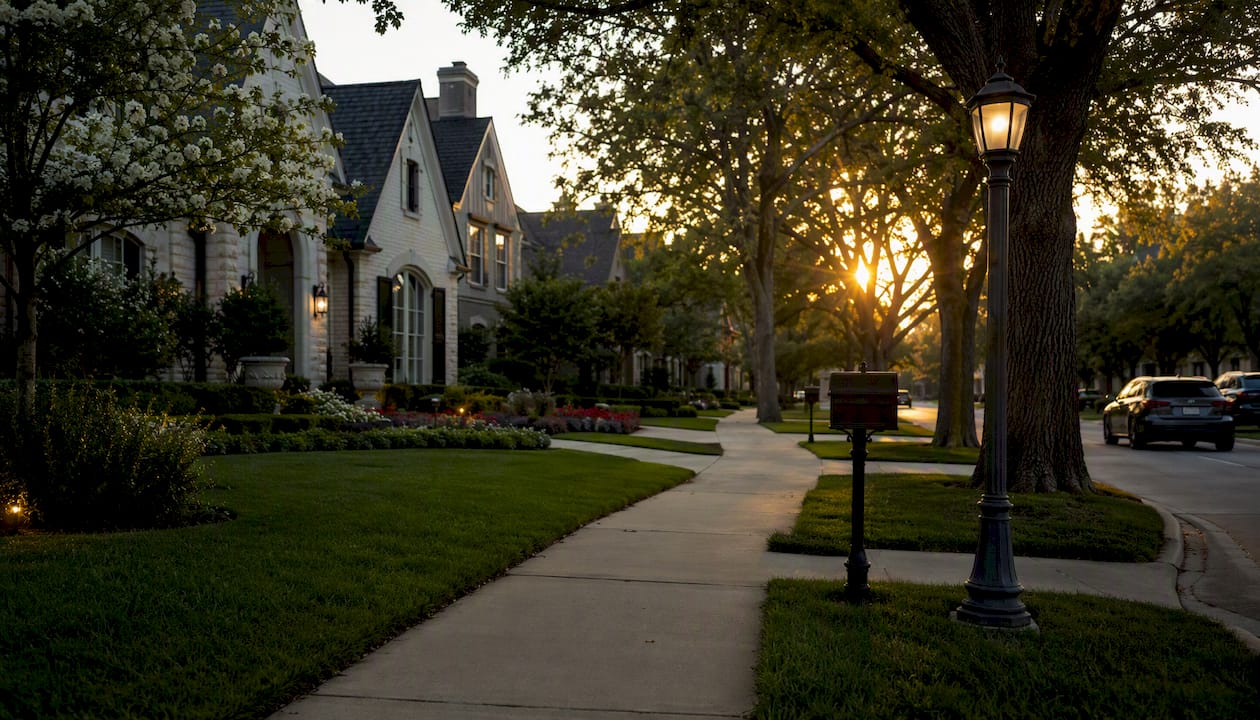
For most families and homebuyers, the top Plano neighborhoods break down quickly: West Plano (Legacy West, Willow Bend, Windhaven) for luxury and walkability, Lakeside on Preston and Deerfield for established family living, Kings Ridge/Kingsgate for value without sacrificing school quality, and Downtown Plano for buyers who want character and a shorter commute into Dallas.
Here is the shortlist at a glance:
- Legacy West / Legacy Town Center — best for young professionals and luxury buyers who want walkable dining, retail, and a short drive to major corporate campuses
- Willow Bend — best for families who want large lots, top-rated PISD schools, and proximity to the Shops at Willow Bend
- Lakeside on Preston — best for buyers who want a polished, master-planned feel with lake access and strong resale
- Deerfield — best for families prioritizing established tree-lined streets, mature lots, and consistent school quality
- Shoal Creek — best for luxury buyers who want gated privacy and a peer group that skews toward private schooling and high-maintenance expectations
- Kings Ridge / Kingsgate — best for move-up buyers and families who want good schools at a more accessible price point
- Windhaven — best for buyers who want newer construction and HOA-maintained common areas in West Plano
- Old Shepard Place — best for buyers who want character homes and a quieter, established neighborhood feel
- Downtown Plano — best for buyers who want walkability, arts, and a distinct sense of place
- East Plano — best for affordability seekers and investors who accept older housing stock in exchange for lower entry prices
U.S. Census Bureau QuickFacts places Plano among the larger cities in Collin County, with a population profile that skews toward owner-occupied housing and higher-than-average household incomes. Ballotpedia confirms the city spans both Collin and Denton counties and operates under a council-manager government structure. Those two facts matter for buyers: Plano’s tax base and school funding are relatively stable, and the city’s governance model tends to produce consistent municipal services across neighborhoods.
Key Takeaways
The strongest Plano neighborhoods for families combine verified PISD school assignments, established community infrastructure, and price shapes that support long-term resale.
| Point | Details |
|---|---|
| West Plano leads for families | Willow Bend, Lakeside, and Deerfield offer the strongest combination of PISD school quality and resale stability. |
| Verify school boundaries by address | PISD boundary lines do not follow subdivision lines; always confirm the specific address at pisd.edu before committing. |
| East Plano offers real affordability | Older housing stock and lower entry prices make East Plano a legitimate option for first-time buyers and investors. |
| HOA costs vary widely | Annual HOA fees range from a few hundred dollars in basic neighborhoods to several thousand in gated communities like Shoal Creek. |
| Kamilashayehomes guides the search | The team provides subdivision-level data, school verification, and TREC-informed contract guidance for Plano buyers. |
Table of Contents
- Which Plano neighborhoods are right for you?
- How East, Central, and West Plano differ for buyers
- How to choose a Plano neighborhood: a buyer’s checklist
- Plano housing market snapshot
- How do Plano ISD schools affect neighborhood choice?
- Getting around Plano: roads, commute times, and transit
- Safety, parks, and walkability across Plano neighborhoods
- Why people move into and out of Plano
- How to tour and lock in a neighborhood choice
- What does the homebuying timeline look like in Plano?
- Community events and neighborhood atmosphere in Plano
- What the data says about Plano neighborhoods
- Work with Kamilashayehomes to find your neighborhood fit
- Sources
- FAQ
Which Plano neighborhoods are right for you?
Legacy West / Legacy Town Center
Legacy West is Plano’s most recognizable address for a reason. The mixed-use district along the Dallas North Tollway puts residents within walking distance of Toyota’s North American headquarters, JPMorgan Chase’s regional campus, and a dense strip of restaurants, boutique retail, and hotel bars. Housing here skews toward luxury townhomes and high-rise condos, with prices starting at relatively high levels and climbing well past seven figures for larger units. PISD serves the area, though many residents in this corridor are young professionals without school-age children. Walkability is the highest in Plano by a significant margin.
Willow Bend
Willow Bend sits in the southwest corner of Plano and draws families who want space. Lots here run larger than the city average, homes tend to be traditional single-family builds from the 1990s and early 2000s, and the Shops at Willow Bend mall anchors the retail scene. Plano West Senior High School feeds from this area, and it carries a strong reputation within PISD. Prices typically range from the mid to high end of the market, depending on lot size and renovation status. HOA presence is common, and deed restrictions are enforced.
Lakeside on Preston
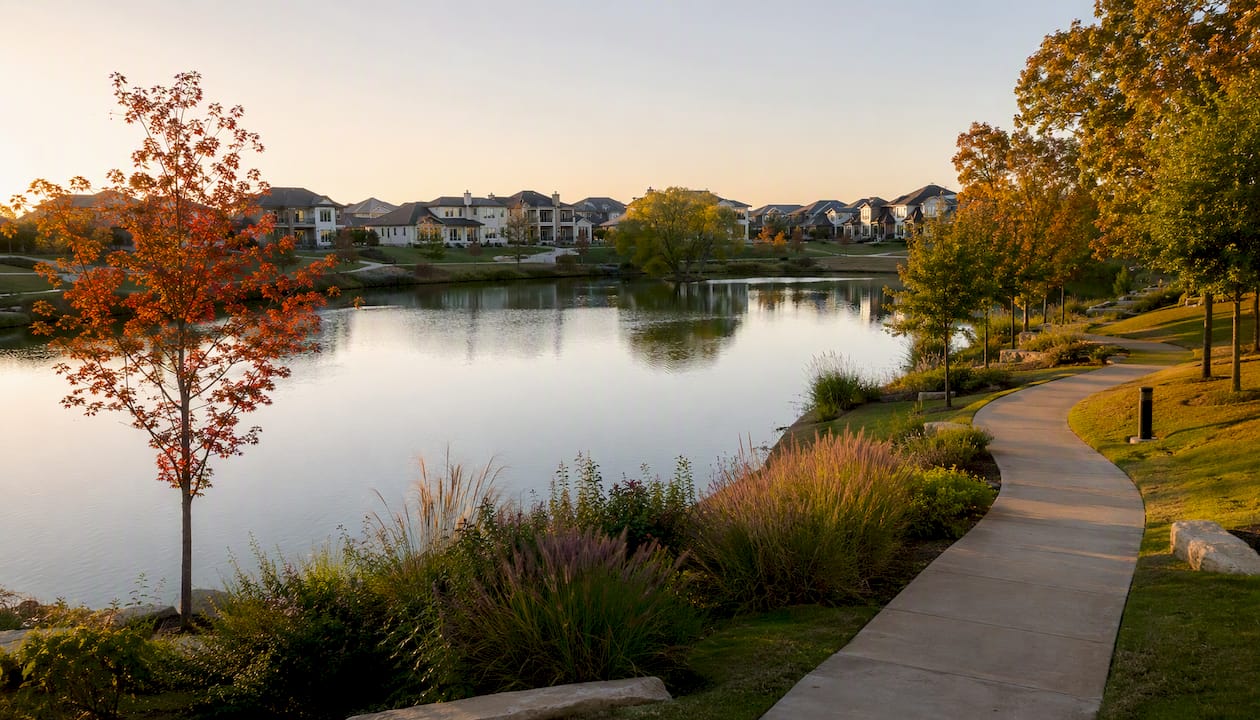
Lakeside on Preston delivers a master-planned feel that holds resale value well. The community wraps around a small lake, giving it a visual identity that most Plano subdivisions lack. Homes are predominantly large single-family builds, many with brick exteriors and mature landscaping. Buyers here tend to be families with children in elementary or middle school, drawn by the neighborhood’s reputation for safety and the quality of nearby PISD campuses. Price ranges typically run from the mid to high end of the market, reaching over one million dollars for the larger lakefront lots.
Deerfield
Deerfield is one of Plano’s most consistently recommended family neighborhoods, and the reason is simple: it has aged well. The streets are tree-lined, the lots are generous, and the homes, mostly built in the late 1980s and 1990s, have been well maintained. It feeds into strong PISD elementary and middle schools. Prices tend to sit in a moderately high price range. There is an active HOA, and the community has a reputation for organized neighborhood events that keep residents engaged.
Shoal Creek
Shoal Creek occupies a different tier. NeighborhoodScout’s profile notes that exclusive neighborhoods like this one attract buyers who weigh gated security, maintenance standards, and peer-group preferences, including private school enrollment, as heavily as price. Expect HOA fees that reflect the amenity level, disclosure expectations that differ from standard subdivisions, and a buyer pool that is less price-sensitive and more lifestyle-driven. Homes here are large, custom-built, and priced accordingly, often reaching into luxury price tiers.
Kings Ridge / Kingsgate
Kings Ridge and Kingsgate offer a practical middle ground. The homes are solid single-family builds, the PISD school assignments are good, and the price points, generally in the $400,000–$650,000 range, make them accessible to move-up buyers who have been priced out of Willow Bend or Lakeside. The neighborhoods are established enough to have mature trees and a settled feel, generally at more accessible price points compared to premium lakefront or gated areas.
Windhaven
Windhaven sits in West Plano near the Sam Rayburn Tollway and draws buyers who want newer construction with HOA-maintained common areas. The housing stock skews toward homes built in the 2000s and 2010s, and the community has a clean, well-kept appearance. It is a practical choice for families who want West Plano’s school quality and tollway access without paying Willow Bend prices.
Old Shepard Place
Old Shepard Place is a smaller, quieter neighborhood that often gets overlooked in favor of the bigger names. Homes here have more architectural variety than newer subdivisions, and the streets feel genuinely residential rather than planned. It appeals to buyers who want character and a neighborhood that does not feel like it was built from a template. Prices are generally more moderate compared to West Plano’s premium areas.
Downtown Plano
Downtown Plano has changed meaningfully over the past decade. The Arts District along 15th Street has brought independent restaurants, galleries, and a farmers market that runs seasonally. Housing includes renovated bungalows, new townhomes, and some loft-style units. It is the most walkable non-Legacy West area in the city, and it draws buyers who want a sense of place and a shorter drive into Dallas. School assignments vary, so boundary verification through PISD is especially important here.
East Plano
East Plano is the city’s affordability pocket. Housing stock is older, lots are smaller, and the retail environment is less polished than West Plano. But entry prices are meaningfully lower, and for investors or first-time buyers who want to get into Plano’s school district without a $600,000 price tag, it is worth a serious look. The tradeoff is commute patterns that can be more complex and a neighborhood character that varies block by block.
How East, Central, and West Plano differ for buyers
The east-to-west divide in Plano is real, and it shapes almost every decision a buyer makes.
West Plano is where the premium addresses cluster. Legacy West, Willow Bend, Shoal Creek, Lakeside on Preston, and Windhaven all sit west of U.S. 75. Housing is newer on average, lots are larger, HOA infrastructure is more developed, and PISD school assignments in this corridor are consistently strong. The tradeoff is price: West Plano is expensive, and the Dallas North Tollway and Sam Rayburn Tollway are the primary commute arteries, which means toll costs add up quickly.
Central Plano is where Deerfield, Kings Ridge, and Old Shepard Place sit. This corridor offers a balance of established neighborhoods, good school access, and prices that are slightly more forgiving than the far west. Preston Road is the main north-south spine here, and commute times into Dallas tend to be manageable outside of peak hours.
East Plano is the most affordable zone, with older housing stock and a more mixed retail environment. U.S. 75 (Central Expressway) runs through this corridor, which gives direct access to Dallas but also means traffic noise is a real factor near the highway.
- West Plano: luxury, newer homes, top PISD assignments, highest prices, toll-dependent commutes
- Central Plano: established neighborhoods, mid-range prices, Preston Road access, good school options
- East Plano: affordability, older stock, U.S. 75 access, more variable neighborhood character
Pro Tip: Before you commit to one side of the city, drive the actual commute from each area you are considering, at 7:30 AM on a Tuesday. The difference between a 20-minute and a 45-minute commute often comes down to which side of the Dallas North Tollway you are starting from.
How to choose a Plano neighborhood: a buyer’s checklist
Choosing between Plano neighborhoods is less about finding the “best” one and more about matching the right area to your specific situation. Work through this list before you tour.
- Confirm school boundaries first. Do not assume a neighborhood feeds into the school you want. Use the PISD boundary tool and verify the elementary, middle, and high school assignments for the specific address, not just the general area.
- Map your commute. Identify where you work, then test the drive from each neighborhood you are considering during actual peak hours. Plano’s tollway system can make a 10-mile commute feel very different depending on your starting point.
- Check lot size and housing type against your lifestyle. A patio home with a small yard is a different daily experience than a half-acre lot. Know which one you actually want before you fall in love with a price.
- Read the HOA documents. Request the CC&Rs and financials before making an offer. Some Plano HOAs have restrictions on parking, exterior modifications, and short-term rentals that surprise buyers after closing.
- Ask about recent sales in the exact subdivision. Neighborhood-level median prices can mask wide variation within a single zip code. Ask your agent for the last six months of closed sales in the specific subdivision, not the broader area.
- Research future development. Check the City of Plano’s planning and zoning notices for any approved or pending development near the neighborhood. A quiet street today can look very different in three years if a commercial corridor is planned nearby.
- Assess resale factors. School assignments, lot size, and proximity to major retail all influence resale. Neighborhoods with strong PISD elementary assignments tend to hold value better during market softening.
Red flags to watch for: long-term heavy traffic corridors that run through or adjacent to the neighborhood; ambiguous school boundary lines that could shift with the next PISD redistricting; HOA reserves that are underfunded relative to the community’s age and amenity level.
Pro Tip: Visit the neighborhood twice: once on a weekday morning to gauge traffic and school pickup patterns, and once on a Saturday afternoon to see how residents actually use the streets and common areas. The two visits often tell very different stories.
Plano housing market snapshot
Plano sits at the higher end of the Dallas-Fort Worth suburban price spectrum. U.S. Census Bureau QuickFacts provides city-level housing context, and DataUSA’s Plano profile adds 2024 owner-occupancy and employment data that help explain why demand has stayed relatively firm even as interest rates have risen.
| Housing type | Where you find it | Typical price shape |
|---|---|---|
| Large-lot single-family | Willow Bend, Deerfield, Lakeside, Shoal Creek | Upper $500s to $1M+ |
| Standard single-family | Kings Ridge, Windhaven, East Plano | Moderately high price range |
| Patio homes / smaller lots | Central and East Plano pockets | $300,000–$500,000 |
| Townhomes | Legacy West, Downtown Plano | $400,000–$750,000 |
| Luxury / custom builds | Shoal Creek, Lakeside lakefront | $900,000–$2M+ |
A few ownership-cost notes worth knowing before you tour:
- Property taxes in Collin County run higher than the national average. Texas has no state income tax, and property taxes are the primary mechanism for funding schools and local services. Budget accordingly.
- HOA fees vary widely. A basic neighborhood HOA might charge $400–$800 per year. A gated community with amenities can run $2,000–$5,000 or more annually.
- Market volatility: use price ranges as directional guidance, not guarantees. Prices in specific subdivisions can vary based on interest rates, inventory, and local demand. A local agent with access to current MLS data is the only reliable source for what a specific home is worth today.
How do Plano ISD schools affect neighborhood choice?
For families, school assignments are often the deciding factor, and Plano ISD has a strong overall reputation. PISD serves the majority of Plano neighborhoods and is the authoritative source for attendance boundaries, campus contacts, and program information.
A few things families consistently get wrong about school selection in Plano:
- Boundary lines do not follow subdivision lines. Two houses on the same street can feed into different elementary schools. Always verify the specific address using PISD’s boundary tool, not a general neighborhood description.
- Feeder patterns matter as much as the elementary school. A strong elementary school that feeds into a weaker middle school changes the calculus. Trace the full K-12 feeder pattern before committing to a neighborhood.
- Ratings shift. GreatSchools scores and state accountability ratings change year to year. Use them as a starting point, not a final answer. Campus visits and conversations with current parents give you information that no rating captures.
Steps worth taking before you make an offer:
- Contact PISD’s attendance zone team directly to confirm the assignment for the specific address
- Visit the campus during a school day, not just on an open house night
- Check extracurricular offerings, especially if your child has a specific sport, arts program, or academic interest
- Ask about any pending boundary reviews, since PISD does redistrict periodically
Families often pick neighborhoods based on elementary school fit and nearby parks rather than headline home style. That pattern holds in Plano too, and it influences resale: neighborhoods with strong elementary assignments tend to attract more competitive offers when inventory is tight.
Getting around Plano: roads, commute times, and transit
Plano is a car-dependent city. That is not a criticism; it is a planning reality that shapes where you live and how you spend your commute time. The major arteries that define neighborhood access are:
- U.S. 75 (Central Expressway): the primary north-south corridor through East and Central Plano, connecting directly to Dallas. Fast when traffic is light; miserable during peak hours.
- Dallas North Tollway: the western spine, running through Legacy West and connecting to Frisco to the north and downtown Dallas to the south. Toll costs add up, but the road moves.
- President George Bush Turnpike (SH 190): the east-west tollway that cuts across the southern edge of Plano, connecting U.S. 75 to the Dallas North Tollway and beyond.
- Sam Rayburn Tollway (SH 121): runs along the northern edge of Plano and connects West Plano to Frisco and the broader DFW airport corridor.
- Preston Road: the main non-toll north-south alternative through Central Plano. Slower than the tollways but useful for local trips.
DART (Dallas Area Rapid Transit) operates rail service in Plano, with stations at Downtown Plano, Parker Road, and Bush Turnpike on the Red Line. Rail is genuinely useful for commuters heading into downtown Dallas, but it does not serve most of Plano’s residential neighborhoods directly. Buyers who plan to use DART regularly should prioritize proximity to a station, which generally means Central or East Plano rather than the western suburbs.
Average commute times from Plano to downtown Dallas run roughly 25–45 minutes by car depending on the route and time of day. Commutes to Legacy West corporate campuses from within West Plano can be as short as 10 minutes. Commutes from East Plano to far-north Frisco employers can exceed an hour during peak hours.
Safety, parks, and walkability across Plano neighborhoods
Plano consistently ranks as one of the safer large cities in Texas. That said, safety is not uniform across all neighborhoods, and walkability varies dramatically depending on where you land.
Parks and green space by area:
- Arbor Hills Nature Preserve (West Plano): 200 acres of trails, one of the best urban nature areas in DFW
- Oak Point Park and Nature Preserve (Central/East Plano): large park with trails, sports fields, and a nature center
- Haggard Park (Downtown Plano): central green space adjacent to the Arts District, used for farmers markets and community events
- Bob Woodruff Park (East Plano): extensive trail system and lake access
Walkability hotspots: Legacy West and Downtown Plano are the two areas where you can realistically run errands or reach a restaurant on foot. Everywhere else in Plano, a car is the practical default.
Checking safety data: the City of Plano Police Department publishes crime statistics and neighborhood-level reports. For a specific address, cross-reference city crime data with the neighborhood’s block-level patterns, not just the city-wide average. Ask your agent whether the subdivision has a neighborhood watch program or active HOA security presence, since gated communities like Shoal Creek operate with a different baseline than open subdivisions.
For families, the practical safety questions are often less about crime statistics and more about traffic: sidewalk networks, crosswalk placement near schools, and traffic calming on residential streets. Walk the neighborhood during school pickup hours to see how it actually functions.
Why people move into and out of Plano
Plano’s growth story has been one of the most consistent in North Texas for three decades. The pull factors are well documented: a strong job market anchored by major corporate relocations (Toyota, JPMorgan Chase, Liberty Mutual, and others), top-tier public schools, and a retail and dining environment that rivals much larger cities.
The push factors are real too. DataUSA captures the employment and housing occupancy context that explains some of the pressure: Plano’s workforce skews toward high-income professional sectors, which has driven housing demand and prices upward over time. Traffic on U.S. 75 and the Dallas North Tollway during peak hours is a genuine quality-of-life issue for residents who commute daily. Rising housing costs have pushed some long-term residents toward neighboring cities like Allen, McKinney, and Frisco, where newer inventory is available at comparable or lower prices.
PlanoMagazine’s coverage of Texas redistricting highlights another factor buyers should track: boundary changes can affect neighborhood political representation and, indirectly, local services and school district governance over time.
Development trends worth watching:
- Continued densification around Legacy West and the Dallas North Tollway corridor
- Infill development in Downtown Plano and adjacent blocks
- Zoning changes along major commercial corridors that may affect residential character in adjacent neighborhoods
- PISD boundary reviews that periodically shift school assignments as population patterns shift
The net picture: Plano remains a strong destination for families and professionals, but buyers should go in with clear eyes about traffic, cost, and the pace of change in specific corridors.
How to tour and lock in a neighborhood choice
Once you have narrowed to two or three areas, the touring phase is where you gather the information no listing description provides.
Touring itinerary:
- Drive your actual commute route from each neighborhood at peak hours, not on a Saturday afternoon
- Visit the neighborhood on both a weekday morning and a weekend afternoon
- Walk to the nearest park, school, and grocery store to test the pedestrian experience
- Eat at a local restaurant and talk to people who live nearby
- Drive through the neighborhood after dark to assess lighting and street activity
Agent checklist for Plano buyers:
- Request the last six months of closed sales in the specific subdivision, not the zip code
- Ask for HOA documents including CC&Rs, meeting minutes, and reserve fund statements
- Confirm school boundary assignments for the specific address through PISD
- Review Texas disclosure requirements and standard TREC contract forms with your agent before making an offer
- Ask about any pending zoning or development applications near the property
- Understand the inspection and option period timeline under Texas contract law
Pro Tip: In Plano’s market, the negotiation window tends to open on homes that have been listed for more than 21 days. If a home in a desirable subdivision has sat longer than that, ask your agent to pull the showing history and price reduction timeline before you write an offer. That context often reveals more than the list price does.
Kamilashayehomes works with buyers across North Dallas communities and can pull subdivision-level sales data, verify school assignments, and walk you through TREC forms before you make an offer. For relocating families, including those moving from Canada or California, the team offers neighborhood-specific guidance that goes beyond what any online search delivers.
What does the homebuying timeline look like in Plano?
The Texas homebuying process has a specific rhythm, and Plano’s market conditions shape it further.
Pre-approval (1–2 weeks): Get a mortgage pre-approval before you tour seriously. Sellers in competitive Plano subdivisions expect buyers to come with financing confirmed, and some HOA-governed communities require proof of financing before allowing showings.
Neighborhood research and touring (2–6 weeks): This is where most buyers underestimate the time needed. Plano has dozens of distinct subdivisions, and narrowing from a list to two or three neighborhoods worth pursuing takes real legwork. Use this phase to verify school boundaries, test commutes, and review HOA documents.
Offer and option period (1–2 weeks): Under Texas contract law, buyers typically negotiate an option period during which they can terminate for any reason while paying a small option fee. Use this time for inspections and final HOA document review. TREC standard forms govern the contract structure.
Financing and closing (30–45 days): Texas closings typically run 30–45 days from executed contract to keys. Title companies handle the closing process in Texas, not attorneys, which is different from many other states.
Total timeline: most buyers who are pre-approved and focused on a specific area can close within 60–90 days of starting their search. Buyers who are still deciding between East and West Plano at the start of touring often extend that timeline significantly.
Community events and neighborhood atmosphere in Plano
Neighborhood atmosphere is harder to quantify than school ratings or median prices, but it is often what makes a buyer feel certain about a choice. Plano has a genuine community event calendar that varies meaningfully by area.
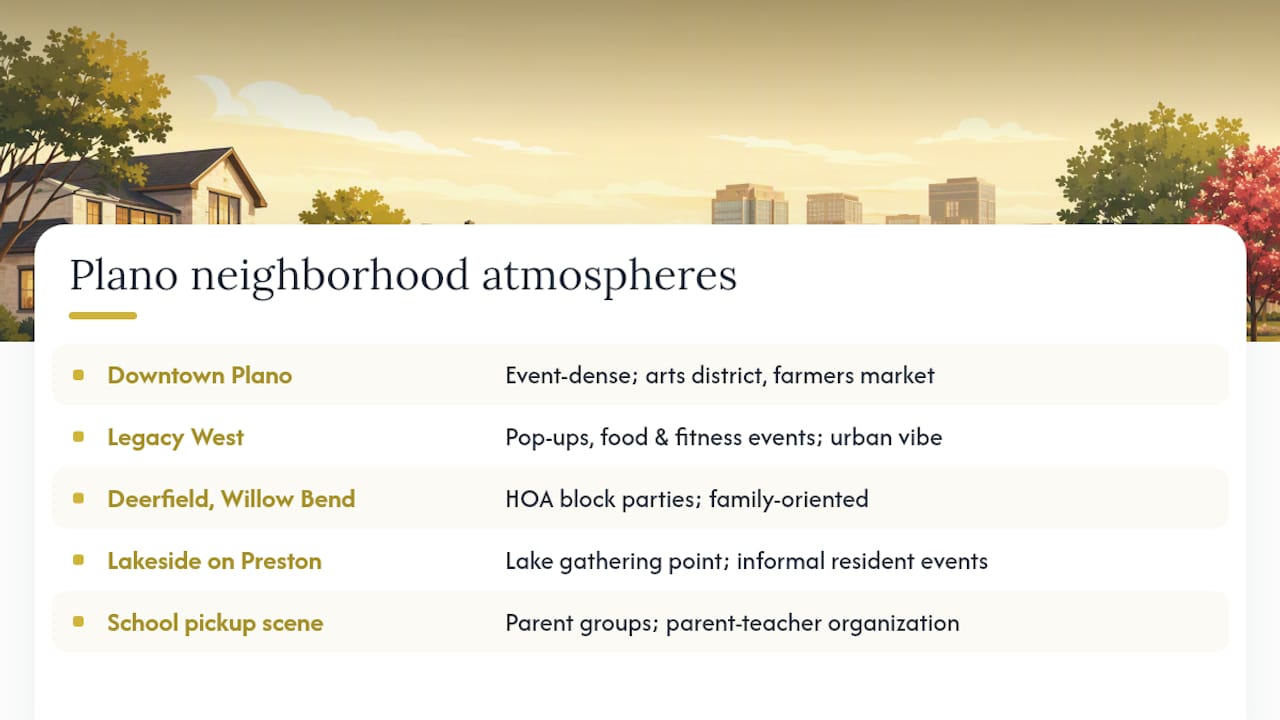
Downtown Plano is the most event-dense part of the city. The Plano Arts District hosts gallery walks, live music, and a seasonal farmers market at Haggard Park. The Historic Downtown Plano Association organizes events that draw residents from across the city, and the area has a walkable, small-town-within-a-city feel that is genuinely different from the suburban character of West Plano.
Legacy West hosts regular outdoor events, pop-up markets, and seasonal programming tied to its retail and restaurant tenants. The atmosphere skews younger and more urban, and the events reflect that: food festivals, fitness events, and brand activations are common.
Deerfield and Willow Bend neighborhoods tend to have HOA-organized block parties, holiday lighting events, and neighborhood watch programs that create a quieter, more family-oriented community feel. These are not neighborhoods where you stumble into a street festival; they are neighborhoods where you know your neighbors because the HOA creates the conditions for it.
Lakeside on Preston benefits from its physical setting: the lake creates a natural gathering point, and residents often organize informal events around it. The community has a cohesion that purely suburban subdivisions without a central amenity often lack.
For families evaluating neighborhood atmosphere, the most useful data point is often the school pickup scene. How parents interact at dismissal, whether there are organized parent groups, and how active the school’s parent-teacher organization is all signal the level of community investment in a neighborhood.
What the data says about Plano neighborhoods
Most buyers who end up in West Plano neighborhoods like Willow Bend or Lakeside on Preston made the decision based on school assignments first, then resale trajectory, then lifestyle fit. The price premium those neighborhoods carry is not arbitrary; it reflects sustained demand from buyers who have run the same calculus and reached the same conclusion.
What gets underweighted in most neighborhood searches is the feeder pattern. A family that buys in a neighborhood with a strong elementary school but a weaker middle school feeder often faces a difficult choice in five years: stay and accept the middle school, pay for private school, or sell and move. That decision is expensive in every direction. The buyers who avoid it are the ones who traced the full K-12 feeder pattern before they made an offer, not after.
The other thing most guides do not say plainly: East Plano is a legitimate choice for the right buyer. If you are a first-time buyer, an investor, or someone who does not have school-age children, the price difference between East and West Plano is real money. The neighborhood character is more variable, but the city’s infrastructure, parks, and safety record extend across the whole city, not just the premium western corridor.
Plano’s best neighborhoods are not the ones with the highest prices. They are the ones that match your actual life: your commute, your children’s school stage, your tolerance for HOA rules, and your honest assessment of how much yard you will actually use.
Work with Kamilashayehomes to find your neighborhood fit
Narrowing from a list of Plano neighborhoods to the one address where you actually want to live takes more than a map and a Zillow search. Kamilashayehomes brings subdivision-level sales data, school boundary verification, and hands-on touring support to buyers across North Dallas, including families relocating from Canada and California who need local context fast.
The team can pull recent closed sales in the specific subdivision you are considering, walk you through HOA documents before you make an offer, and help you time your search around Plano’s negotiation windows. Browse featured properties to see what is currently available in the neighborhoods covered here, or reach out directly to schedule a guided neighborhood tour with Kamila Shaye.
Sources
- U.S. Census Bureau QuickFacts: Plano city, Texas
- Pisd
- Plano, TX | Data USA
- Plano, Texas – Ballotpedia
- NeighborhoodScout — Shoal Creek
- PlanoMagazine — Texas redistricting maps and Plano
- Plano, TX voting — BestPlaces
- Trec
FAQ
What is the best area to live in Plano, Texas?
West Plano, particularly Willow Bend, Lakeside on Preston, and Deerfield, consistently ranks highest for families due to strong PISD school assignments, larger lots, and stable resale values. Young professionals often prefer Legacy West for its walkability and proximity to major corporate campuses.
What is the richest neighborhood in Plano?
Shoal Creek is widely considered Plano’s most exclusive neighborhood, with large custom homes, gated security, and a buyer profile that skews toward high-income households. NeighborhoodScout notes that buyers in neighborhoods like this one tend to prioritize privacy, maintenance standards, and private school access alongside price.
Is Plano a red or blue city?
Plano leans Republican at the local and county level, consistent with Collin County’s broader political profile, though the city has become more competitive in recent election cycles. BestPlaces provides current voting split data for buyers who want to understand the local civic climate.
Why are people moving out of Plano?
The primary reasons are rising housing costs, traffic congestion on U.S. 75 and the Dallas North Tollway, and the availability of newer inventory at comparable prices in neighboring cities like Frisco, McKinney, and Allen. Some long-term residents have also cited changing neighborhood character in corridors undergoing rapid densification.
How long does it take to buy a home in Plano?
Pre-approved buyers who are focused on a specific area typically close within 60–90 days of starting their search. The Texas option period runs 5–10 days for inspections, and closing typically takes 30–45 days from an executed contract under standard TREC forms.