

When multiple offers land on your listing, the right move is not to grab the highest number. Pick the offer with the strongest combination of net proceeds, financing certainty, and workable terms. That is the one most likely to close.
Before your next conversation with your agent, run these checks right now:
- Confirm every offer is complete. Missing signatures, blank contingency dates, or absent pre-approval letters disqualify an offer before you can fairly compare it.
- Verify proof of funds or financing strength. A pre-approval letter is not the same as a fully underwritten commitment. Ask your agent to call the buyer’s lender.
- Note critical dates. Closing timelines, inspection windows, and earnest money deadlines vary offer to offer and affect your net proceeds more than most sellers expect.
- Do not respond to any offer until your agent has presented all of them to you in writing. Responding piecemeal creates legal exposure and can accidentally create a binding contract.
Pro Tip: Ask your agent to build a side-by-side comparison spreadsheet before you discuss any single offer in detail. Seeing all offers on one page prevents anchoring on the first number you read.
Key Takeaways
Sellers who negotiate multiple offers successfully treat net proceeds and financing certainty as the two non-negotiable filters, and document every decision in writing from offer receipt through closing.
| Point | Details |
|---|---|
| Certainty beats headline price | Normalize every offer to net proceeds and verify financing before ranking by price. |
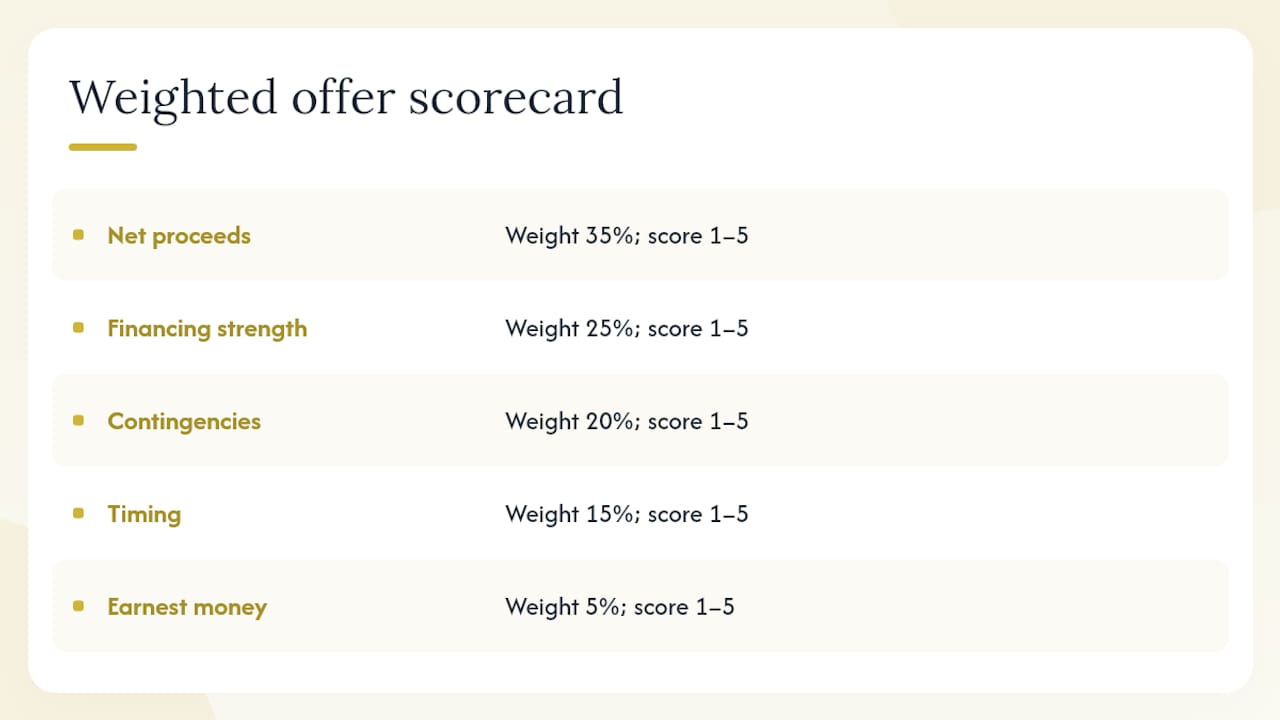
| Use a weighted scorecard | Assign weights across net proceeds, financing, contingencies, timing, and earnest money to rank offers objectively. |
| Know your four response options | Accept, call for highest-and-best, counter one while pausing others, or counter one while rejecting the rest. |
| Document everything in writing | Record all presentations, rejections, and counteroffers; never accept via text or informal email. |
| Kamilashayehomes | Provides comparative offer analysis, local lender verification, and full documentation for North Dallas sellers. |
Table of Contents
- What should you compare in every offer?
- How do you evaluate competing offers step by step?
- What are your four options when multiple offers arrive?
- How do you run a fair highest-and-best round?
- Which negotiation tactics actually improve your outcome?
- What legal and ethical pitfalls should you avoid?
- How does the North Dallas market change your decision?
- How we handle multiple offers to protect your interests
- Kamilashayehomes makes multiple-offer decisions clearer
- Sources
- FAQ
What should you compare in every offer?
Evaluating multiple offers means normalizing very different documents into a single comparable set of metrics. Headline price is the least reliable column.
Net proceeds, not list price
Seller concessions, repair credits, and closing-cost contributions all reduce what you actually walk away with. A $620,000 offer with $12,000 in concessions nets less than a $610,000 clean offer. Run the math on every bid before ranking.
Financing strength
Cash offers carry the least risk. Among financed offers, a fully underwritten approval (where the lender has already reviewed income, assets, and credit) is meaningfully stronger than a standard pre-approval letter. Confirm the lender’s name, call them, and ask whether the file has been through underwriting.
Contingencies
Inspection, appraisal, financing, and home-sale contingencies each add a window during which the buyer can exit. Fewer contingencies mean less exposure for you. An appraisal-gap guarantee, where the buyer commits in writing to cover any gap between the appraised value and the purchase price, removes one of the most common deal-killers in a rising market.

Earnest money
A larger earnest money deposit signals buyer commitment. In North Dallas, deposits are typically around 1%–2% of the purchase price. Requesting 2%–3% of the purchase price (or more) filters out buyers who are not fully committed.
Closing timeline and flexibility
Your preferred closing date matters. A buyer who matches your timeline without demanding a long inspection period is worth more than a buyer who offers $5,000 more but needs 60 days.
Inspection and repair terms
Some buyers waive inspection entirely; others cap repair requests at a dollar amount. Know what each offer actually obligates you to fix or credit before you rank it.
Pro Tip: Build a simple scorecard: assign weights to each dimension (e.g., net proceeds 35%, financing 25%, contingencies 20%, timing 15%, earnest money 5%) and score each offer 1–5 per category to help identify the best overall offer. The total score often surfaces the real winner faster than gut feel.*
How do you evaluate competing offers step by step?
A repeatable workflow prevents you from making a rushed decision under pressure. Here is the sequence your agent should walk you through.
- Collect all offers with a firm deadline. Set a cutoff time so you are not evaluating offers one at a time as they trickle in.
- Confirm completeness. Every offer needs a signed purchase agreement, proof of financing or funds, and all required addenda. Incomplete offers go back to the buyer’s agent with a request to complete, not into your ranking.
- Normalize to net proceeds. Subtract concessions, credits, and any seller-paid closing costs from each offer price. This is your real comparison number.
- Verify financing. Call or email each buyer’s lender. Ask: Is this file fully underwritten? What is the loan type? What is the down payment percentage?
- Check contingencies and timing. Flag any contingency that extends beyond your preferred closing date or that introduces a home-sale dependency.
- Score each offer. Use the weighted scorecard from the previous section.
- Choose your response strategy. Accept, counter, or call for highest-and-best based on how the scores cluster (see the next section).
| Dimension | Weight | What to look for |
|---|---|---|
| Net proceeds | 35% | Offer price minus all concessions and credits |
| Financing strength | 25% | Cash, fully underwritten, or standard pre-approval |
| Contingencies | 20% | Fewer and shorter windows; appraisal-gap guarantee |
| Closing timeline | 15% | Match to your preferred date; no home-sale dependency |
| Earnest money | 5% | Higher deposit signals commitment and liquidity |
[Escalation clauses, appraisal-gap guarantees, and proof of funds](https://www.effectiveagents.com/reso urces/multiple-offers-how-sellers-pick-the-strongest-buyer) help reveal which buyer can actually close at the price on paper. An escalation clause tells you a buyer’s ceiling; an appraisal-gap guarantee tells you they will not walk when the appraiser comes in low.
What are your four options when multiple offers arrive?
NAR outlines four primary seller responses to a multiple-offer situation. Each fits a different market condition and risk tolerance.
Accept the best offer outright
Use this when one offer is clearly superior across every dimension: price, financing, contingencies, and timing. Waiting for more bids when you already have a strong, clean offer risks losing that buyer to another listing. In a fast-moving North Dallas market, a strong offer today can evaporate by tomorrow morning.
Call for highest-and-best
Ask all buyers to submit their best terms by a set deadline. This works well when offers are clustered within a narrow price range and you want to surface true buyer ceilings. The NAR consumer guide notes the trade-off clearly: some buyers will improve their offers, but others will withdraw rather than compete in a second round. Read your market before choosing this path.
Counter one offer while pausing the others
Send a counteroffer to your top-ranked buyer and hold the other offers without formally rejecting them. This preserves your backup options if the counter falls through. The risk: buyers you have paused may accept other offers while they wait.
Counter one while rejecting the rest
This signals confidence and urgency to your chosen buyer. It also closes the door on alternatives. Use it only when your top offer is substantially stronger than the others and you are confident the counter will be accepted.
“Sellers have the right to choose which offer to accept, reject, or counter — and they are not obligated to disclose the existence of other offers to any buyer unless they choose to do so.”
NAR Code of Ethics and Arbitration Manual, Appendix IX
Pro Tip: Never counter more than one buyer simultaneously without a clear “subject to” clause. Countering two buyers at once without that protection can result in two accepted contracts on the same property, which is a legal and financial nightmare.
How do you run a fair highest-and-best round?
A highest-and-best round works best when it is structured, time-limited, and communicated clearly to all buyer agents at the same moment.
Checklist for running the round:
- Set a single deadline for all buyers (typically 24–48 hours from notice).
- State in writing what buyers must submit: revised purchase price, updated proof of financing or funds, and any improved terms.
- Specify whether escalation clauses are accepted or whether you require a flat best price.
- Require written confirmation from each buyer’s lender if financing terms have changed.
- Communicate the deadline to all buyer agents simultaneously, not sequentially.
On deadlines: a 24-hour window is standard in active markets. Shorter windows favor cash buyers who do not need lender coordination. If you want financed buyers to compete fairly, give them at least 36 hours. Late offers are at your discretion, but treating them inconsistently creates fairness exposure. Backup offers from buyers who do not win the round are worth keeping on file, especially in North Dallas where deals occasionally fall through during the inspection period.
Which negotiation tactics actually improve your outcome?
Concrete levers exist to increase both net proceeds and contract certainty. Not all of them are worth pressing in every situation.
Higher earnest money. Requesting 2%–3% of the purchase price (or more) filters out buyers who are not fully committed. A buyer who hesitates at a larger deposit is signaling uncertainty about their own financing or resolve.
Shortened contingency windows. A standard inspection period in Texas runs 10 days. Asking a buyer to shorten it to 5–7 days is reasonable in a competitive market and reduces your exposure window. Pushing below 5 days risks a buyer who rushes the inspection and then uses minor findings to renegotiate anyway.
Appraisal-gap commitments. In a market where homes are selling above appraised value, an appraisal-gap guarantee is one of the most valuable terms a buyer can offer. It means the buyer will cover the difference between the appraised value and the purchase price out of pocket, up to a stated cap. Without it, a low appraisal can force a price renegotiation or kill the deal.
Cash or fully underwritten financing. Financing and appraisal problems are common failure points in transactions that appeared solid on paper. A cash buyer eliminates both risks. A buyer with a fully underwritten approval eliminates the financing risk, though not the appraisal risk.
Post-closing rent-backs. If you need time after closing to move, a rent-back agreement lets you stay in the home for a set period after the sale closes. Buyers who offer this flexibility are worth a premium, especially if you are coordinating a simultaneous purchase. For complex leaseback arrangements, IREM’s transaction resources offer useful operational guidance.
| Risk factor | What it means for your deal |
|---|---|
| Standard pre-approval only | Lender has not reviewed full file; loan can be denied after contract |
| No appraisal-gap guarantee | Low appraisal triggers renegotiation or buyer exit |
| Home-sale contingency | Deal depends on buyer selling their current home first |
| Long inspection window | More time for buyer to find reasons to renegotiate or exit |
For luxury home negotiations, these levers carry even more weight because the pool of qualified buyers is smaller and the cost of a failed deal is higher.
What legal and ethical pitfalls should you avoid?
Multiple-offer situations create specific legal and ethical risks that sellers and agents must manage carefully.
Countering multiple buyers at once. Sending a counteroffer to more than one buyer simultaneously, without a “subject to seller’s acceptance” clause, can result in two binding contracts. This is one of the most avoidable and costly mistakes in a multiple-offer scenario. NAR risk-management guidance warns explicitly that a counteroffer constitutes a rejection of the original offer, and that email communication can, in some circumstances, create a binding acceptance.
Electronic acceptances. Responding “yes” or “accepted” to an offer via text or email may constitute a binding contract in some states, even without a formal signature. Always use your state-approved purchase agreement forms and execute acceptance through your agent with proper signatures.
“Document everything. Present all offers in writing, record rejections in writing, and keep copies of proof of funds and lender contacts for every offer you receive.”
NAR Code of Ethics and Arbitration Manual, Appendix IX
Disclosure of competing offers. NAR’s Appendix IX is clear: sellers decide whether to disclose the existence of other offers. Your agent must be honest if asked directly, but you are not required to reveal offer details, prices, or terms to competing buyers. Confirm your state’s specific rules with your broker or a real estate attorney.
Documentation checklist:
- Record the date and time each offer was presented to you, in writing.
- Keep signed rejection letters or written records of verbal rejections.
- Retain copies of all proof-of-funds letters and lender contacts.
- Have your broker review any counteroffer before it goes out.
- Consult a real estate attorney if any offer contains unusual terms, contingencies you do not recognize, or language that conflicts with your state’s standard forms.
How does the North Dallas market change your decision?
Sellers in Prosper, Frisco, and Celina operate in a market with specific dynamics that shift how you weight the scorecard.
New construction is a constant competitor. Buyers in these communities can often choose between a resale home and a builder contract, which means your pricing and terms need to justify the premium over a brand-new home with a builder warranty. A financed buyer who is also considering a new build may have less urgency than a buyer who has already lost out on several resale homes.
Appraisal trends in North Dallas have run tight in recent years. Homes in master-planned communities like Windsong Ranch and Light Farms often sell at or above appraised value during peak demand periods, which makes appraisal-gap guarantees especially valuable here. A buyer who offers $15,000 over asking without an appraisal-gap commitment may net you less than a buyer who offers $8,000 over asking with one.
School calendar timing matters. Listings that go active in late winter through early spring (February through April) attract the most buyer competition in North Dallas because families want to close before the school year ends. If you are listing during this window and receive multiple offers quickly, the market is telling you something: do not rush to accept the first strong offer before your deadline, but do not wait so long that serious buyers move on.
Locality-specific tactics:
- Work with local lenders (not just national online lenders) when evaluating financed offers. Local underwriters close faster and are more familiar with North Dallas appraisal comps.
- Stage for the community’s buyer profile. Prosper and Celina attract families; Frisco attracts corporate relocations. Staging that speaks to the likely buyer pool sustains bidding longer.
- Keep backup offers. In North Dallas, inspection-period exits happen. A signed backup offer from your second-ranked buyer protects you from going back to market.
A seller in Celina recently received three offers: $485,000 financed with a standard pre-approval, $478,000 financed with a fully underwritten approval and an appraisal-gap guarantee up to $10,000, and $470,000 cash. The $485,000 offer looked best on paper. After the agent called the lender, it turned out the file had not been through underwriting and the buyer’s debt-to-income ratio was borderline. The seller accepted the $478,000 fully underwritten offer. The deal closed on time with no renegotiation.
Pro Tip: Ask your agent to pull recent closed sales in your specific subdivision, not just your zip code. Appraisers use hyper-local comps, and knowing your true appraised ceiling helps you evaluate appraisal-gap offers accurately.
How we handle multiple offers to protect your interests
When a seller I work with receives multiple offers, the first thing I do is slow the process down by exactly one hour. That hour is spent confirming every offer is complete, calling lenders, and building the side-by-side comparison before we discuss a single number. Sellers who skip that step almost always anchor on the highest price and miss the offer that would have actually closed.
My process: present all offers to you in writing, normalize each to net proceeds, verify financing directly with the lender, and then walk you through the weighted scorecard together. Every rejection and counteroffer goes out in writing, reviewed at the broker level before it leaves my desk. I keep copies of all proof-of-funds letters and lender contacts on file through closing.
If the chosen deal falls through during the inspection period, a signed backup offer from your second-ranked buyer means you do not go back to market. I keep that backup active and in communication until the primary contract clears all contingencies. That is not standard practice everywhere, but in North Dallas it has saved more than one seller from a second listing cycle.
Kamilashayehomes makes multiple-offer decisions clearer
Sellers in Prosper, Frisco, and Celina who work with Kamilashayehomes get a structured offer-comparison process built into every listing, not as an add-on. Kamila Shaye brings direct experience with North Dallas appraisal patterns, local lender relationships, and the contract nuances that separate a deal that closes from one that falls apart at inspection.
Services include comparative offer analysis, local-market pricing, contingency and contract management, and full coordination with title, escrow, and lenders through closing. Every decision is documented, every rejection is in writing, and fiduciary duty to you runs through every step.
Request a free home valuation to see where your home stands in today’s North Dallas market, and get the pricing foundation you need before the first offer arrives.
Sources
- A Buyers’ and Sellers’ Guide to Multiple Offer Negotiations
- Evaluating multiple offers as a seller, beyond the headline price · Real Estate Field Guide
- Multiple Offers? How Sellers Pick the Strongest Buyer | EffectiveAgents®
FAQ
What does “highest and best” mean in a multiple-offer situation?
It is a request from the seller asking all competing buyers to submit their strongest price and terms by a set deadline. Sellers use it to surface true buyer ceilings when offers are clustered closely together, though some buyers may withdraw rather than re-bid.
Can a seller counter more than one buyer at the same time?
Technically yes, but only with a “subject to seller’s final acceptance” clause on each counteroffer. Without that protection, two buyers could accept simultaneously, creating two binding contracts on the same property.
Does a seller have to disclose how many offers they have received?
No. NAR guidance confirms that sellers control whether to disclose the existence of competing offers. Your agent must be honest if asked directly, but is not required to reveal offer prices, terms, or the number of bids.
What is an appraisal-gap guarantee and why does it matter in North Dallas?
It is a buyer’s written commitment to cover the difference between the appraised value and the purchase price, up to a stated cap. In North Dallas communities where homes frequently sell above appraised value, this guarantee removes one of the most common reasons deals fall apart after contract.
How quickly should a seller respond to multiple offers?
Fast enough to keep serious buyers engaged, but not so fast that you skip the verification steps. Setting a firm offer deadline (typically 24–48 hours from listing or from a highest-and-best notice) gives you time to compare offers properly without losing buyer interest.