

Your California equity can realistically buy you one of three things in North Dallas: a significantly larger home for roughly the same monthly payment you carry now, a smaller mortgage that frees up cash flow, or both at once if your equity is substantial. Dallas-area median home prices run significantly below comparable California markets, so the math tends to favor California sellers in a way that almost never works in reverse.
The smartest default path is sell-first. You walk away with clean liquidity, a lender who can underwrite your Texas purchase without contingencies, and no risk of carrying two mortgages across state lines. If timing forces a buy-first approach, a bridge loan or HELOC can work, but only after a lender models the full carrying cost and a tax professional reviews your California residency timeline.
One thing that catches California buyers off guard in 2026: Texas SB 1968 now requires a written buyer-representation agreement before any agent can show you a home or submit an offer on your behalf. You will sign paperwork at the first showing, not at closing.
- Sell-first: Cleanest path; converts equity to cash before you shop.
- Bridge loan or HELOC: Lets you buy before selling; requires strong equity documentation and lender approval.
- Cash-out refinance: Pulls equity from your California home while you still own it; adds a second monthly obligation.
- Carry two mortgages: Possible but lender-dependent; requires documented reserves.
Pro Tip: Before you list your California home, get a written pre-approval from a Texas lender who has experience with out-of-state relocators. They will model your full monthly payment, including property taxes, insurance, and HOA, so you know exactly what your equity buys before you make an offer.
Table of Contents
- What does your California equity actually buy in North Dallas?
- How much does your equity buy in Prosper, Frisco, and Celina?
- What are your financing options for converting California equity?
- What are the tax and residency traps for Californians moving to Texas?
- What does the full relocation timeline look like?
- How do you choose the right North Dallas agent for this transaction?
- What does Texas SB 1968 mean for your home search?
- Key Takeaways
- What most relocation guides get wrong about this move
- Kamilashayehomes makes the California-to-North Dallas move manageable
- Useful sources
- FAQ
What does your California equity actually buy in North Dallas?
The answer depends on which of three equity tiers you fall into, and each one opens a different set of doors in the North Dallas suburbs.
- Lower equity ($150K–$250K): Covers a 10–20% down payment on a $700K–$900K home in communities like Celina or McKinney. Your monthly payment may be similar to what you carry in California, but the home is typically larger and newer, often in a master-planned community with strong school ratings.
- Mid-level equity ($300K–$500K): Puts 20–30% down on a home in Frisco, Allen, or Prosper, reducing your mortgage meaningfully and giving you real school-district choice. This tier is where most California relocators land, and it tends to produce the best combination of buying power and monthly-payment relief.
- High equity ($600K+): Opens the door to near-cash or all-cash purchases in premium North Dallas neighborhoods, including Southlake and parts of Prosper. Some buyers in this tier carry little to no mortgage at all.
DFW has led U.S. metros in recent population growth, and lender norms here are well-suited to relocators. Most purchases fall within 2026 conforming loan limits, which keeps financing costs predictable.
Buying power snapshot: Dallas-area median home prices are roughly 40–55% below comparable California markets, meaning the same equity that barely covers a down payment in Los Angeles can eliminate a mortgage in Prosper.
How much does your equity buy in Prosper, Frisco, and Celina?
The table below translates three equity levels into illustrative North Dallas outcomes. Mortgage and monthly payment estimates include typical components like principal, interest, taxes, insurance, and HOA fees but are representative examples only.
Property taxes in Collin County typically run 1.8–2.2% of assessed value annually, which is a real line item. Lenders who model only principal and interest can underestimate your true monthly obligation by 30–40%, so always ask for a comprehensive payment projection that includes tax, insurance, and HOA assumptions before you commit to a price range.
Community notes worth knowing:
- Celina and Anna: Best value per square foot right now; large lots, newer builds, and strong growth trajectory. Good fit for $200K equity buyers who want space.
- Frisco and Allen: Established infrastructure, top-rated Frisco ISD schools, and a wide price range. Homes in A-rated Texas ISDs tend to sell faster and at a higher price per square foot, which builds equity faster for buyers who choose well.
- Prosper and Southlake: Premium communities with larger lots and higher price points. High-equity buyers often land here with minimal mortgage exposure.
Pro Tip: Ask your lender to run two scenarios side by side: one with your equity as a down payment on a $700K home, and one with a lower purchase price and the remaining equity in reserves. Sometimes a smaller mortgage with cash reserves is a stronger financial position than maxing your down payment.
What are your financing options for converting California equity?
Getting your California equity into a Texas closing requires choosing a path that fits your timeline, risk tolerance, and lender’s requirements. Each option has a different cost and risk profile.

Sell-first: the cleanest path
You sell your California home, receive net proceeds, and use them as a down payment in Texas. No bridge loan fees, no dual-mortgage risk, and your Texas lender underwrites you as a cash-down buyer with no contingencies. The downside is timing: you may need temporary housing between closings, and in a competitive North Dallas market, a delayed start can cost you the home you want.
Bridge loans and HELOCs
A bridge loan lets you borrow against your California home’s equity to fund a Texas down payment before you sell. A HELOC works similarly but draws from an existing line of credit. Lenders typically require proof of substantial equity and a current appraisal or broker price opinion on the California property to approve either product. These tools are useful in competitive markets where a contingent offer won’t win, but they add cost and complexity.
Cash-out refinance
You refinance your California mortgage and pull out equity as cash. This works if you have a low existing rate and significant equity, but it adds a second monthly payment and resets your California loan. Timing matters: if you plan to sell California within six months, the refinance costs may not pencil out.
Carrying two mortgages
Some buyers close on Texas first and sell California after. Lenders will require documented reserves, not just theoretical equity, to approve this. Underwriters often ask for a recent appraisal of the California property and proof you can service both payments simultaneously.
| Path | Speed | Cost | Risk | Best When |
|---|---|---|---|---|
| Sell-first | Moderate | Lowest | Lowest | You can time closings or tolerate temp housing |
| Bridge loan | Fast | Moderate (fees + interest) | Moderate | Competitive market, strong equity |
| HELOC | Fast if pre-approved | Low-moderate | Moderate | Existing HELOC in place |
| Cash-out refi | Moderate | Moderate (closing costs) | Moderate | Low existing rate, staying in CA briefly |
| Two mortgages | Flexible | Highest (dual payments) | Highest | Strong reserves, short California sale window |
Lender checklist for cross-state equity transactions:
- Recent appraisal or broker price opinion on your California home
- Proof of equity (mortgage statement, title report)
- Employment documentation and out-of-state income verification
- Reserve documentation (typically 2–6 months of payments on both properties)
- Pre-approval letter from a Texas lender familiar with relocator underwriting
Pro Tip: Work with a lender who has closed cross-state relocator transactions before. They know how to document out-of-state income and will not be surprised by the California property on your balance sheet. For North Dallas closing cost examples, Kamilashayehomes has a detailed breakdown that helps you budget accurately.
What are the tax and residency traps for Californians moving to Texas?
Texas has no state income tax, and that is a genuine financial benefit for high earners. But the savings are not automatic. California taxes California-source income and enforces residency rules aggressively; the Franchise Tax Board uses a totality-of-circumstances domicile test that looks at where your family lives, where you spend most of your time, and where your primary home is located.
California does not impose an “exit tax,” but it retains the right to tax income and gains tied to California property even after you move. If you sell your California home after relocating, the timing of that sale relative to your documented domicile change matters significantly.
Key tax and residency steps:
- Get a Texas driver’s license as soon as possible after closing. This is one of the FTB’s primary domicile indicators.
- Register to vote in Texas and update your bank accounts, investment accounts, and professional registrations to your Texas address.
- File the Texas homestead exemption promptly after closing. Missing the filing window forfeits your first year’s tax savings, so file as soon as you have your Texas driver’s license in hand.
- Document the timeline carefully. A rushed or thin paper trail around a California home sale is a frequent FTB audit trigger; staged documentation over several months is far stronger evidence than a single transaction date.
Residency note: The FTB’s domicile test is not a checklist you complete in a weekend. Relocators who change their driver’s license, voter registration, and bank accounts over a period of months, rather than all at once, build a much more defensible domicile record.
Most California homeowners qualify for the federal Section 121 exclusion ($250,000 for single filers, $500,000 for married couples) on gains from the sale of a primary residence, provided they meet the two-year ownership and use tests. Gains above those thresholds are taxable. Consult a tax professional familiar with California FTB rules before finalizing your sale and move timeline.
This article is general information, not tax or legal advice. Confirm your specific situation with a qualified tax professional and the California Franchise Tax Board.
What does the full relocation timeline look like?
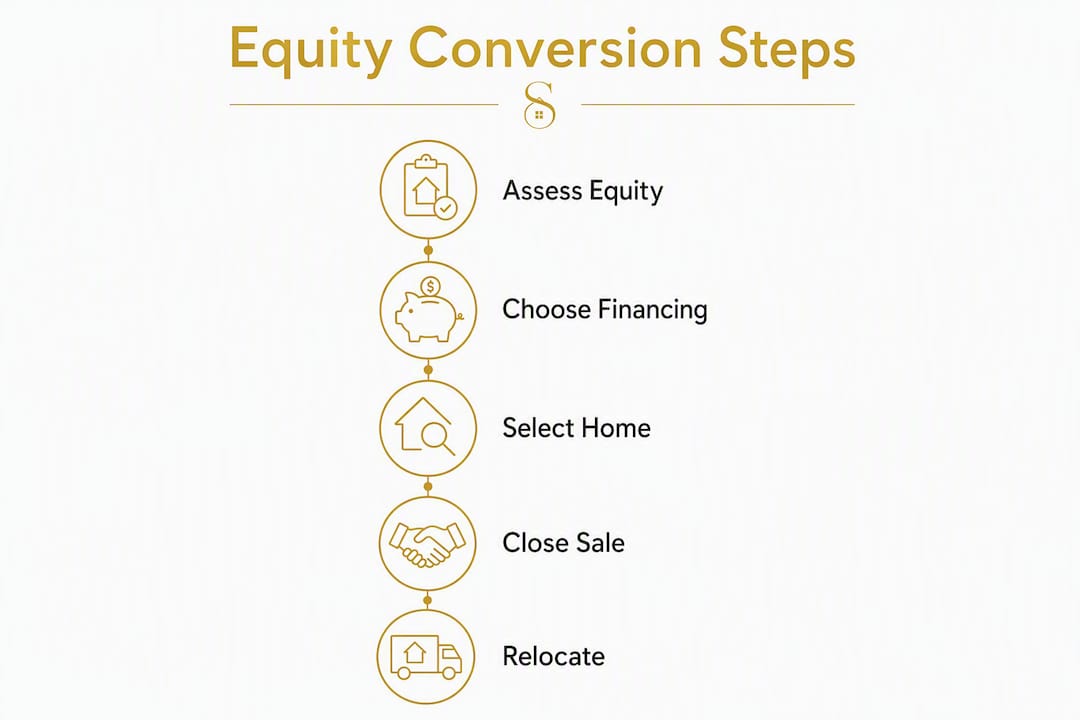
A well-coordinated California-to-North Dallas move typically takes four to six months from first valuation to Texas closing. Rushing any phase increases both financial and tax risk.
Sell-first timeline (recommended):
- Month 1: Get a California home valuation and a Texas lender pre-approval simultaneously. Identify your equity range and target price band in North Dallas.
- Month 1–2: List your California home. Begin touring North Dallas communities virtually or in person.
- Month 2–3: Accept a California offer. Negotiate a leaseback or extended closing to give yourself time to find a Texas home.
- Month 3–4: Make a Texas offer with your equity proceeds confirmed. Proceed through inspection, appraisal, and underwriting.
- Month 4–5: Close on Texas home. Move.
- Immediately after closing: File Texas homestead exemption, get Texas driver’s license, update voter registration, bank accounts, and professional registrations.
Buy-first timeline (bridge/HELOC):
- Month 1: Get California appraisal and bridge loan or HELOC approval. Confirm you can carry both payments.
- Month 1–2: Make a non-contingent Texas offer using bridge funds. Close on Texas home.
- Month 2–4: List and sell California home. Pay off bridge loan from proceeds.
Coordination checklist:
- School transfer records and enrollment documentation for Texas ISD
- Utility setup and service transfers (Texas providers differ from California)
- Documented domicile change timeline (driver’s license, voter registration, bank accounts)
- Texas homestead exemption filing (file after you have your Texas driver’s license)
- Moving company booking (8–12 weeks lead time recommended for cross-country moves)
For a neighborhood-level look at what this process looks like on the ground, the California to Light Farms relocation guide walks through community-specific logistics and local service vendors.
How do you choose the right North Dallas agent for this transaction?
Not every North Dallas agent has handled a cross-state equity transaction. The coordination required, California sale timing, bridge financing, domicile documentation, and Texas buyer-representation rules, is genuinely different from a local move-up purchase. The agent you choose should be able to speak to all of it.
Questions to ask before you hire:
- How many cross-state relocations have you closed in the past 12 months, and from which states?
- Do you have a lender network that includes bridge loan and HELOC specialists?
- Can you walk me through SB 1968 and what I’ll sign at my first showing?
- What communities do you know best, and can you show me comparable sales in Prosper, Frisco, or Celina?
- What does your post-close support look like for relocating families?
Red flags:
- Cannot explain the written buyer-representation agreement required under SB 1968
- No lender referrals for out-of-state buyers
- No examples of cross-state closings or relocator clients
- Vague on property tax estimates or HOA costs in target communities
Trust signals to look for:
- Specific transaction examples in your target communities (Frisco, Prosper, Celina, Southlake)
- A documented relocation process with a timeline and checklist
- Lender introductions before you need them, not after you’re under contract
- Familiarity with buyer agent duties under Texas brokerage rules and the 2026 representation changes
Pro Tip: Ask for a sample closing timeline from a recent cross-state transaction. An agent who has done this before will have one ready. An agent who hasn’t will struggle to produce it.
What does Texas SB 1968 mean for your home search?
Under Texas SB 1968, effective in 2026, no real estate agent can show you a residential property or submit an offer on your behalf without a written agreement in place first. This applies to every showing, including open houses where an agent is present.
The agreement must spell out three things: compensation terms, the duration of the representation, and the geographic scope of the arrangement. You are not locked into a permanent relationship, but you do need to sign before you walk through a door.
What to expect and do:
- Expect a short written agreement at your first showing or before your first offer.
- Read the compensation terms carefully. Ask what you owe if the seller does not offer buyer-agent compensation.
- Clarify the geographic scope. If you want to tour homes in both Frisco and Prosper, confirm both are covered.
- Discuss the agreement with your agent before your first tour so there are no surprises at the door.
- Refusing to sign prevents the showing. If you have concerns about the terms, address them before you arrive, not at the property.
2026 rule snapshot: SB 1968 applies to all residential property transactions in Texas. Written buyer-representation or showing-only agreements must disclose compensation, duration, and geographic scope before any showing or offer.
California buyers accustomed to more informal agent relationships sometimes push back on this step. It is not optional. The upside is that it forces a clear conversation about compensation and representation before you are emotionally invested in a specific home.
Key Takeaways
Using California equity to buy a North Dallas home works best when you sell first, document your domicile change carefully, and work with a lender and agent who understand cross-state transactions.
| Point | Details |
|---|---|
| Equity buying power | Dallas-area median home prices are roughly 40–55% below comparable California markets, giving most California sellers substantial purchasing power in North Dallas. |
| Sell-first is safest | Selling your California home before buying in Texas eliminates dual-mortgage risk and simplifies lender underwriting. |
| Model the full payment | Property taxes, insurance, and HOA can raise your monthly obligation by as much as 30–40% above principal and interest alone; always request a comprehensive payment projection. |
| Domicile documentation matters | California FTB audits target thin or rushed domicile changes; stage your documentation over months, not days, to build a defensible record. |
| Kamilashayehomes | Kamilashayehomes specializes in cross-state relocations to Prosper, Celina, Frisco, and surrounding communities, with a documented relocation process and lender network for California buyers. |
What most relocation guides get wrong about this move
The conventional advice for California-to-Texas relocators focuses almost entirely on the tax savings. Texas has no state income tax, the story goes, so you save immediately. That framing is incomplete in a way that costs people real money.
The tax benefit is real, but it is not automatic and it is not instant. California’s FTB does not release high-income earners the moment they cross the state line. The domicile test is a process, not a transaction. Relocators who rush the paperwork, change their driver’s license the week before closing and nothing else, often find themselves in an audit two years later when they sell their California home and the FTB argues they were still California residents at the time of the gain.
The second thing guides underestimate is the lender side of a cross-state equity transaction. Most mortgage content treats a down payment as a simple input: you have $400,000, you put it down, you borrow the rest. In reality, underwriters scrutinize the source of that equity, the California property’s current value, your ability to carry two mortgages if the timing slips, and your reserves. A lender who has not done this before will slow your transaction down at the worst possible moment.
What actually works is treating the move as a coordinated project with three parallel tracks: the California sale, the Texas purchase, and the domicile documentation. None of the three can be an afterthought. The families who execute this well start the lender conversation and the tax conversation at the same time they start the California valuation, not after they’ve already fallen in love with a house in Prosper.
Kamilashayehomes makes the California-to-North Dallas move manageable
Relocating from California and converting your equity into a North Dallas home is a multi-track transaction. Kamilashayehomes handles the Texas side of that equation with a process built specifically for out-of-state buyers. Kamila Shaye brings local expertise across Prosper, Celina, Frisco, Southlake, McKinney, and Allen, along with a lender network that understands cross-state underwriting and a documented relocation timeline that coordinates your California sale with your Texas closing.
From your first market valuation through to moving-day logistics, the team provides comparable sales, school-district guidance, and the kind of on-the-ground knowledge that makes a difference when you’re buying from 1,500 miles away. Browse featured properties in North Dallas to get a feel for what your equity buys right now, or schedule a consultation to map out your specific equity scenario, timeline, and target communities before you list in California.
Useful sources
- Texas Real Estate Commission (TREC) — SB 1968 buyer-representation changes: Primary source for the 2026 written buyer-representation requirement.
- TREC — Buying and Selling a Home in Texas: Overview of licensed agent requirements and standard contract forms in Texas.
- California Franchise Tax Board — Residency and domicile guidance (Publication 1031): Primary source for California’s totality-of-circumstances domicile test and California-source income rules.
- FTB domicile documentation and audit risk: Practical guidance on documentation steps and common audit triggers for California movers.
- California exit tax clarification: Addresses the “exit tax” misconception and redirects to domicile documentation priorities.
- Kamilashayehomes — North Dallas relocation guides and featured properties: Local market expertise, relocation process, and current listings for California buyers.
- Kamilashayehomes — North Dallas buyer closing cost examples: Detailed closing-cost breakdowns for 2025–2026 North Dallas transactions.
- Collin County Appraisal District: Property tax assessment data for Collin County communities including Prosper, Frisco, and Celina.
FAQ
Can a Californian buy a house in Texas?
Yes, there are no state residency requirements to purchase property in Texas. California homeowners can buy in North Dallas before, during, or after selling their California home, though financing options and tax implications vary depending on timing.
Is it a good time to buy a home in Dallas in 2026?
DFW remains one of the strongest relocation markets in the country, with population growth that has consistently supported home values. California buyers with substantial equity often find that North Dallas prices offer significantly more home for their money than comparable California markets.
What is the 3-3-3 rule for buying a house?
The 3-3-3 rule is not a standardized industry framework; definitions vary by source. A common version suggests spending no more than three times your annual income, putting 30% down, and keeping housing costs under 30% of monthly take-home pay. For California relocators, the more practical guide is a lender’s comprehensive payment projection that includes Texas property taxes, insurance, and HOA.
What is the hardest month to sell a house?
January and February are historically the slowest months for home sales nationally, with lower buyer activity and longer days on market. For California sellers targeting a spring Texas purchase, listing in late February or March tends to align with peak buyer demand on both ends of the move.
Do I have to sign paperwork before seeing homes in Texas?
Under SB 1968, effective in 2026, Texas agents must have a written buyer-representation agreement in place before showing any residential property or submitting an offer. Expect to sign a short agreement at your first showing that discloses compensation, duration, and geographic scope.