

A luxury home appraisal is a lender-ordered expert valuation tailored to high-value residential properties. It determines how much a lender will fund, directly shapes your negotiating position, and carries more judgment than a standard residential appraisal because comparable sales are scarce and unique features require documented justification.
Why it matters for you:
- Who orders it: The lender or an Appraisal Management Company (AMC) selects the appraiser. On cash deals, buyers can request a specialist directly.
- Typical timeline: Two to three weeks from order to final report, with on-site inspection running two to four hours for large homes.
- Three common outcomes: The appraisal matches the contract price (loan proceeds normally); it comes in low (creating a financing gap that may require renegotiation or cancellation); or it comes in above the contract price (buyer gains equity and no lender action is required).
- The core risk: A low appraisal on a high-value property can create a substantial financing gap overnight. Knowing how the process works is your best protection.
Table of Contents
- What makes a luxury appraisal different from a standard one?
- Step-by-step: the luxury home appraisal process from order to report
- Exactly what appraisers inspect on-site for luxury properties
- How appraisers value unique, high-end features
- How comparable sales work in luxury markets and what can go wrong
- What the appraisal report includes, the timeline, and what it costs
- How sellers and listing agents should prepare a luxury home for appraisal
- If the appraisal comes in low: step-by-step actions to take
- Expert insights and common appraisal red flags from industry research
- How to find and vet an appraiser qualified for luxury homes
- Key Takeaways
- What a skilled agent actually does during the appraisal process
- Kamilashayehomes helps North Dallas luxury clients get appraisals right
- Useful sources and further reading
- FAQ
What makes a luxury appraisal different from a standard one?
The difference is not just price. In appraisal terms, “luxury” typically means a property in the higher segment of its local market, defined by a combination of price, custom features, and lifestyle amenities rather than a fixed dollar threshold. A $900,000 home in Prosper, Texas qualifies as luxury; the same price tag in a rural county might not.
Three mechanics separate luxury appraisals from standard residential work:
- Data scarcity. Standard appraisals draw from numerous comparable sales. Luxury appraisals for high-value properties often rely on only a few comparables, which increases reliance on appraiser judgment and widens potential valuation variability.
- Larger, harder-to-justify adjustments. When a comp lacks a home theater or a resort-style pool, the appraiser must quantify that difference. The dollar amount is a judgment call, and lenders scrutinize it.
- Narrative weight. A luxury appraisal report is substantially longer and more descriptive. The appraiser must explain why each adjustment is appropriate, not just state the number.
Appraisers follow the Uniform Standards of Professional Appraisal Practice (USPAP) and lender guidelines, but those standards leave room for professional discretion. At the high end, that discretion is exercised constantly. A low appraisal often reflects appraiser unfamiliarity with the luxury micro-market rather than an overpriced property, which is exactly why specialist experience matters so much.
Pro Tip: Before the appraiser arrives, prepare a one-page property narrative listing unique features, estimated upgrade costs, and suggested comparable sales. Appraisers who understand why nuanced adjustments are appropriate produce more defensible reports.
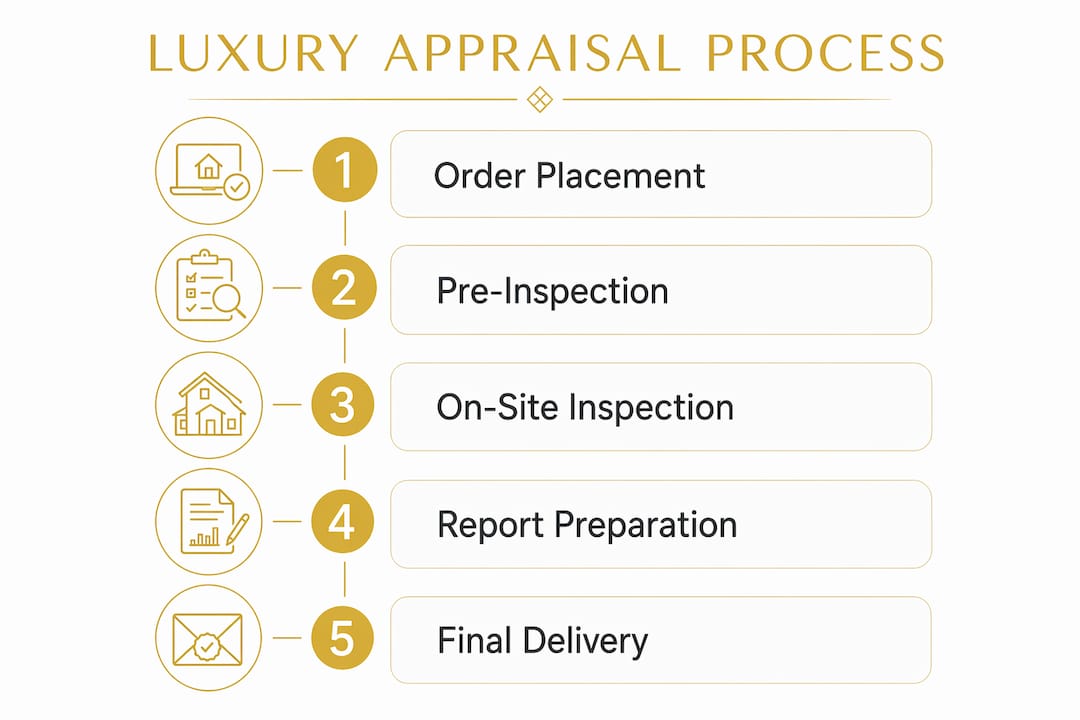
Step-by-step: the luxury home appraisal process from order to report
The process follows a predictable sequence, though the timeline stretches longer than most buyers expect.
- Order placement. The lender or AMC places the order and assigns an appraiser. On a financed deal, the buyer has limited say in who is selected. Cash buyers can request a luxury specialist directly.
- Pre-inspection research. The appraiser pulls public records, MLS history, prior transfers, and preliminary comparable sales before setting foot on the property.
- On-site inspection. The appraiser measures the home, documents finishes and systems, photographs every room, and verifies features against listing data and public records. For large luxury homes, this typically runs two to four hours.
- Data analysis. The sales comparison approach is primary. The cost approach and income approach are applied selectively (more on this in the next section).
- Report production. The appraiser writes the narrative, reconciles the valuation approaches, and delivers the report. Standard turnaround is 5–10 business days; complex luxury assignments commonly take 7–14 business days.
- Lender review. The underwriter reviews the report for compliance, adjustment logic, and comp quality before issuing a final lending decision.
Documents to prepare before the inspection:
- Builder specifications and floor plans
- Permits for additions, pools, or accessory structures
- Receipts for high-end finishes, appliances, and systems
- HOA documents and maintenance records
- Professional photos of features that photograph poorly (wine cellars, mechanical rooms, specialty lighting)
| Stage | Who Acts | Typical Duration |
|---|---|---|
| Order placement | Lender / AMC | 1–3 business days |
| Pre-inspection research | Appraiser | 1–3 business days |
| On-site inspection | Appraiser | 2–4 hours |
| Report production | Appraiser | 5–14 business days |
| Lender underwriting review | Underwriter | 3–5 business days |
| Total order-to-decision | All parties | 2–3 weeks |
Exactly what appraisers inspect on-site for luxury properties
The on-site inspection is where preparation pays off. Appraisers document far more than square footage.
Interior items:
- Gross living area (measured independently, not taken from tax records)
- Room counts and ceiling heights
- Kitchen finishes: countertops, cabinetry, appliances, and layout quality
- Primary suite features: size, closet systems, spa bath specifications
- Custom millwork, built-ins, and architectural details
- Smart-home systems, home automation, and integrated AV
- HVAC type, age, and zoning
- Wine cellars, home theaters, and specialty rooms
Exterior and site items:
- Lot size, topography, and usable acreage
- Views, privacy screening, and orientation
- Pool, spa, and outdoor kitchen specifications
- Guest houses, sport courts, and equestrian facilities
- Landscaping quality and irrigation systems
- Garage capacity and finish level
Accessory structures and specialty systems:
- Detached guest houses or casitas (appraised separately and added to the overall value)
- Solar panels and battery storage systems
- Generators and whole-home water filtration
Third-party specialists often play a role here. Appraisers for luxury homes frequently collaborate with custom home builders, architects, and engineers who can supply cost data and market context that make the report more defensible. If your home has unusual structural features or rare materials, having an architect’s letter or a builder’s cost breakdown ready can prevent an under-valuation.
Pro Tip: Lead the appraiser through the property yourself or have your agent do it. A short walk-through with a printed one-page feature summary and a photo packet ensures that custom details are visible, documented, and included in the report.

For a deeper look at which features carry the most weight with appraisers, the luxury home features guide on Kamilashayehomes covers the amenities that consistently move the needle in North Dallas markets.
How appraisers value unique, high-end features
Three approaches to value exist. Knowing when each applies helps you understand why the appraiser made the choices they did.
The sales comparison approach is primary for almost every luxury residential appraisal. The appraiser selects comparable sales, adjusts for differences, and reconciles the adjusted values into a final opinion. The challenge at the high end is that adjustments for custom features can run $50,000–$200,000 per line item, and each one needs documented justification.
The cost approach becomes relevant for proposed or custom-built homes, properties with rare materials, or situations where comparable sales simply do not exist. The appraiser estimates the land value separately, then adds the depreciated replacement cost of the improvements. Common pitfalls here include failing to read construction documents and using arbitrary cost assumptions rather than interviewing the builder for actual specifications and costs.
The income approach applies when the property has rental potential (a guest house with a separate entrance, for example) and when market participants would consider that income stream in their purchase decision.
How adjustments get justified matters as much as the dollar amount. Appraisers use paired-sales analysis: finding two sales that are identical except for the feature in question, then measuring the price difference. When paired sales are unavailable, the appraiser relies on market behavior evidence and a written narrative explaining why a buyer would pay a specific premium.
Lenders expect “market logic” behind large adjustments for unique amenities. Unexplained dollar-for-dollar adjustments invite underwriter challenges and possible funding delays.
Pro Tip: If your property has a feature with no direct comp support (a regulation tennis court, a recording studio), ask the appraiser early whether they plan to use the cost approach for that item. Having builder cost documentation ready can prevent a zero-dollar adjustment.
How comparable sales work in luxury markets and what can go wrong
Comp sourcing at the high end is genuinely harder than in standard markets, and the consequences of a weak comp set are proportionally larger.
Appraisers draw from MLS data, public record transfers, private off-market sales, and broker-reported transactions. Off-market sales are common in luxury markets, and appraisers without strong local relationships may miss many of them, leading to incomplete data. Differences of several hundred thousand dollars can occur between qualified appraisers on high-value properties when comparables are scarce. That variability is not a flaw in the system. It is an honest reflection of how much judgment is required when the data is thin.
Red flags in adjustment patterns to watch for:
- Comps that are more than 12 months old in a fast-moving market, with no written justification for using older data
- Geographic stretching: pulling comps from a different neighborhood or school district to fill the set
- Inconsistent feature accounting: a pool adds $40,000 in one comp and $0 in another, with no explanation
- Large unexplained dollar adjustments with no paired-sales support or narrative
- Missing interior photos or a report that describes finishes in generic terms (“good quality”) rather than specifics
In rapidly appreciating markets, using comps from 6–12 months ago may understate current value. Appraisers must use the most current market evidence and provide a clear written narrative linking those comparables to the subject property.
Your agent’s role here is concrete: compile the strongest available comps, including off-market sales, and present them to the appraiser before or during the inspection. An agent with access to broker-to-broker sales data in your micro-market can close the information gap that causes low appraisals. The Prosper vs. Frisco community comparison illustrates how micro-market premiums vary even within a short distance, which is exactly the kind of context a comp package should include.
What the appraisal report includes, the timeline, and what it costs
The final report is a substantial document covering site and floor measurements, neighborhood analysis, a full comparable sales grid with adjustments, a reconciliation of the valuation approaches, and a narrative explaining the appraiser’s reasoning.
Timeline breakdown:
- On-site inspection: typically a few hours for a large luxury home
- Standard report turnaround: about a week or more
- Complex luxury assignments may take longer
- Total order-to-report: typically a few weeks
Rush requests are possible but carry a fee premium. If your closing timeline is tight, build the appraisal order into your schedule before you need it.
Cost range: Luxury appraisal fees rise with assignment complexity rather than strictly with price. A complex luxury appraisal commonly ranges from $800 to $2,500+, with very large or complex estates exceeding that range. A standard single-family home appraisal typically runs $350–$550, so the premium for luxury work is real and worth budgeting.
| Fee Driver | Impact on Cost |
|---|---|
| Property size (sq ft) | Larger homes require more inspection and measurement time |
| Number of structures | Each accessory building adds scope |
| Comp scarcity | More research time increases fees |
| Rush turnaround | Typically adds an extra fee |
| Specialty consulting | Architect or engineer involvement billed separately |
When you receive a quote, ask specifically whether it includes an interior inspection, independent floor measurements, and any specialty consulting for unusual features. A low quote that excludes those items is not a bargain.
How sellers and listing agents should prepare a luxury home for appraisal
Preparation is not about staging for aesthetics. It is about making sure the appraiser can see, measure, and document every value-contributing feature without obstacles.
The day before the inspection:
- Unlock and clear access to all rooms, the attic hatch, basement, mechanical rooms, and every accessory structure.
- Turn on all systems: HVAC, pool equipment, smart-home panels, and specialty lighting.
- Photograph any feature that is hard to see during a standard walk-through (wine cellar, generator room, equipment storage).
- Assemble your document packet: builder specs, permits, upgrade receipts, HOA documents, and floor plans.
- Prepare a one-page “value highlights” sheet listing major upgrades with estimated costs and dates, plus two or three comparable sales that support the asking price.
Agent responsibilities:
- Compile off-market and broker-reported comparable sales the appraiser may not find independently
- Provide neighborhood context: school district premiums, community amenities, and recent market trends
- Coordinate the inspection for daylight hours so exterior features, views, and landscaping photograph accurately
- Be present or have a knowledgeable representative available to answer questions
Pro Tip: The “value highlights” sheet is not a sales pitch. Frame it as factual documentation: “Primary suite renovation completed March 2024, $185,000 contractor cost.” Appraisers respond to documented facts, not marketing language.
If the appraisal comes in low: step-by-step actions to take
A low appraisal is not the end of the deal. It is a decision point with several viable paths.
- Review the report immediately. Check for factual errors: wrong square footage, missing rooms, incorrect feature descriptions, or comps from the wrong neighborhood.
- Assess your contract options. Most purchase contracts include an appraisal contingency. Confirm the deadline for exercising it before taking any other action.
- Choose your path: The buyer pays the difference in cash, the parties renegotiate the price, or the buyer cancels under the contingency.
- File a Reconsideration of Value (ROV). A structured ROV package with off-market comps, documented report errors, corrected measurements, and market data postdating the appraiser’s comparables is the most effective challenge tool. Submit it through the lender, not directly to the appraiser.
- Request a second appraisal. If the ROV is denied and the gap is large, ask the lender whether a second appraisal is permitted. Some lenders allow it; others do not.
- Consult a luxury appraisal specialist or legal counsel for complex disputes involving significant dollar amounts or alleged USPAP violations.
A well-assembled ROV package is not an argument. It is additional evidence. Present it as factual documentation with sourced data, and let the numbers make the case.
What to include in an ROV package:
- Two to three comparable sales the original appraiser did not use, with a brief explanation of why each is relevant
- Documented factual errors (wrong room count, incorrect square footage) with supporting evidence
- Builder cost documentation for features the appraiser adjusted at zero or below market
- A concise cover letter (one page) addressed to the lender’s underwriting department
Pro Tip: Keep the ROV cover letter under one page. Underwriters read dozens of these. A tight, factual package with three strong comps and one documented error is more persuasive than a ten-page argument.
For negotiation tactics when an appraisal creates a financing gap, the luxury home negotiation strategies guide on Kamilashayehomes covers the specific language and sequencing that works in high-value transactions.
Expert insights and common appraisal red flags from industry research
The most consistent finding across appraisal industry guidance is that common red flags include inappropriate comparables, excessive unexplained adjustments, inconsistencies with public records, missing or poor-quality interior photos, and a lack of narrative explaining valuation logic. These are not rare edge cases. They appear regularly in luxury appraisals where the appraiser lacks local market depth.
Market timing is underappreciated as a risk factor. In fast-appreciating markets, comps older than six to twelve months can meaningfully understate current value. Appraisers must justify using older sales in writing, and buyers or sellers who notice a report leaning on stale data have a legitimate basis for an ROV.
Lender scrutiny is real and specific. Underwriters are trained to flag large adjustments without market-logic support. An appraiser who adds $200,000 for a custom pool without citing paired-sales evidence or a cost approach will draw a challenge from the underwriting desk, which delays funding regardless of whether the adjustment is ultimately correct.
The most effective defense against a weak appraisal is preparation before the inspection, not a challenge after the fact. Curated ROV packages with off-market sales, documented errors, and builder cost documentation are the strongest tools available after the report is issued, but they work best when the appraiser already has good documentation to work from.
Pro Tip: Retain or consult a luxury appraisal specialist early when transaction value, custom features, or data scarcity make outcomes uncertain. The cost of a specialist consultation is trivial compared to a $200,000 financing gap.
How to find and vet an appraiser qualified for luxury homes
Not every licensed appraiser is equipped for luxury work. The credential gap matters.
Credentials to look for:
- State-certified general or residential appraiser license (required for federally related transactions)
- MAI designation from the Appraisal Institute (commercial and complex residential)
- SRA designation from the Appraisal Institute (residential specialty)
- Documented experience with luxury assignments in the same micro-market, not just the same metro area
How to verify experience:
- Ask for examples of recent luxury appraisals completed in your specific neighborhood or price tier.
- Request redacted sample report excerpts to evaluate narrative quality and adjustment documentation.
- Ask for references from lenders or brokers who have closed luxury transactions with this appraiser.
- Confirm their familiarity with off-market comp sources in your area.
Sample interview questions:
- “How do you source comparables when MLS data is thin?”
- “Can you walk me through how you justified a large adjustment in a recent report?”
- “Have you used the cost approach for custom-built homes in this price range?”
- “What is your typical turnaround for a complex luxury assignment?”
When a property has unusual structural features, rare materials, or significant custom construction, involving third-party specialists is worth the cost. Appraisers frequently collaborate with architects, builders, and engineers whose documentation strengthens the report’s defensibility against underwriter challenges.
Pro Tip: On a cash transaction, you control the appraiser selection entirely. Use that leverage. Hire someone with a verifiable track record in your specific price tier and neighborhood, not just a general residential appraiser who happens to be available.
Key Takeaways
The luxury home appraisal process is a lender-driven, judgment-intensive valuation that requires specialist experience, thorough documentation, and a prepared response plan when results come in below expectations.
| Point | Details |
|---|---|
| Comp scarcity drives variability | Two qualified appraisers can differ significantly on a multimillion-dollar property when comparables are scarce. |
| Preparation changes outcomes | A one-page property narrative with upgrade costs and suggested comps helps appraisers justify accurate adjustments. |
| Low appraisal response | File a structured ROV with off-market comps, documented errors, and builder cost data through the lender. |
| Fees reflect complexity | Luxury appraisal fees commonly range from $800 to $2,500+; budget accordingly and confirm what the quote includes. |
| Kamilashayehomes | Kamilashayehomes provides comp research, appraisal-prep packages, and ROV support for luxury buyers and sellers in North Dallas. |
What a skilled agent actually does during the appraisal process
Most buyers and sellers think the agent’s job ends when the contract is signed. In a luxury transaction, that is where the appraisal work begins.

The practical tasks are specific: compiling off-market and broker-reported comparable sales the appraiser may not find independently; preparing a property narrative that explains why nuanced adjustments are appropriate; coordinating inspection access during daylight hours; and assembling an ROV package when the report comes in short. None of these are passive. They require local market knowledge, relationships with other brokers, and familiarity with how underwriters evaluate adjustment logic.
The cases where agent intervention changes an outcome are not dramatic. They are quiet. An appraiser who receives a well-organized document packet with three strong comps and a one-page feature summary produces a better report than one who walks through an empty house with no context. That difference rarely makes headlines, but it shows up in the final number.
Local market knowledge is the variable that matters most. An agent with deep access to off-market data in Prosper, Frisco, or Southlake can close the information gap that causes low appraisals in the first place. That is the work Kamilashayehomes does on every luxury transaction in North Dallas.
Kamilashayehomes helps North Dallas luxury clients get appraisals right
When a luxury appraisal creates a financing gap or a seller needs to prepare for inspection, the difference between a smooth closing and a stalled deal often comes down to preparation and local data. Kamilashayehomes works with luxury buyers and sellers across Prosper, Frisco, Celina, Southlake, and surrounding North Dallas communities to build the comp packages, property narratives, and ROV documentation that support accurate valuations.
Kamila Shaye brings direct experience with high-value transactions, access to off-market sales data, and a hands-on approach to appraisal prep that most buyers and sellers never get from a standard agent relationship. Whether you are preparing a home for market or responding to a low appraisal, the process is clearer with someone who knows the micro-market.
Request a home valuation or browse current luxury listings to see how Kamilashayehomes positions properties in the North Dallas luxury market.
Useful sources and further reading
Official standards and industry guidance:
- Uniform Standards of Professional Appraisal Practice (USPAP) — the governing standards for all U.S. appraisers
- Appraisal Institute — MAI Designation — credential for complex and commercial appraisal work
- Appraisal Institute — SRA Designation — credential for residential appraisal specialists
- Texas Real Estate Commission (TREC) — Texas-specific appraisal and consumer protection guidance
Research and practical guides:
- Luxury Home Appraisal Guide — Own Luxury Homes® — comp scarcity, variability, and ROV guidance
- Atlanta Luxury Home Appraisal Guide — The Luxury Realtor Group — market timing and specialist experience
- What Lenders Look for in an Appraisal Report — Advanced Appraisals — red flags and underwriter expectations
- 4 Common Pitfalls in Appraising Proposed New Luxury Homes — Appraisal Buzz — custom construction documentation
- Luxury Appraisal Fee Factors — Wondermapped — cost drivers and fee ranges
- Appraisal for Luxury Homes — Appalachian Appraisal Services — third-party specialist collaboration
Kamilashayehomes internal resources:
- Luxury Home Features Explained — which amenities carry the most appraisal weight
- Luxury Home Negotiation Strategies — handling a financing gap after a low appraisal
- Buy a Luxury Home in Prosper, Texas — local market context for North Dallas buyers
- Home Valuation — request a local agent valuation or appraisal-prep consult
FAQ
What is a red flag on a luxury home appraisal?
Common red flags include inappropriate or geographically stretched comparables, large adjustments with no narrative justification, inconsistencies between the report and public records, and missing interior photos. Lenders flag these because they signal the appraiser may not have sufficient local market knowledge.
What will fail a luxury home appraisal?
No single item automatically “fails” a luxury appraisal, but unresolved safety issues (missing handrails, exposed wiring, non-functional systems), significant deferred maintenance, and unpermitted additions can trigger “subject to repair” conditions that delay or reduce funding until corrected.
Do appraisers always go inside a luxury home?
For a standard purchase mortgage backed by Fannie Mae or Freddie Mac, a full interior inspection is almost always required. Exterior-only and desktop appraisals exist but are typically reserved for lower-risk refinances with substantial equity, not high-value purchases.
Do luxury appraisals usually match the asking price?
Not always. Because luxury appraisals rely on 3–5 comparables rather than a larger data set, the appraiser’s judgment carries more weight and outcomes vary more widely. Two qualified appraisers can differ by $150,000–$300,000 on a $3M property when comparables are scarce, making a match with the asking price possible but far from certain.
How long does a luxury home appraisal take?
The on-site inspection typically runs two to four hours for a large luxury home. The full report takes 5–10 business days for standard assignments and 7–14 business days for complex luxury properties, putting the total order-to-report timeline at roughly two to three weeks.