

A simultaneous closing (SIMO) is two back-to-back real estate transactions where an investor buys and immediately resells the same property, often using the end-buyer’s funds to close both legs at the same time. The three parties are A (the original seller), B (the investor or wholesaler), and C (the end buyer). Both legs close on the same day, sometimes within minutes of each other.
Here is the practical bottom line for each party:
- Sellers (A): Get a fast, clean close without knowing what B earns on the resale.
- Investors (B): Pocket the spread between the A-to-B and B-to-C prices without needing to hold the property or disclose their profit.
- End buyers ©: Purchase directly from B as a standard transaction, often unaware of A’s original price.
- Funding: In a true SIMO, C’s funds flow through escrow to close both legs. When that is not permitted, the investor needs transactional funding or cash.
Table of Contents
- What is simultaneous closing in real estate, exactly?
- How does simultaneous closing work, step by step?
- Who benefits from a simultaneous closing?
- Simultaneous closing vs. double closing vs. assignment
- What are the biggest risks of a simultaneous closing?
- What does a simultaneous closing cost, and how long does it take?
- How to proceed: the checklist before you attempt a SIMO
- A worked example: cash flows, fees, and net profit
- Key Takeaways
- The part most guides skip about simultaneous closings
- Navigating a same-day closing in North Dallas? Kamilashayehomes handles the coordination
- Useful sources
- FAQ
What is simultaneous closing in real estate, exactly?
The industry uses several terms interchangeably: simultaneous closing, SIMO, back-to-back closing, and sometimes double closing. They are related but not identical. In a true SIMO, both the A-to-B deed and the B-to-C deed are prepared, signed, and recorded on the same day, with the title company coordinating fund flow so that C’s purchase money effectively pays A.
Each leg is a complete, independent transaction. B takes actual legal title, even if only for a matter of minutes. Two separate deeds are recorded, and two separate settlement statements (HUD-1s or Closing Disclosures) are prepared. That brief ownership period is what distinguishes a SIMO from a contract assignment, where B never takes title at all.
The terminology gets slippery because different title companies and markets use “simultaneous close” and “double close” to mean the same thing, or to mean slightly different things depending on where the A-to-B funding comes from. The cleaner distinction: a SIMO uses C’s funds to close both legs; a double close uses separate investor funds or transactional funding for the A-to-B leg.
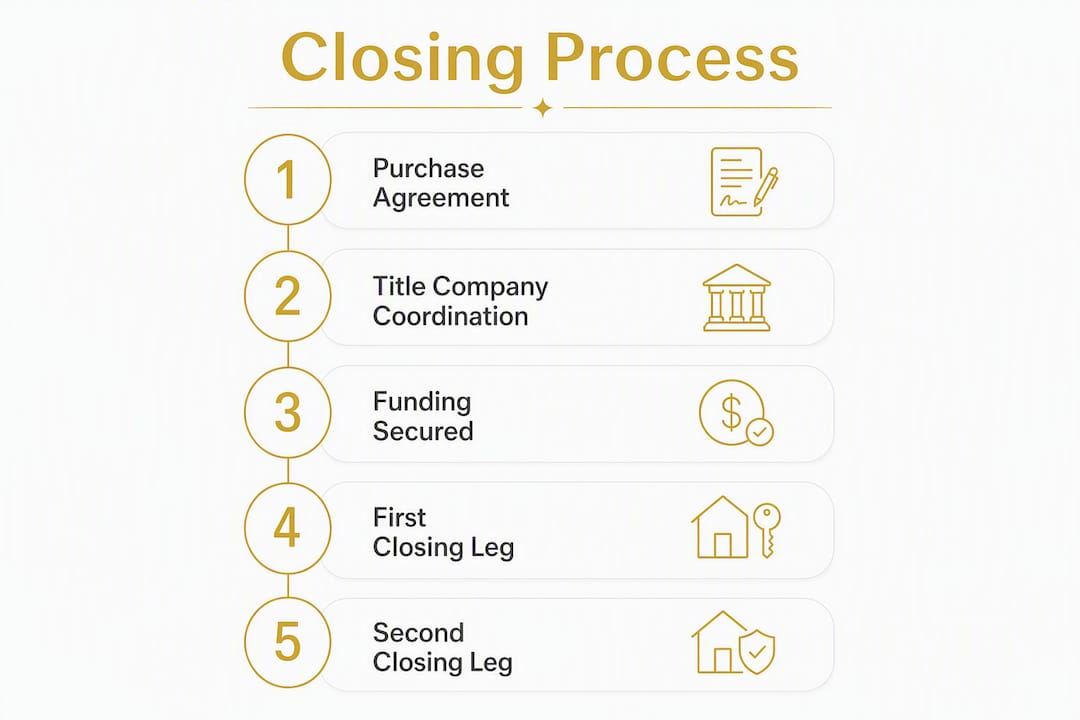
How does simultaneous closing work, step by step?
The entire sequence can happen in a single afternoon. Here is the operational order:
- Both closings are scheduled at the same title company on the same day. The title company prepares two deeds, two settlement statements, and two sets of closing documents.
- A and B sign the A-to-B closing documents first. The deed from A to B is executed, and the settlement statement for that leg is finalized.
- B and C sign the B-to-C closing documents. This happens immediately after, sometimes in the same room, sometimes in a separate session.
- Funds are released from escrow. In a true SIMO, C’s purchase funds are used to pay A through escrow. The title company controls disbursement order so A is paid, any transactional lender is repaid, and B receives the net profit.
- Deeds are recorded in sequence. The A-to-B deed records first, then the B-to-C deed. Recording order matters: B cannot convey title to C before B legally holds it.
- Form 1099-S is filed for each transfer. The closing agent reports both conveyances separately to the IRS.
The critical variable is funding. When C’s lender funds the A-to-B leg, title insurers often prohibit it outright. If the title company will not allow C’s funds to pay A directly, the investor needs transactional funding wired in before the A-to-B leg closes.
Who benefits from a simultaneous closing?
The primary draw is privacy. Simultaneous closing keeps the investor’s profit private because A never sees C’s purchase price and C never sees A’s original price. For wholesalers working on thin margins or large spreads, that privacy is worth a lot.
Beyond privacy, SIMO serves three distinct groups:
Investors and wholesalers use it to exit quickly without holding costs, property taxes, or insurance. When a deal closes and reopens the same day, carrying costs are essentially zero.
Sellers who need a fast, certain close benefit because B is typically a cash buyer or has transactional funding lined up. There is no financing contingency on the A-to-B leg.
End buyers get a clean title purchase from B, often at a price that reflects market value, without the complexity of buying distressed property directly from A.
Where SIMO usually breaks down: when C is using FHA or VA financing. FHA seasoning rules require the seller to have held title for at least 90 days before resale in most cases, which makes a same-day flip impossible. Strict title company policies are the other common blocker.
Simultaneous closing vs. double closing vs. assignment
These three methods solve the same core problem for wholesalers and investors, but they differ on funding, privacy, cost, and how easily a title company will cooperate.

| Feature | Simultaneous closing (SIMO) | Double closing | Contract assignment |
|---|---|---|---|
| A-to-B funding source | C’s purchase funds (through escrow) | Investor cash or transactional funding | N/A — B never takes title |
| Investor provides separate funds? | No (or minimal) | Yes | No |
| Profit privacy | High — two separate settlement statements | High — two separate settlement statements | Low — profit visible on one settlement statement |
| Title company acceptance | Harder to find; many refuse | More widely accepted | Widely accepted; subject to assignment restrictions |
| Two sets of closing fees? | Yes | Yes | No |
| FHA/VA buyer compatible? | No (seasoning rules) | No (seasoning rules) | Sometimes, if contract allows |
| Best use case | Investor with no cash, large spread, privacy needed | Investor with access to transactional funding, title company won’t do SIMO | Small spread, simple deal, no assignment restriction in contract |
A few points worth highlighting:
- Many active wholesalers default to double closing because it is easier to execute, even though it costs more upfront.
- Contract assignment is the cheapest and simplest method but exposes the investor’s profit margin on the closing disclosure.
- Assignment is blocked when the purchase contract contains a no-assignment clause, which is common with bank-owned properties and some MLS listings.
What are the biggest risks of a simultaneous closing?
The risks are real and specific. Understanding them before you commit to a SIMO can save a deal, or save you from a very expensive mistake.
Title company and lender reluctance
Title companies frequently refuse to perform true simultaneous closings because of fraud and fund-control concerns. Title insurers often require that the A-to-B purchase be funded independently of B-to-C proceeds. When a title company discovers the plan mid-process, the deal can collapse days before closing.
The domino effect
The biggest operational risk for coordinated same-day closings is the domino effect: a delay or failure in one leg cascades into the other. If C’s lender pulls funding at the last minute, B may be left holding a property financed by transactional funding that must be repaid immediately. Contingency clauses help but may not undo a funded A-to-B closing once disbursements have occurred.
FHA and VA seasoning rules
FHA seasoning requirements effectively block SIMO when C is using FHA financing. The 90-day hold requirement means B must own the property for three months before C can purchase with an FHA loan. VA loans carry similar restrictions. If you discover C’s financing type late, the deal structure needs to change entirely.
Tax and reporting consequences
The closing agent files Form 1099-S for each conveyance separately. Investors owe taxes on net profit after both sets of closing costs and any applicable transfer taxes. States with transfer taxes (like Texas’s deed recording fees) charge per conveyance, so two legs means two charges.
The single biggest practical barrier is not the contract — it is finding a title company willing to execute the transaction. Many investors spend weeks negotiating a deal only to discover their preferred title company will not touch a SIMO. Identify an investor-friendly title company before you put a property under contract.
Pro Tip: Ask the title company one specific question before you sign anything: “Will you allow B-to-C funds to close the A-to-B leg in the same escrow?” A yes or no answer tells you immediately whether a true SIMO is possible or whether you need transactional funding.
What does a simultaneous closing cost, and how long does it take?
Cost is where investors most often miscalculate. A SIMO involves two complete closings, which means two of everything.
- Two title searches (one per leg)
- Two sets of closing/escrow fees
- Two recording fees (deed recording per conveyance)
- Two transfer taxes in states that charge them
- Transactional funding fee if the investor cannot use C’s funds directly
Transactional funding is a short-term loan wired to cover the A-to-B purchase. The lender is repaid from B-to-C proceeds, often within 24 hours. Fees vary by lender and deal size. On a $200,000 A-to-B purchase, even a modest transactional funding fee can meaningfully reduce the investor’s net spread.
The timeline on closing day is typically a few hours, not days. Both signings happen sequentially, deeds record in order, and funds disburse the same afternoon. The preparation work, confirming title company cooperation, lender approval, and document preparation, takes days or weeks beforehand.
Investors frequently underestimate the cumulative effect of two sets of closing fees when pricing a wholesale spread. A deal that looks like a $25,000 profit can shrink to $18,000 after double closing costs and transactional funding.
For local North Dallas buyers and sellers, closing cost expectations vary by transaction type and should be modeled before committing to a SIMO structure.
How to proceed: the checklist before you attempt a SIMO
Before scheduling anything, work through these steps in order:
- Confirm the title company’s policy. Ask directly: “Do you perform simultaneous closings where B-to-C funds close the A-to-B leg?” Get the answer in writing.
- Identify C’s financing type. FHA or VA financing means SIMO is almost certainly off the table. Confirm this before negotiating the deal structure.
- Arrange transactional funding as a backup. Even if the title company says yes to a true SIMO, have a transactional lender identified in case the policy changes or the title insurer objects.
- Review the purchase contract for assignment restrictions. If the A-to-B contract prohibits assignment, that is fine for a SIMO, but confirm B can close independently.
- Build contingency language into both contracts. The B-to-C contract should include a contingency that protects B if C fails to fund. Experienced agents help structure contingency language that reduces cascading risk.
- Coordinate all parties on timeline. A, B, C, both lenders (if any), and the title company all need to be aligned on the same closing date and time window.
- Confirm 1099-S and transfer tax obligations. Know your tax exposure on both legs before you finalize the deal.
- Know your exit if SIMO fails. If the title company refuses at the last minute, can you pivot to a double close or assignment? Have that conversation with your agent before closing day.
For structuring competitive offers and contingency language in North Dallas specifically, the market’s pace makes pre-closing coordination especially important.
A worked example: cash flows, fees, and net profit
Here is a simple numeric example showing how a SIMO plays out financially.
| Item | A-to-B leg | B-to-C leg |
|---|---|---|
| Purchase / sale price | The investor buys from A at an agreed price | The investor sells to C at a higher negotiated price |
| Title search fee | Typical title search fees for each leg | Typical title search fees for each leg |
| Closing / escrow fee | Settlement or escrow fees for each leg | Settlement or escrow fees for each leg |
| Recording fee | Recording fees per deed recording | Recording fees per deed recording |
| Transactional funding fee | If needed, short-term loan fees for A-to-B leg | — |
| Total costs per leg | Estimated combined costs per transaction leg | Estimated combined costs per transaction leg |
| Gross spread | The potential difference between purchase and resale prices | |
| Total closing costs (both legs) | Estimated total closing costs for both legs combined | |
| Net investor profit | Estimated profit after deducting all costs |
Form 1099-S is filed for both the $150,000 conveyance and the $185,000 conveyance. B reports income on the net profit of $31,200 after both sets of costs. Transfer taxes, where applicable, are charged on each conveyance separately.
Now consider the FHA scenario: if C switches to an FHA loan after the A-to-B contract is signed, the SIMO is blocked. B now holds title and must wait the FHA seasoning period (typically 90 days) before C can purchase. That converts a same-day flip into a short-term hold, adding carrying costs, insurance, and property taxes to B’s expense column.
Key Takeaways
A simultaneous closing works only when the title company cooperates, C’s financing is conventional or cash, and the investor has transactional funding ready as a backup.
| Point | Details |
|---|---|
| Title company is the gating factor | Confirm the title company’s SIMO policy before signing any contract. |
| FHA/VA financing blocks SIMO | Seasoning rules (typically 90 days for FHA) make same-day flips impossible with government-backed loans. |
| Two closings mean double fees | Budget for two title searches, two escrow fees, two recording fees, and any transactional funding cost. |
| Domino effect is the top operational risk | If C fails to fund, B may be left holding a property with transactional debt due immediately. |
| Kamilashayehomes coordinates the details | For North Dallas buyers and sellers, Kamilashayehomes manages lender, title, and timing to reduce same-day closing risk. |
The part most guides skip about simultaneous closings
The conversation around SIMO almost always centers on the investor’s profit and the mechanics of fund flow. What gets less attention is how often the deal structure is decided too late.
Most investors identify the title company question as a paperwork step, something to sort out after the deal is under contract. That is backwards. The title company’s policy is the constraint that determines which structure is even available. A SIMO, a double close, and an assignment are not interchangeable options you choose from at the end. They are paths with different prerequisites, and the title company’s answer narrows the field immediately.
The domino effect risk is similarly underweighted, particularly for homeowners doing a coordinated buy-sell rather than investors. A seller who needs to close on their new home the same day they sell their current one is running a SIMO in spirit, even if no wholesaler is involved. Pre-qualification is not the same as lender commitment. One underwriting hiccup at 2 PM can unwind two closings, two moving trucks, and two families’ plans.
The practical lesson: treat the title company conversation and full lender vetting as prerequisites, not follow-ups. The investors and homeowners who navigate same-day closings without incident are the ones who had those conversations three weeks before closing day, not the morning of.
Navigating a same-day closing in North Dallas? Kamilashayehomes handles the coordination
Tightly timed closings in Prosper, Frisco, Celina, and surrounding communities require more than a willing title company. They require an agent who has already had the hard conversations with lenders and escrow officers before the clock starts.
Kamilashayehomes coordinates directly with title companies, lenders, and all parties to confirm feasibility, structure contingency language, and keep every leg of a same-day transaction on track. Whether you are a seller who needs to close and move in one day, a buyer whose purchase depends on a concurrent sale, or an investor structuring a wholesale deal, the process is cleaner when someone is managing the timeline from the start.
Request a consultation or home valuation to talk through your specific situation, or browse featured North Dallas properties currently available in the communities Kamilashayehomes serves.
Useful sources
These resources offer deeper legal, mechanical, and practitioner-level guidance on simultaneous closings and related structures:
- How a simultaneous closing works in real estate — LegalClarity: Best for legal mechanics, title insurer rules, FHA seasoning, and 1099-S obligations.
- Double closing — Wikipedia: Explains the double-close structure, funding rationale, and how it differs from a true SIMO.
- Double close and simultaneous close — Best Transactional Funding: Step-by-step disbursement order and transactional funding mechanics.
FAQ
Is a simultaneous closing the same as a double closing?
Not exactly. A true SIMO uses the end-buyer’s funds to close both legs in the same escrow; a double closing uses separate investor funds or transactional funding for the A-to-B leg. Both involve two deeds and two settlement statements, but the funding source is different.
Can a house fall through on closing day?
Yes. If the end buyer’s financing fails or they back out, the investor may be left holding a property with transactional debt due immediately. Contingency clauses reduce this risk but cannot always reverse a closing once funds have disbursed.
Do buyers and sellers attend the same closing in a SIMO?
Not necessarily. A and B sign the first set of documents, then B and C sign the second set. They may be in the same building at different times, or the title company may schedule them separately. A and C rarely meet.
What kills a simultaneous closing before it starts?
Two things stop most SIMOs: the title company refusing to allow B-to-C funds to close the A-to-B leg, and the end buyer using FHA or VA financing, which triggers seasoning rules that prevent an immediate resale.
What questions should I ask my title company before a SIMO?
Ask: “Will you allow the end-buyer’s funds to close the A-to-B leg in the same escrow?” and “What recording order and disbursement controls will you require?” Their answers determine whether a true SIMO is possible or whether you need transactional funding.