

Frisco, Texas has become one of the most deliberate relocation decisions California tech families make, and the reasons stack up fast. No state income tax, a SaaS corridor reporting hundreds of operators with strong year-over-year growth, Frisco Independent School District schools that consistently earn top state ratings, and housing prices that make Bay Area math look surreal. If you are a tech professional in California weighing your next move, Frisco is not a compromise. It is a calculated upgrade on several fronts simultaneously.
The short version:
- Jobs: The Dallas–Fort Worth region ranks as a top North American tech hub, and Frisco sits at the center of its fastest-growing employment corridor.
- Taxes: Texas has no state income tax. A California tech salary earning $200,000 keeps thousands more per year the moment you change your residency.
- Schools: Frisco ISD is one of the highest-rated large districts in Texas, a real differentiator for families with school-age children.
- First step: Run a side-by-side after-tax income and housing-cost comparison, then request a live market snapshot from a local agent who works specifically with relocating families.
Table of Contents
- Why California tech families are choosing Frisco for jobs
- How does Frisco compare to California on taxes and cost of living?
- What makes Frisco genuinely livable for families?
- What does the Frisco housing market look like for buyers?
- What should you evaluate before committing to the move?
- How do you actually execute the move from California to Frisco?
- What is the Frisco market actually doing right now?
- Key Takeaways
- What relocating California families should actually expect
- Kamilashayehomes makes your Frisco relocation straightforward
- Useful sources for your research
- FAQ
Why California tech families are choosing Frisco for jobs
The job-market case for Frisco is not just about one employer or one campus. Professional, Scientific, and Technical Services is the leading employment sector for Frisco residents, with computer and mathematical occupations among the strongest individual categories. That concentration matters: it means the professional network you build here is relevant to your career, not incidental to it.
The SaaS corridor anchored along the Dallas North Tollway and the Sam Rayburn Tollway has grown into something genuinely unusual for a suburban market. Over 280 operators now work within the corridor, with a 28% year-over-year growth rate and more than $1.2 billion in annualized SaaS revenue. Operator density runs 2.4 times the national metro average. For a product manager, a solutions engineer, or a B2B sales leader coming out of San Francisco or Los Angeles, that density translates directly into options.
The Frisco Economic Development Corporation has been the engine behind much of this. FEDC runs a proactive, multi-year corporate attraction strategy that targets campus-scale employers and aligns workforce development with incoming demand. This is not passive growth. Local reporting documents roughly 70 companies establishing or expanding operations, creating or retaining thousands of jobs over a three-year span, alongside a 24% reduction in the labor shed. For tech professionals considering why Frisco attracts corporate relocations, that pipeline of incoming employers is the story.
Remote and hybrid workers benefit too. Many California-based tech companies with Texas operations allow employees to relocate without changing employers. Frisco’s infrastructure, fiber connectivity, and proximity to DFW International Airport make it practical for roles that require occasional travel to headquarters.
How does Frisco compare to California on taxes and cost of living?
Texas has no state income tax. Full stop. For a household earning $200,000 in California, the state income tax bill alone can exceed $15,000 annually, depending on filing status and deductions. Moving to Texas does not change your federal obligation, but it eliminates that state layer entirely. That is money that can go toward a mortgage, college savings, or simply staying in your account.
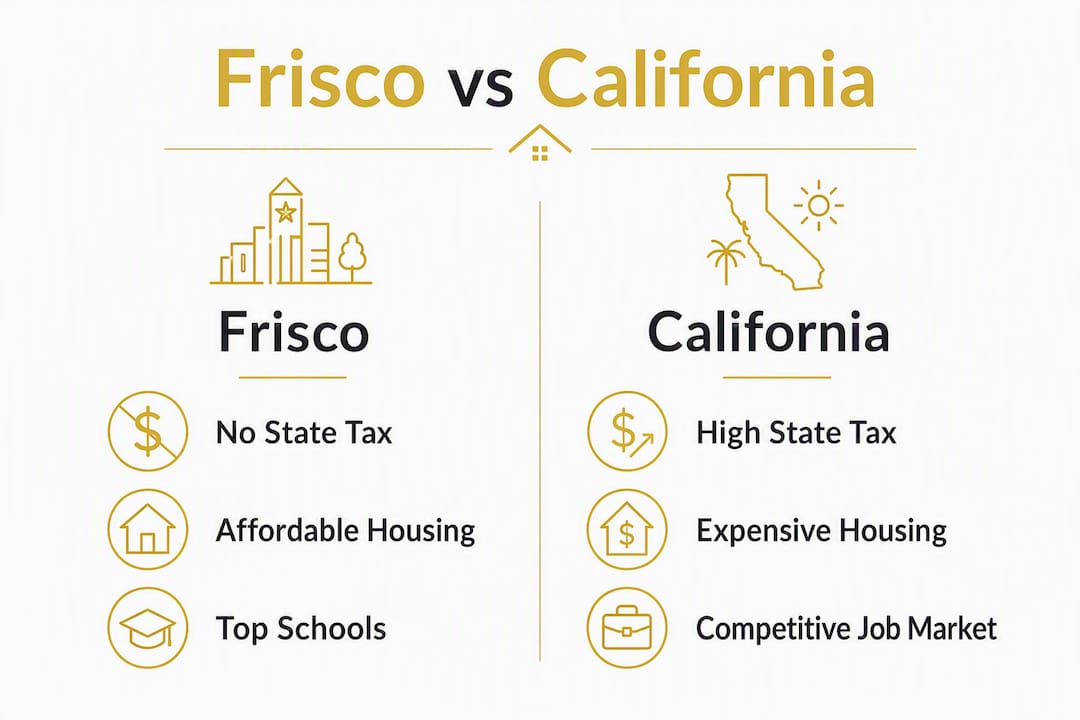
Housing is where the comparison gets dramatic. Cost-of-living data comparing San Francisco and Frisco shows Frisco tracking near the national average while San Francisco sits substantially above it, with housing as the primary driver of that gap. The same pattern holds against Los Angeles: Frisco shows lower median home prices, lower price-to-income ratios, and lower monthly carrying costs for a representative purchase.
A few practical comparisons worth knowing:
- A home that would cost $1.5 million or more in a mid-tier Bay Area suburb often has a Frisco equivalent in the $550,000–$750,000 range, with more square footage and a newer build.
- Monthly rent for a three-bedroom in Frisco runs well below comparable units in San Jose or Santa Monica.
- Texas property taxes are higher than California’s Prop 13-capped rates, so factor that into your monthly payment estimate. A $600,000 home in Frisco will carry a higher annual property tax bill than a similarly valued California home under Prop 13 protections.
Pro Tip: Use a salary-to-take-home calculator that accounts for state income tax (try SmartAsset or PaycheckCity), then run a mortgage payment estimate using current Frisco listing prices. The combination gives you a realistic monthly cash-flow picture before you ever visit. Tax rates and listing prices shift, so check current data before making any financial decisions.
What makes Frisco genuinely livable for families?
Schools come first for most families, and Frisco ISD delivers. FISD serves roughly 67,000 students across a district that has earned consistent recognition for academic performance, graduation rates, and extracurricular depth. For California families accustomed to navigating underfunded public schools or paying private-school tuition, FISD is often a genuine surprise. The Frisco ISD school system includes multiple campuses with specialized programs, fine arts academies, and STEM pathways that rival what many families pay for privately.
Safety metrics in Frisco consistently rank among the best in the DFW metro. The city has invested heavily in parks and recreation infrastructure, including multi-use trail systems, sports complexes, and community centers. Frisco’s youth sports ecosystem is genuinely exceptional: the city hosts multiple professional and semi-professional sports venues, and sports and entertainment investments actively drive neighborhood property values in ways that benefit long-term buyers.

Healthcare access is strong. Texas Health Presbyterian Hospital Frisco, Baylor Scott and White Medical Center, and several pediatric specialty clinics operate within or immediately adjacent to the city. Families moving from California metro areas will find comparable access to specialists without the wait times common in higher-density markets.
Pro Tip: Visit schools on a weekday during the school day, not during an open house. You will see actual classroom energy, traffic patterns, and how staff interact with students. Also confirm your specific address falls within your preferred school’s attendance boundary before making an offer, since boundary lines in growing districts can shift.
What does the Frisco housing market look like for buyers?
Frisco’s housing stock skews toward single-family homes, with a strong mix of master-planned communities, newer construction, and established resale neighborhoods. Most California buyers land in one of two categories: families seeking a master-planned community with HOA amenities and walkable parks, or buyers prioritizing proximity to corporate campuses along the tollway corridors.
Master-planned communities like Starwood, Phillips Creek Ranch, and Hollyhock offer resort-style amenities, community pools, and organized social programming that helps transplant families build a social network quickly. New construction is still available in outer Frisco and adjacent Prosper and Celina, typically starting in the mid-$400,000s for a production build and climbing well above $1 million for custom or semi-custom options. Resale inventory in established neighborhoods tends to move faster and often comes with mature landscaping and finished upgrades that new builds lack.
- New construction: Longer timelines (6–12 months for a build), builder incentives on financing, but limited negotiation on base price.
- Resale: Faster close (30–45 days typical), more room to negotiate, and school-zone certainty since the home already has an assigned campus.
- Luxury segment: Frisco’s luxury versus affordable home breakdown shows a clear bifurcation, with luxury inventory concentrated in gated enclaves near Legacy Drive and the Stonebriar area.
The market moves quickly. Homes in desirable school zones at competitive price points often receive multiple offers within days. California buyers accustomed to contingency-heavy offers sometimes find the Texas market less tolerant of extended option periods, though a skilled local agent can negotiate terms that protect you without making your offer uncompetitive.
Pro Tip: Map your top two or three employer locations before you shortlist neighborhoods. A 20-minute commute difference compounds over a year into real time and fuel cost. Then overlay school attendance boundaries. The intersection of those two filters usually narrows your search to two or three subdivisions.

What should you evaluate before committing to the move?
This checklist covers the decisions that determine whether Frisco is actually the right fit, not just an appealing idea:
- After-tax income modeling: Calculate your net pay under Texas residency versus California. Include property tax estimates for homes in your target price range.
- Job-market fit: Confirm whether your role, industry, and seniority level have active demand in the DFW corridor. Check LinkedIn, Glassdoor, and direct FEDC announcements for employer activity.
- School catchment verification: Identify your preferred FISD campuses and confirm which streets fall within those boundaries. Do this before you make an offer, not after.
- Commute mapping: Drive or simulate your commute during peak hours. The Dallas North Tollway and Sam Rayburn Tollway are efficient but not immune to congestion near major interchanges.
- Healthcare access: Confirm your insurance network includes providers in Frisco. Most major national plans cover the hospital systems here, but verify pediatric specialists if that is a priority.
- Housing budget and timeline: Decide whether you are buying immediately or renting for 6–12 months to learn the market. Both are valid; renting first reduces pressure but adds a move.
- Community fit: Frisco is suburban, car-dependent, and family-oriented. If your California lifestyle centered on walkable urban density, that is a real tradeoff worth naming honestly.
The deal-breakers for most families come down to job certainty and school-zone fit. Everything else, including commute length, housing type, and community culture, is negotiable once those two are confirmed.
How do you actually execute the move from California to Frisco?
Sequencing matters more than speed. Here is a practical order:
- Confirm employment first. Whether you are transferring with your current employer, accepting a new offer, or going fully remote, have written confirmation before you list your California home.
- Shortlist three to five Frisco neighborhoods based on your commute corridor and school preferences. Use this to focus house-hunting trips rather than touring the entire city.
- Schedule a dedicated house-hunting trip of three to four days. Two days of touring, one day to revisit top choices, and one day to meet with a local agent and lender.
- Line up Texas-licensed mortgage pre-approval before you arrive. Texas has specific title and closing processes that differ from California, and a local lender will know the timeline.
- Coordinate the California sale timing. If you own in California, talk to your agent there about listing timing relative to your Texas offer. A bridge loan or temporary rental can absorb a gap if the timings do not align perfectly.
- Handle school enrollment early. FISD enrollment typically opens in spring for the following fall. If you are moving mid-year, contact the district directly for transfer procedures and required documentation.
- Transfer medical records before your move date, not after. Getting established with a new pediatrician or specialist in Frisco takes time, and having records in hand speeds the process.
Pro Tip: If you are selling in California and buying in Texas simultaneously, ask your lender about a bridge loan or a home-sale contingency. Many Texas sellers will not accept a contingent offer in a competitive market, so having a bridge facility available lets you make a clean offer without waiting for your California proceeds to close first.
What is the Frisco market actually doing right now?
Demand from California buyers in Frisco has been concentrated in the $550,000–$900,000 price range, particularly in school zones served by top-rated FISD campuses. Appreciation has been steadiest in established master-planned communities with strong HOA management and proximity to the tollway corridors. Newer outer-ring neighborhoods in north Frisco and adjacent Prosper have seen builder incentives return as inventory increased, which creates real opportunity for buyers willing to wait on a build timeline.
Negotiation dynamics have shifted slightly from the peak years. Sellers in the mid-range are more open to covering closing costs or rate buydowns than they were in 2021–2022, while the luxury segment above $1.2 million has seen longer days on market. For California buyers, that means the $600,000–$800,000 range often offers the best combination of value, school-zone quality, and negotiating room.
Kamilashayehomes tracks neighborhood-level pricing drivers and publishes updated buyer guides covering market timing and appreciation patterns for North Dallas. Market conditions change, and any snapshot here reflects current patterns rather than a guarantee. Request a live listing report before making any decisions.
Pro Tip: Ask your agent for a 90-day sold-price analysis in your target zip code and school zone, not just current listings. Sold data tells you what buyers actually paid; active listings tell you what sellers hope to get. The gap between those two numbers is your negotiating context.
- California buyers are concentrating in the $550,000–$900,000 range in top FISD school zones.
- Builder incentives have returned in outer Frisco and Prosper for new construction.
- The luxury segment above $1.2 million carries longer days on market, giving buyers more leverage.
- Mid-range sellers are more open to closing-cost contributions and rate buydowns than in prior years.
Key Takeaways
Frisco combines no state income tax, a 280+ operator SaaS corridor, and top-rated FISD schools into a relocation case that is hard for California tech families to dismiss once the numbers are on paper.
| Point | Details |
|---|---|
| Tax and cost advantage | Texas has no state income tax, and Frisco housing costs track near the national average versus California’s substantially higher index. |
| SaaS corridor depth | The Frisco corridor has 280+ operators, 28% year-over-year growth, and $1.2B+ in annualized SaaS revenue. |
| School quality | Frisco ISD serves a large student population with consistently high state ratings and specialized academic programs. |
| Housing market reality | The $550,000–$900,000 range in top FISD zones is most active; builder incentives have returned in outer Frisco and Prosper. |
| Kamilashayehomes | Kamilashayehomes specializes in relocating California families to Frisco and North Dallas, with school-zone guidance, neighborhood matching, and live market reports. |
What relocating California families should actually expect
The families who make this move most smoothly are the ones who treat it as a lifestyle trade, not just a financial arbitrage. Yes, the tax math is compelling. Yes, the housing comparison is stark. But Frisco is suburban Texas, and that comes with real differences from life in San Jose or Los Angeles. The car dependency is real. The summers are genuinely hot. The social culture is different, and it takes time to build the kind of community you may have spent a decade cultivating in California.
What surprises most families is how quickly that community forms. Master-planned neighborhoods are designed for it: the HOA events, the youth sports leagues, the school volunteer culture. Families from California often find themselves more socially connected within a year in Frisco than they were in their last California neighborhood, partly because the infrastructure for it is built into the community design.
The financial breathing room also changes family dynamics in ways that are hard to quantify until you experience them. When your mortgage payment drops by $2,000 a month and your take-home pay increases because of the tax difference, the daily stress level shifts. That is not a small thing.
Kamilashayehomes makes your Frisco relocation straightforward
Relocating from California to Frisco involves more moving parts than a local move: timing a California sale, understanding Texas title and closing processes, verifying school attendance boundaries, and reading a market you have never bought in before. Kamilashayehomes handles all of it, specifically for families making this exact transition.
Kamila Shaye brings local market knowledge across Frisco, Prosper, Celina, and surrounding North Dallas communities, with a track record of guiding relocating families through school-zone selection, neighborhood matching, and negotiation in a market that moves faster than most California buyers expect. The service covers everything from your first neighborhood shortlist to closing day, with no guesswork about what step comes next.
Browse current Frisco listings to get a feel for what your budget buys, or contact Kamilashayehomes directly to request a live market snapshot tailored to your price range, preferred school zone, and commute corridor. Kamilashayehomes is a commission-based real estate service; you pay nothing until a transaction closes.
Useful sources for your research
These are the primary sources used in this article and the best places to verify live data before making decisions:
- Frisco Economic Development Corporation / City of Frisco — FEDC strategic plans, corporate relocation announcements, and economic development updates.
- Data USA: Frisco, TX — Employment sector breakdowns, population data, and income statistics for Frisco residents.
- Local Profile: Frisco Business Growth — Reporting on job creation and company establishment figures from FEDC activity.
- Kamilashayehomes: Frisco Real Estate Market 2026 Buyers’ Guide — Local market timing, appreciation drivers, and neighborhood pricing for buyers.
- Kamilashayehomes: Frisco ISD Explained for Families — School district overview, enrollment logistics, and campus-level information.
Live data note: Listing prices, school boundaries, and FEDC announcements change frequently. Always verify current figures directly with the source before making financial or relocation decisions.
FAQ
Is Frisco a tech hub?
Frisco anchors a fast-growing North Texas SaaS corridor with 280+ operators and 28% year-over-year growth, and the broader Dallas–Fort Worth region ranks as a top North American tech hub by site-selection metrics.
Why is Frisco, Texas so popular right now?
Frisco combines no state income tax, highly rated public schools through Frisco ISD, affordable housing relative to major California metros, and a proactive economic development strategy that has attracted dozens of corporate campuses and thousands of jobs over the past several years.
Is Frisco one of the wealthiest cities in Texas?
Frisco consistently ranks among the highest-income cities in Texas, driven by its concentration of Professional, Scientific, and Technical Services employment and the high median household incomes that accompany that sector. It is not the single wealthiest city in the state, but it regularly appears near the top of those rankings.
Is Frisco a good fit for families moving from California?
For California tech families, Frisco offers the specific combination most are looking for: career-relevant job density, top-rated public schools through Frisco ISD, and housing that is substantially more affordable than Bay Area or Los Angeles equivalents. Kamilashayehomes works specifically with families making this transition and can provide a school-zone and neighborhood shortlist matched to your priorities.