

Frisco’s sports and entertainment investments directly raise residential property values through five compounding mechanisms: the halo effect on retail and office demand, event-driven housing interest, corporate relocation and job growth, public-finance reinvestment through TIRZ tools, and youth-sports integration that keeps families rooted. The Star alone draws roughly 4 million visitors annually, and the broader Sports City USA model has attracted billions in cumulative public and private investment across the city. Short-term construction noise and market cycles can soften gains near active development sites, but the long-run trajectory is well-supported.
The core mechanisms at work:
- Halo effect: Sports venues pull restaurants, hotels, and corporate offices into adjacent corridors, lifting the commercial tax base that funds schools and roads.
- Event-driven demand: Game days and tournaments create short-term rental and buyer interest that keeps inventory moving.
- Corporate relocation: Companies follow amenities. Corporate relocations to Frisco have accelerated as employers cite quality-of-life assets when recruiting talent.
- TIRZ reinvestment: Commercial growth funds infrastructure without raising residential property taxes, per city financing agreements.
- Youth-sports integration: Frisco ISD partnerships give students access to pro-grade facilities, making the district a genuine draw for families.
Table of Contents
- How Frisco’s sports build-out has moved property values over time
- How does Frisco compare to other sports-driven cities?
- Kamilashayehomes helps you act on what Frisco’s sports market tells you
- Key Takeaways
- FAQ
How Frisco’s sports build-out has moved property values over time
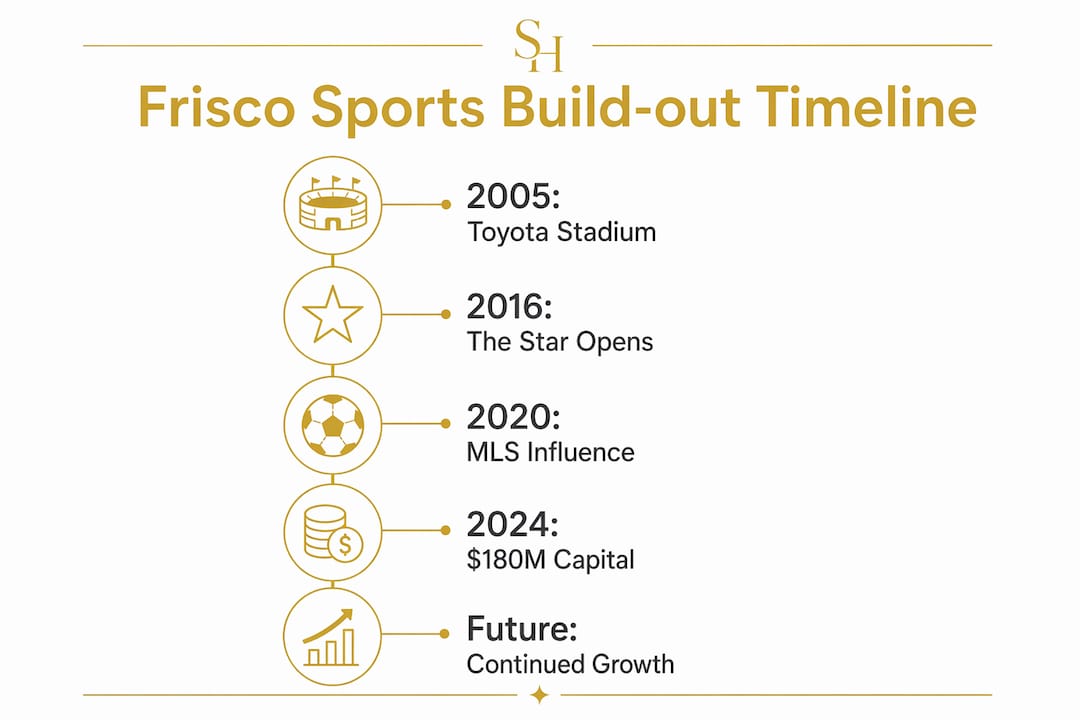
The sequence matters. Toyota Stadium opened in 2005 and anchored Frisco’s identity as a soccer city. The Star, the Dallas Cowboys’ world headquarters and practice facility, opened in 2016 and immediately reframed the city’s commercial ceiling. Hotels, restaurants, and Class A office space followed within two years. Frisco then landed PGA Frisco, which opened in 2023, adding a second major anchor on the city’s western edge.
Each opening triggered a wave of mixed-use development nearby. In 2024, Frisco approved over $180 million in capital improvements and incentives for a hotel, apartment, and office project around Toyota Stadium, with explicit language in the city council agreements that the deal would not raise property taxes for residents. That structure, performance-based reimbursements through TIRZ financing, is the same model used to fund The Star’s surrounding district.
Academic research on stadium announcements shows mixed short-term effects on nearby home prices; long-term gains depend on sustained economic activity and sound public financing. Frisco’s TIRZ loop, where commercial revenue is reinvested into infrastructure and schools, is precisely the structure that research identifies as the stabilizing factor. A 2013 economic impact analysis projected $23.4 billion in cumulative economic impact from the Project Azul mixed-use development through 2042, covering the 91-acre tract that became the foundation for The Star district.
How does Frisco compare to other sports-driven cities?
Most cities that host a single pro franchise see localized price bumps within a half-mile radius, then diminishing returns. Frisco built a cluster: soccer, football, golf, and minor-league baseball at Riders Field, all within a compact geography. That density is closer to what you see in purpose-built sports corridors in Nashville or Kansas City’s Power and Light District than in a typical suburban stadium deal.
The difference is intentionality. Frisco’s Sports City USA model ties youth athletic programs and school access directly to professional facilities, so residents benefit daily rather than only on game days. Nashville’s Germantown neighborhood saw sustained appreciation after the Predators arena opened, but the youth-sports integration Frisco built is unusual at this scale. Spatial hedonic research on Columbus, Ohio sports facilities found a significant positive distance-decaying effect on surrounding home values, confirming that proximity to well-managed facilities adds measurable value. Frisco’s multi-venue cluster amplifies that effect across a wider radius than a single-facility city can achieve.
Regional commercial real estate professionals tracking DFW broker activity consistently note that Frisco’s sports district draws office tenants who then generate residential demand from relocated employees, a feedback loop most single-stadium cities never develop.
Kamilashayehomes helps you act on what Frisco’s sports market tells you
Knowing the mechanisms is one thing. Knowing which subdivision sits inside the TIRZ reinvestment zone, which streets absorb game-day traffic, and how to price a home that backs up to a mixed-use corridor is a different skill set entirely. Kamila Shaye brings both: an experienced agent with deep North Dallas roots who understands how location shapes home pricing in Frisco’s sports districts and how to position a listing or an offer accordingly.
Three questions to bring to your next agent conversation:
- Is this property inside an active TIRZ boundary, and what infrastructure improvements are scheduled?
- What is the noise and traffic pattern on event days, and how has that affected comparable sales?
- Does the seller’s pricing reflect the mixed-use pipeline nearby, or is it lagging the market?
Start with a free home valuation to see where your property sits relative to Frisco’s sports-district premium, or browse featured properties near The Star and Toyota Stadium to calibrate your search.
Key Takeaways
Frisco’s sports and entertainment cluster drives long-term residential value through TIRZ reinvestment, corporate relocation, and youth-sports integration rather than short-term event spikes alone.
| Point | Details |
|---|---|
| Halo effect is real | The Star draws roughly 4 million visitors annually, pulling retail and office investment that lifts the surrounding tax base. |
| TIRZ financing protects residents | City agreements explicitly tie commercial growth to infrastructure reinvestment without raising residential property taxes. |
| Multi-venue cluster outperforms single stadiums | Frisco’s density of soccer, football, golf, and baseball venues creates a wider appreciation radius than a single-franchise city. |
| Short-term risks exist | Stadium announcements can produce mixed near-term price effects; buyers should prioritize TIRZ stability and school investment over event-day hype. |
| Kamilashayehomes adds local precision | Kamila Shaye helps buyers and sellers identify which neighborhoods sit inside the reinvestment loop and price accordingly. |
FAQ
Does living near The Star increase home values?
Proximity to The Star tends to support higher demand and faster absorption, given its millions of annual visitors and the commercial density it has attracted. The effect is strongest within the surrounding mixed-use corridor.
What is a TIRZ and why does it matter for Frisco buyers?
A Tax Increment Reinvestment Zone captures commercial property tax growth and reinvests it in local infrastructure and schools. Frisco’s TIRZ agreements are structured so that growth funds public improvements without raising residential property taxes.
Are there risks to buying near a sports venue in Frisco?
Yes. Academic research shows stadium announcements can produce short-term price volatility, and buyers near active construction may face noise and traffic disruption. Ask your agent for event-day traffic data and review any special assessment language in the HOA or city documents.
How does Frisco’s sports model differ from other Texas cities?
Frisco built a multi-venue cluster tied to youth programming and school access, not just a single franchise deal. That daily-resident benefit structure is what separates the Sports City USA model from a conventional stadium suburb.
How can Kamilashayehomes help me use this information?
Kamila Shaye can identify which Frisco neighborhoods sit inside active reinvestment zones, interpret municipal incentive language, and time a purchase or listing around major mixed-use deliveries near The Star or Toyota Stadium.