

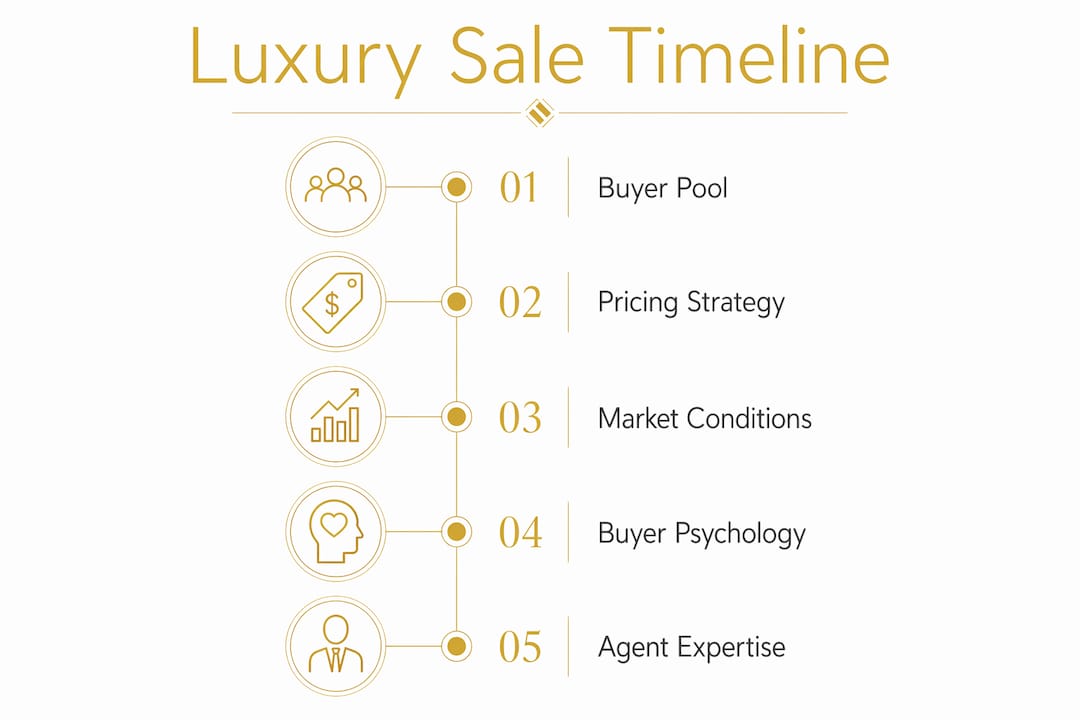
Luxury homes take longer to sell because the qualified buyer pool is small, selective, and unhurried. Unlike standard residential markets, high-end real estate operates on a different clock. Entry-level luxury homes sit on the market a median of 92 days, while ultra-luxury properties average 108 days. Those numbers reflect a structural reality, not a marketing failure. The factors affecting luxury home sales run deeper than price alone. Pricing discipline, buyer psychology, local market conditions, and the segmented nature of the luxury tier all shape how long a property stays listed before it closes.
Why luxury homes take longer to sell than standard properties
The core reason is supply-demand imbalance at the top of the market. There are far fewer buyers who can afford a $3 million home than a $400,000 home. That math alone extends the luxury home selling process significantly.

Pricing accuracy compounds the problem. A standard home priced 5% too high still attracts buyers who negotiate down. A luxury home priced 5% too high often attracts no one. The buyer pool is thin enough that even a small mispricing can eliminate most of your audience entirely. Homes overpriced by 5–10% stagnate and frequently sell below market value, losing both time and money for the seller.
Buyer psychology adds another layer. Luxury buyers are not in a rush. They evaluate properties over months, weigh non-monetary factors like privacy and architectural integrity, and treat time as an asset rather than a cost. That mindset is not a red flag. It is the normal pace of high-end decision-making, and sellers who do not account for it tend to make reactive pricing mistakes that hurt their position.
How does pricing strategy affect the speed of a luxury sale?
Pricing is the single most controllable factor in the luxury home selling process. Get it right, and you create urgency. Get it wrong, and you trigger a slow, damaging spiral.
The first 7–10 days on market are the most critical window a seller has. MLS alerts and buyer agent activity peak immediately after listing, meaning the most motivated buyers see the property first. An overpriced listing wastes that window entirely. By the time the seller adjusts the price, the initial audience has moved on.
The consequences of overpricing compound over time. Overpriced properties enter a cycle of declining buyer interest that requires multiple price cuts to reverse. Each cut signals weakness. Buyers begin to wonder what is wrong with the property, even when nothing is. That perception alone reduces offers and negotiating leverage.
- Aspirational pricing sets the list price above recent comparable sales, hoping a single buyer will pay a premium. This rarely works in luxury markets and almost always extends days on market.
- Market-aligned pricing matches the list price to the most recent comparable sale. This attracts the right buyers immediately and preserves negotiating leverage.
- Competitive pricing sets the price slightly below comparable sales to generate multiple-offer scenarios. This works well in entry-level luxury tiers where the buyer pool is deeper.
Pro Tip: Get a professional home valuation before listing. Accurate pricing from day one is the most effective way to reduce days on market and protect your final sale price.
Why does the buyer pool size slow down luxury home sales?
The luxury market is not one market. It is a collection of distinct tiers, each with its own buyer pool size, behavior, and timeline. The “deep-pool” entry luxury market and the “trophy” ultra-luxury market require completely separate strategies. Treating them the same is one of the most common mistakes sellers make.
At the entry-level luxury tier, say $1 million to $2 million in North Dallas markets like Frisco and Prosper, the buyer pool is relatively active. Competition exists. Sellers who price correctly can move quickly. At the trophy tier, $5 million and above, the pool shrinks to a handful of qualified buyers nationally. A single property may need to wait months for the right buyer to appear.
Luxury buyers evaluate privacy, architectural integrity, and lifestyle alignment alongside price. These are not factors that resolve in a weekend showing. A buyer considering a $4 million home may visit three times, bring an architect, and consult a financial advisor before making an offer. That process takes time by design.
- Cash buyers close faster and skip financing contingencies, which speeds up the final transaction. 63% of luxury purchases are all-cash, which creates liquidity at the very top of the market.
- Financed buyers in the near-luxury tier face longer timelines due to jumbo loan underwriting, appraisal challenges, and lender scrutiny on high-value properties.
- International buyers add complexity through currency considerations, legal review, and travel schedules that extend the decision cycle further.
Pro Tip: Identify your property’s tier before setting expectations. A Frisco luxury home in the $1.5 million range operates on a very different timeline than a $6 million estate in a resort market.
How do local market conditions shape luxury sale timelines?
Geography matters enormously in high-end real estate. Local market conditions vary drastically across U.S. luxury submarkets, and what works in one city can fail completely in another.
Tech hub markets like Austin and Seattle tend to move entry-level luxury faster. High-income tech workers create consistent demand, and inventory turns over more quickly. Resort markets and micropolitan areas, think mountain retreats or coastal second-home destinations, see much longer listing periods because the buyer pool is geographically dispersed and purchases are discretionary rather than need-driven.
The rise of all-cash purchases creates a split market where ultra-wealthy buyers act decisively while buyers just below that threshold delay, wait for rate changes, or pause entirely during economic uncertainty. That divide shows up directly in days-on-market data across different price bands.
| Market type | Typical days on market | Cash purchase rate |
|---|---|---|
| Entry-level luxury (tech hubs) | 60–75 days | Moderate |
| Entry-level luxury (median U.S.) | ~92 days | Moderate |
| Ultra-luxury (top tier) | ~108 days | High (63%) |
| Resort and micropolitan luxury | 120+ days | Variable |
Pro Tip: Monitor local absorption rates, not just national luxury trends. North Dallas submarkets like Prosper and Celina have their own supply and demand cycles that differ significantly from national averages.
What psychological challenges slow down luxury home sales?
Buyer psychology is the least discussed and most underestimated factor in the luxury home selling process. Sellers often interpret slow activity as a pricing problem when the real issue is the natural pace of high-value decision-making.
Ultra-luxury buyers treat time as an asset. They scrutinize every detail, revisit properties multiple times, and are fully prepared to wait months for the right match. A seller who panics during this period and drops the price too quickly signals weakness rather than flexibility. That signal damages negotiating leverage at exactly the wrong moment.
Market stigma is a real and measurable risk. Homes sitting on the market over 90 days sell for 8–12% below asking price on average. Buyers assume something is wrong with a property that has been listed for months, even when the only issue was an overpriced launch. That assumption is hard to reverse once it takes hold.
“The longer a luxury home sits on the market, the more buyers believe they have leverage. Sellers who hold their price discipline through the first 60 days protect their outcome. Those who react emotionally in week three rarely recover their position.”
- Avoid multiple price reductions in quick succession. Each cut reinforces buyer suspicion.
- Respond to showing feedback with adjustments to presentation, not reflexive price drops.
- Sellers responding emotionally to slow activity by cutting prices prematurely undermine their own negotiation power.
What strategies actually reduce days on market for luxury homes?
Reducing sale time in the luxury market requires preparation before listing, not adjustments after. The sellers who move fastest are the ones who do the most work before the sign goes in the yard.
- Complete a pre-listing inspection. Luxury buyers expect turnkey condition. Surprises discovered during due diligence kill deals and restart timelines. Addressing issues before listing removes that risk entirely.
- Price to the last comparable sale. Not to your aspirational number. Not to what you paid plus renovations. To what the market has actually paid for similar properties in the last 90 days.
- Invest in professional photography, video, and 3D tours. Luxury buyers often preview properties remotely before visiting in person. Poor visual marketing eliminates your home from consideration before a showing is ever scheduled. The features that define luxury homes need to be visible and compelling from the first click.
- Target buyer behavior, not just buyer demographics. Luxury buyers search differently. They use agent networks, private listings, and curated platforms. A mass-market MLS strategy alone will not reach the right audience.
- Respond to market feedback with discipline. If showings are happening but offers are not, the issue is likely presentation or price. If showings are not happening at all, the price is almost certainly the problem.
Pro Tip: Work with an agent who has direct experience in your specific luxury tier and local market. General real estate experience does not translate automatically to high-end sales strategy.
Key Takeaways
Luxury homes take longer to sell because the buyer pool is small, pricing discipline is non-negotiable, and buyer decision cycles are measured in months, not weeks.
| Point | Details |
|---|---|
| Median days on market | Entry-level luxury averages 92 days; ultra-luxury averages 108 days in 2026. |
| Pricing accuracy is critical | Overpricing by 5–10% stagnates listings and forces below-market final sale prices. |
| Buyer pool varies by tier | Trophy-tier buyers are few, selective, and unhurried; entry-level luxury moves faster. |
| Market stigma compounds losses | Homes over 90 days on market sell 8–12% below asking price on average. |
| Local conditions override national trends | Tech hubs sell faster; resort and micropolitan markets see 120+ day timelines. |
What I have learned from watching sellers get this wrong
The most common mistake I see is sellers treating the luxury market like a faster version of the standard market. It is not. It is a different market with different rules, different buyers, and a completely different relationship with time.
Sellers who price emotionally, based on what they need to net or what they paid for renovations, almost always extend their own timelines. The market does not care about your cost basis. It cares about what comparable properties have sold for recently. The sellers who accept that reality early move faster and net more.
The other pattern I see consistently is sellers confusing slow showing activity with a pricing problem. At the trophy tier, slow activity is normal. Buyers at ultra-high price points leverage time deliberately, and a property that receives two serious showings in 60 days may be performing exactly as expected. Dropping the price after week three because the phone is not ringing is a reactive move that rarely ends well.
Patience and pricing discipline are not passive strategies. They are the most active choices a luxury seller can make. The sellers who hold their position, respond to feedback thoughtfully, and trust accurate market data are the ones who close at or near their asking price.
— Felix
Selling luxury real estate in North Dallas? Kamilashayehomes can help
Kamilashayehomes specializes in the Prosper, Frisco, and Celina luxury markets, where pricing accuracy and local knowledge directly determine how long a home sits on the market. Kamila Shaye brings hands-on experience with high-end buyers and sellers, polished marketing tailored to luxury properties, and data-driven pricing strategies that protect your position from day one. Whether you are preparing to list or trying to understand what your property is worth in today’s market, the right guidance makes a measurable difference. Browse featured luxury listings or visit Kamilashayehomes to connect with Kamila directly.
FAQ
Why do luxury homes stay on the market longer than regular homes?
Luxury homes have a smaller, more selective buyer pool and require precise pricing to attract qualified offers. Entry-level luxury homes average 92 days on market, while ultra-luxury properties average 108 days.
What is the biggest mistake luxury sellers make?
Overpricing at launch is the most damaging mistake. Homes overpriced by 5–10% stagnate, attract no serious offers, and typically sell below true market value after multiple price reductions.
Does the type of luxury property affect how long it takes to sell?
Yes. Entry-level luxury homes in active markets like Frisco sell faster because the buyer pool is deeper. Trophy-tier properties above $5 million can take six months or more because the qualified buyer pool is extremely limited.
How does the first week on market affect a luxury home sale?
The first 7–10 days generate the highest buyer agent activity through MLS alerts. An overpriced listing wastes this window, and recovering buyer attention after it closes is significantly harder.
Do all-cash buyers speed up luxury home sales?
At the ultra-luxury tier, yes. 63% of luxury purchases are all-cash, which removes financing contingencies and speeds up closing. Buyers just below that threshold who require financing face longer timelines due to jumbo loan complexity.