

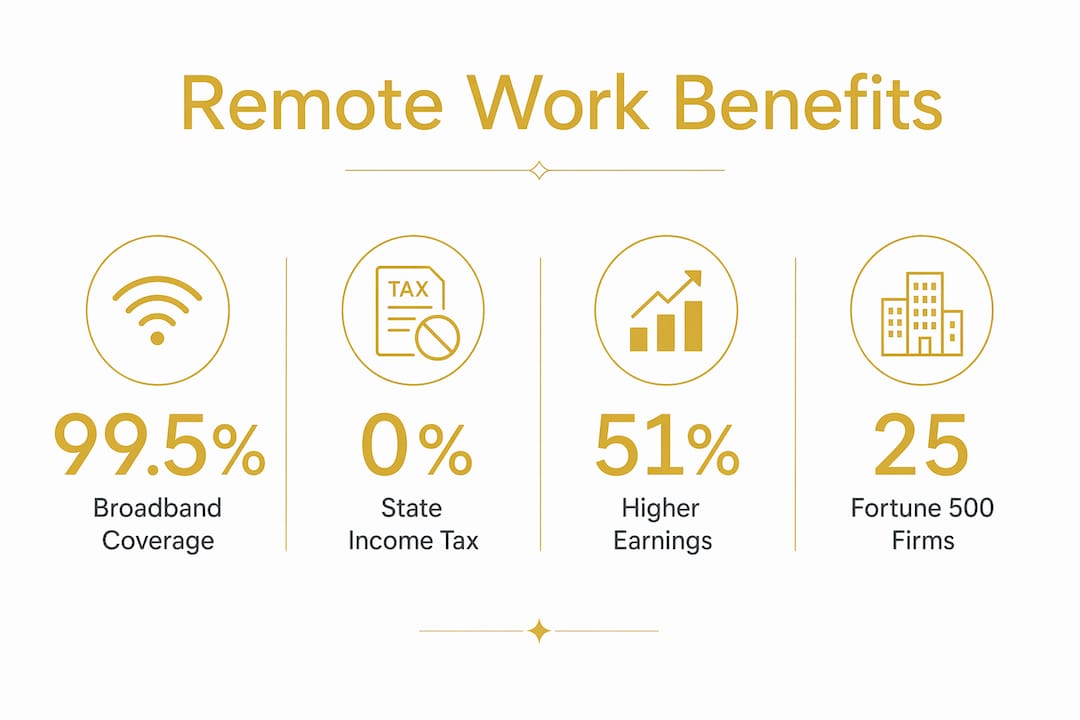
North Dallas is the top relocation destination for remote workers because it combines 99.5% broadband coverage, zero state income tax, and a lifestyle that coastal cities simply cannot match at the same price point. Suburbs like Frisco, Plano, and Prosper offer fast internet, coworking amenities, and green space within minutes of each other. Remote professionals relocating here earn 51% more than local averages because they bring coastal salaries into a lower cost market. That income gap is the single most powerful financial argument for why North Dallas appeals to remote workers today.
Why North Dallas appeals to remote workers: infrastructure that delivers
The foundation of any remote work location is reliable internet. Frisco leads North Texas with broadband speeds up to 526 Mbps and 99.5% coverage across the suburb. That speed supports video conferencing, cloud uploads, and simultaneous household use without degradation.
Beyond home internet, the physical workspace options in North Dallas have expanded significantly. New apartment communities across Frisco, Plano, and Allen now include dedicated coworking lounges, private conference rooms, and high-speed shared networks. These on-site amenities matter because they give remote workers a professional backup when home setups need a break.
Transportation access adds another layer of flexibility. North Dallas sits at the intersection of major highways including US-75, the Dallas North Tollway, and the Sam Rayburn Tollway. Average in-office commute times in Frisco run 27.3 minutes, which is well below the national average. That matters for hybrid workers who need occasional office access without a punishing daily drive.
The region also hosts 25 Fortune 500 companies, which creates a dense network of corporate campuses within reach. Remote workers in hybrid roles benefit from proximity to employers like Toyota, JPMorgan Chase, and Liberty Mutual, all of which maintain significant North Texas operations. That corporate density supports contract work, networking, and career pivots without requiring a full relocation to a major metro core.
Pro Tip: When evaluating a North Dallas apartment for remote work, test the building’s shared Wi-Fi during peak hours, typically between 9 a.m. and 11 a.m. on a weekday. Advertised speeds and real-world performance can differ significantly.
What lifestyle benefits make North Dallas attractive for remote jobs?
Work-life balance is not a slogan in North Dallas. It is built into the physical layout of its communities. Plano ranks 17th nationally for city park systems, giving remote workers direct access to green space within minutes of most neighborhoods. That access matters because stepping away from screens during the day improves focus and reduces burnout.
Walkable retail corridors, local coffee shops, and restaurant clusters exist throughout the area. Legacy West in Plano, the Rail District in Frisco, and the Shops at Willow Bend all offer the kind of casual third-place environments where remote workers can work, meet clients, or simply decompress. These are not generic strip malls. They are purpose-built mixed-use districts designed for daily use.
Community events fill the social calendar year-round. Farmers markets, outdoor concerts, food festivals, and neighborhood association gatherings give remote workers consistent opportunities to build local connections. Remote work isolation is a documented productivity risk, and North Dallas addresses it through sheer density of community programming.
Housing variety supports different remote work styles and budgets. You can find:
- Single-family homes with dedicated office rooms in Prosper and Celina
- Modern apartments with coworking amenities in Frisco and Plano
- Townhomes near walkable retail in Allen and McKinney
- Larger suburban estates for workers who need quiet, space, and separation from urban noise
Pro Tip: If you work in video calls most of the day, prioritize neighborhoods with lower traffic density. Areas north of Highway 380 in Prosper and Celina offer noticeably quieter residential streets compared to more central Plano corridors.
What financial advantages does North Dallas offer remote workers?
Texas charges no state income tax. That single fact increases net take-home pay for every remote worker who relocates here from California, New York, or Illinois. A remote worker earning $120,000 annually saves roughly $9,000 to $13,000 per year compared to living in a high-tax state, depending on their prior state’s rate. That is not a marginal difference. It is a meaningful shift in financial position.
Remote workers in North Dallas suburbs earn 51% more than local averages because they carry coastal-tier salaries into a market where housing, groceries, and services cost significantly less. This income premium gives relocating professionals real purchasing power that they simply did not have in San Francisco or New York.
The local economy benefits from this influx as well. Remote workers bring higher earning power into North Dallas, which supports local businesses, drives demand for quality housing, and raises the overall economic floor of communities like Frisco and Prosper. The real estate market reflects this. Demand for homes with dedicated office space, strong broadband access, and proximity to amenities has grown steadily.
Median income for remote professionals in the area sits at $72,421, which stretches further here than in most comparable metros. Affordable living in North Dallas is not about settling for less. It is about getting more for the same dollar.
“North Dallas offers remote workers the rare combination of coastal-level connectivity and Sunbelt-level affordability. That gap is why relocation inquiries from California and New York continue to rise.”
How do North Dallas neighborhoods fit different remote work styles?
North Dallas is not one place. It is a collection of distinct communities, each with a different character and a different set of trade-offs for remote workers. Understanding those differences prevents relocation regret.
Central North Dallas and Addison suit workers who want urban proximity. Shorter drives to downtown Dallas, denser restaurant and nightlife options, and older housing stock with character define this zone. The trade-off is more traffic and smaller lot sizes.
Plano balances corporate access with suburban comfort. Its park system, retail corridors, and DART light rail connections make it one of the most practical choices for hybrid workers who commute occasionally. The combination of retail, corporate centers, and parks makes Plano a consistent top pick.
Frisco leads in remote work infrastructure. With 33.7% of its workforce working remotely, Frisco has built an ecosystem around that demographic. New developments, coworking spaces, and corporate campuses all cater to the remote and hybrid professional. Learn more about Frisco’s corporate growth and what it means for residents.
Prosper and Celina appeal to workers who prioritize space, quiet, and newer construction. These northern suburbs offer larger homes, lower density, and a strong sense of community. The trade-off is a longer drive to major employment centers, though highway access along the Dallas North Tollway keeps commutes manageable.
McKinney and Allen sit in the middle ground. They offer newer housing, good schools, and access to both Plano’s corporate corridor and Frisco’s tech ecosystem. Workers who want flexibility without committing to the far north suburbs often land here.
Pro Tip: When touring apartments or homes in newer North Dallas developments, ask specifically about wall construction and unit placement. Soundproofing in new builds varies widely, and a unit near a gym or elevator shaft can undermine an otherwise ideal setup.
Key Takeaways
North Dallas delivers a combination of fast broadband, zero state income tax, and diverse neighborhoods that makes it one of the most practical relocation choices for remote workers in 2026.
| Point | Details |
|---|---|
| Broadband coverage | Frisco offers 99.5% coverage with speeds up to 526 Mbps, supporting full-time remote work. |
| Financial advantage | No state income tax and a 51% income premium over local averages give remote workers real purchasing power. |
| Lifestyle access | Plano ranks 17th nationally for parks, and mixed-use districts provide daily third-place work environments. |
| Neighborhood variety | From central Addison to northern Prosper, each community offers a distinct trade-off for remote workers. |
| Housing amenities | New developments include coworking lounges and private conference rooms built for remote professionals. |
North Dallas is not a trend. It’s a structural shift.
I have watched the North Dallas relocation market closely for years, and the pattern is clear. Remote workers are not moving here because it is fashionable. They are moving here because the math works and the lifestyle holds up under daily scrutiny.
What surprises most people after they arrive is how much the community infrastructure has caught up with the demand. Developers are building with remote workers in mind. Coworking spaces, soundproofed units, and fiber-ready buildings are showing up in new projects across Frisco and Prosper. That is not coincidence. It is a response to who is actually moving in.
The one thing I would push back on is the assumption that all of North Dallas is the same. I have seen remote workers choose Frisco for its tech energy and then feel isolated because they wanted walkability. I have seen others choose central Plano for its urban feel and then struggle with noise during calls. The diversity of communities is an asset, but only if you match the neighborhood to your actual work style, not your idealized version of it.
Commute predictability matters more than people admit. Even fully remote workers benefit from living near reliable highway access. Life changes. Hybrid arrangements shift. Having a home near the Dallas North Tollway or US-75 gives you options without locking you into a daily grind.
— Felix
Finding the right home in North Dallas for your remote work life
Kamilashayehomes specializes in matching remote workers and relocating professionals with the right neighborhoods across Frisco, Prosper, Celina, and Plano. Kamila Shaye brings firsthand knowledge of which developments prioritize home office amenities, which streets stay quiet during work hours, and which communities offer the best balance of space and connectivity. Start with a home valuation to understand your buying power in this market, or browse featured properties curated for remote work lifestyles. Whether you are relocating from another state or moving within the region, Kamilashayehomes makes the process clear and personal.
FAQ
Why does Frisco attract so many remote workers?
Frisco leads North Texas with 33.7% of its workforce working remotely, supported by 99.5% broadband coverage and speeds up to 526 Mbps. Its mix of corporate campuses, new residential developments, and strong community amenities creates an environment built for remote professionals.
Does Texas really save remote workers money?
Texas charges no state income tax, which directly increases take-home pay for workers relocating from high-tax states like California or New York. Combined with lower housing costs, the financial advantage is substantial and immediate.
What are the best North Dallas suburbs for remote work?
Frisco ranks highest for broadband and remote work infrastructure, while Plano offers the best balance of parks, transit, and corporate access. Prosper and Celina suit workers who prioritize space and quiet over urban proximity.
Are North Dallas apartments equipped for remote work?
Many new apartment communities in North Dallas now include dedicated coworking lounges and private conference rooms. However, soundproofing quality varies, so requesting a unit away from high-traffic building areas like gyms and elevators is worth the extra step.
How does North Dallas compare to coastal cities for remote workers?
Remote workers in North Dallas suburbs earn 51% more than local averages because they bring coastal-tier salaries into a lower cost market. No state income tax, affordable housing, and strong broadband make the region a direct upgrade for most professionals leaving high-cost coastal metros.