

North Dallas growth is the single most important factor shaping property values, investment potential, and long-term wealth for buyers in the region’s northern suburbs right now. The shift is not subtle. Cities like Celina, Prosper, and Frisco are absorbing tens of thousands of new residents while the city of Dallas itself lost approximately 1,800 residents in 2025. That divergence tells buyers exactly where demand is building and where it is not. Understanding why North Dallas growth matters to buyers means reading those signals before the market prices them in fully.
Why North Dallas growth matters to buyers: the demographic shift driving demand
Population movement is the foundation of every real estate market. Celina has nearly quadrupled its population since 2020, adding over 46,000 residents in roughly five years. That kind of growth does not happen by accident. It reflects a deliberate choice by households to trade urban density for affordability, safety, and newer infrastructure.
Buyers are drawn to northern suburbs for three concrete reasons: more affordable housing relative to inner-ring Dallas, stronger public safety records, and modern commercial centers built from scratch rather than retrofitted. These are not lifestyle preferences. They are economic signals. When a large, income-stable population concentrates in a specific corridor, housing demand firms up and prices follow.
Collin County supports this thesis with hard numbers. Median household income in Collin County sits at approximately $117,588 in 2026. That income level insulates the North Dallas housing market from the affordability stress hitting other metros. Buyers here are not stretching to qualify. They are choosing deliberately, which creates a more resilient demand base than speculative markets produce.

The population story also has a flip side worth understanding. Dallas city’s population decline reflects shifting housing preferences and economic factors that favor outer-ring suburbs. Buyers who recognize this divergence early can position in corridors where demand is accelerating rather than stagnating.
Pro Tip: When evaluating a North Dallas suburb, check the net migration trend for the past three years, not just the current population number. Acceleration matters more than size.
- Celina added over 46,000 residents since 2020, a growth rate exceeding 400%
- Dallas city lost residents in 2025 while its northern suburbs posted net gains
- Collin County’s median household income of $117,588 supports stable, non-speculative demand
- Buyers cite affordability, safety, and modern amenities as the top pull factors
- Outer-ring suburbs like Prosper, Aubrey, and Princeton are absorbing overflow from Frisco and Plano
The Frisco population growth impact follows a similar pattern, with established infrastructure now attracting employment hubs that reinforce residential demand in a self-sustaining cycle.
How infrastructure projects boost North Dallas property values
Infrastructure is the mechanism that converts population growth into property appreciation. The Dallas North Tollway Phase 4A is funded, under construction, and scheduled to open in 2027. That single project will compress commute times for northern suburbs and make previously remote land parcels viable for residential and commercial development.
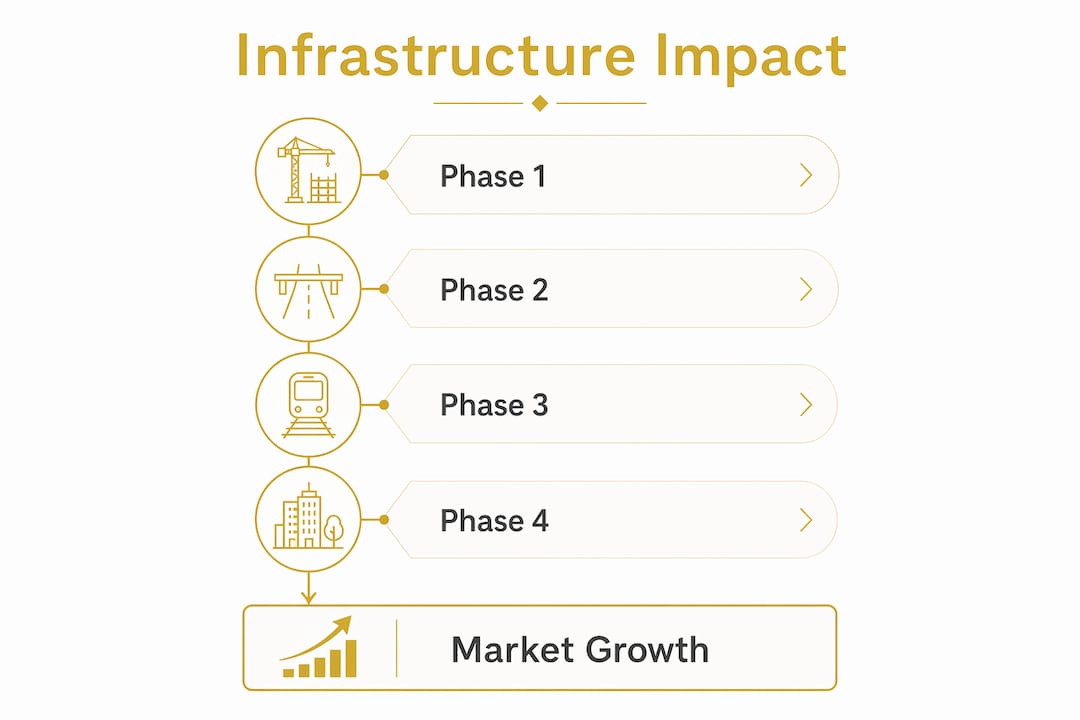
The pattern is consistent across North Texas. The Dallas North Tollway extension and US-380 widening have already driven population and retail growth in outer-ring suburbs. Each infrastructure milestone reduces friction for residents and employers, which pushes demand outward along the corridor. Buyers who purchase before a project opens typically capture the appreciation that follows completion.
The table below summarizes the key infrastructure projects shaping North Dallas real estate values right now.
| Project | Status | Expected Opening | Market Impact |
|---|---|---|---|
| Dallas North Tollway Phase 4A | Funded, under construction | 2027 | Opens northern land corridors; compresses commute times |
| US-380 widening | Ongoing | Phased completion | Supports retail and residential growth in Princeton, Celina, Prosper |
| Outer Loop expansion | Planning and active phases | Multi-year | Improves regional connectivity for outer suburbs |
Retail and commercial development follow road infrastructure closely. When commute times drop, employers consider relocating or expanding into the corridor, which brings jobs, which brings more residents, which drives housing demand further. Buyers who understand this cycle can identify neighborhoods that are one infrastructure milestone away from a pricing step-up.
Pro Tip: Check the Texas Department of Transportation project tracker for scheduled completion dates in your target corridor. Buying six to twelve months before a major road opens is often the best entry point for appreciation.
Understanding how location drives home pricing in established North Dallas suburbs like Frisco shows exactly how this infrastructure-to-value chain plays out over a full market cycle.
What buyers should know about supply-demand imbalances in fast-growing areas
Rapid growth creates a specific problem that catches buyers off guard. Residential rooftops go up fast. Retail, schools, and services take years to catch up. Retail demand in northern corridor suburbs currently outpaces available commercial space by 2 to 3 times in specific northern corridors. That gap is temporary, but buyers need to plan for it.
The concept here is what experienced investors call patience capital. You buy into a high-growth corridor knowing that the grocery store, the urgent care clinic, and the full-service restaurant will arrive in three to five years, not three to five months. The long-term value is real. The short-term convenience is not. Buyers who misread this timeline get frustrated and sometimes sell at the wrong moment.
School district capacity is the other variable that separates sustainable growth from speculative growth. Institutional buyers prioritize school district bond capacity and capital improvement plans over current ratings. A district with a secured bond to build three new schools ahead of residential growth is a stronger long-term signal than a district with a high rating but no expansion plan. The rating reflects the past. The bond reflects the future.
Buyers should evaluate these factors before purchasing in a high-growth North Dallas corridor:
- Current school district enrollment capacity versus projected residential growth
- Approved bond measures and capital improvement plans for new school construction
- Retail and commercial development permits filed in the target zip code
- Distance to the nearest completed infrastructure project versus planned projects
- Whether the neighborhood is an established suburb or an outer-ring growth play
The distinction between a stability play and a growth play matters here. Established suburbs like Frisco offer proven infrastructure and school quality. Outer-ring cities like Celina and Prosper offer higher appreciation potential but require buyers to accept a period where amenities lag behind population. Neither is wrong. They serve different buyer profiles and timelines.
What to look for in North Dallas neighborhoods amid growth
Evaluating a North Dallas neighborhood requires more than a school rating and a price-per-square-foot comparison. The most reliable indicators of long-term value are infrastructure certainty, school district expansion plans, and land pricing trends in the surrounding area.
The table below compares key North Dallas neighborhoods across the factors that matter most for buyers and investors in 2026.
| Neighborhood / City | Growth Stage | School District Status | Infrastructure Access | Buyer Profile |
|---|---|---|---|---|
| Frisco | Established | Frisco ISD, high capacity | DNT access, fully built out | Stability play, lower risk |
| Prosper | Maturing | Prosper ISD, active expansion | US-380, DNT Phase 4A proximity | Balanced stability and growth |
| Celina | High growth | Celina ISD, bond-funded expansion | US-380, DNT Phase 4A corridor | Growth play, higher upside |
| Aubrey / Princeton | Early growth | Multiple ISDs, expanding | US-380 widening | Speculative to early growth |
The 2026 North Dallas market shifted from speculative buyers to value-focused buyers, with homes sitting longer and greater negotiation power in some segments. That shift is good news for prepared buyers. It means you can take time to evaluate properly without losing every offer to a bidding war. The buyers winning in this market are the ones who have done the infrastructure and school district research before they write an offer.
Demographic profiles also signal market resilience. Collin County’s income levels and employment base attract households that can sustain mortgage payments through rate cycles. That stability reduces the downside risk that comes with buying in a growth corridor. Learning how to negotiate home price in this environment gives buyers a concrete edge in a market where sellers are more flexible than they were two years ago.
Key Takeaways
North Dallas growth matters to buyers because population shifts, infrastructure milestones, and income-stable demand are combining to create durable property appreciation in specific northern corridors.
| Point | Details |
|---|---|
| Demographic shift is the core driver | Celina added 46,000+ residents since 2020 while Dallas city lost population, concentrating demand in northern suburbs. |
| Infrastructure timing creates entry opportunities | DNT Phase 4A opens in 2027; buying before completion typically captures the appreciation that follows. |
| Patience capital is required in outer rings | Retail and services lag residential growth by years; buyers must plan for this gap before purchasing. |
| School district bonds signal long-term value | Districts with secured capital improvement plans outperform those with high ratings but no expansion funding. |
| The 2026 market favors prepared buyers | Value-focused buyers now have more negotiation power in segments where homes are sitting longer. |
What I’ve learned watching North Dallas grow from the outside in
The most common mistake I see buyers make in fast-growing North Dallas corridors is treating all growth as equal. It is not. A city adding 10,000 residents per year with a funded school expansion plan and a road project six months from completion is a fundamentally different investment than a city adding the same number of residents with no bond measure passed and no commercial permits filed.
The buyers who do well here are the ones who read the infrastructure calendar the way a stock investor reads an earnings calendar. They know when Phase 4A opens. They know which school districts have bond capacity. They know that retail follows rooftops by roughly three years in these corridors. That knowledge lets them buy with confidence rather than hope.
The 2026 market shift toward value-focused buyers is actually a gift for anyone willing to do the work. Speculative buyers drove prices up on emotion. Value buyers drive prices up on fundamentals. Fundamentals last longer. The North Dallas housing market has the income base, the infrastructure pipeline, and the demographic momentum to support sustained appreciation. The buyers who recognize that now, before the next infrastructure milestone closes the window, are the ones who will look back on 2026 as the year they got the timing right.
Partnering with someone who knows these corridors at the street level makes a real difference. Not because the data is hard to find, but because interpreting it correctly for your specific budget, timeline, and risk tolerance requires local experience that no spreadsheet replaces.
— Felix
How Kamilashayehomes helps buyers position in North Dallas growth corridors
Kamilashayehomes specializes in Prosper, Celina, and Frisco, the three communities sitting directly in the path of North Dallas’s most active growth corridors. Led by Kamila Shaye, the team brings local knowledge of school district expansion plans, infrastructure timelines, and neighborhood-level pricing trends that general market reports miss. Buyers working with Kamilashayehomes get guidance grounded in the same data this article covers, applied to specific properties and specific timelines. Browse featured listings curated for buyers who want growth corridor positioning without the guesswork that comes from searching alone. The right property in the right corridor is available now.
FAQ
Why does North Dallas growth matter to home buyers?
North Dallas growth directly increases property values by concentrating demand in corridors with improving infrastructure and income-stable populations. Buyers who enter before major milestones like the DNT Phase 4A opening in 2027 typically capture the strongest appreciation.
Which North Dallas suburbs are growing the fastest?
Celina has grown by over 46,000 residents since 2020, making it one of the fastest-growing cities in the country. Prosper, Aubrey, and Princeton are also posting strong net gains as buyers move further out along the US-380 and Dallas North Tollway corridors.
How do school districts affect property values in North Dallas?
School districts with secured bond capacity and capital improvement plans for new school construction signal sustained property value growth. Institutional buyers specifically target districts that are building ahead of residential demand rather than reacting to it.
Is the North Dallas housing market still competitive in 2026?
The market shifted in early 2026 toward value-focused buyers, with homes sitting longer and more negotiation room available in some segments. Collin County’s median household income of $117,588 keeps demand stable, but buyers now have more leverage than in prior years.
What is the difference between a stability play and a growth play in North Dallas?
A stability play is an established suburb like Frisco with proven infrastructure and school quality. A growth play is an outer-ring city like Celina with higher appreciation potential but a longer wait for retail and services to catch up with residential development.